
Squirrel Hill Pittsburgh sits on the eastern edge of the city where the land rises above Schenley Park and the great university campuses of Oakland, a neighborhood of tree-lined streets, brick rowhouses, and a commercial district on Murray and Forbes avenues that locals call “upstreet.” It is the traditional center of Pittsburgh’s Jewish community, and the story of how it became that, and what it has endured, runs from a colonial-era farm settlement through the streetcar and the Boulevard of the Allies to October 27, 2018.
Quick facts: The city officially splits the area into Squirrel Hill North (11,879 people in 2020) and Squirrel Hill South (15,317), though almost everyone treats it as one neighborhood. It was part of Peebles Township until Pittsburgh annexed it in 1868. A 2002 Jewish community study called the neighborhood’s stability “unique in North America.”
Before the Neighborhood: Farms on the Hill
The name probably comes from the area’s gray squirrels; one popular belief that Native Americans gave it the name is repeated in local histories but not firmly documented. The first settlement did not grow up around today’s shopping streets. It started along the Monongahela. The first recorded house was built in 1760 by Col. James Burd, an officer at Fort Pitt, at a spot called Summerset. A cabin built around 1765 by Robert Neill, later rebuilt in Schenley Park by the Pittsburgh History & Landmarks Foundation in 1969, is still standing as the Neill Log House.
Through the 1800s the hill was farmland, orchards, and country estates. The Murdoch family began a farm and nursery around 1840 in what is now Murdoch Farms, and by the 1860s mansions lined Fifth Avenue near Woodland Road. In 1889 Mary Schenley donated the land for Schenley Park, which began at 120 acres and grew to 456. Homewood Cemetery opened on 176 acres in 1876.
Transit turned the farms into streets. An electric trolley arrived in 1893 on Forbes and Murray avenues, running through to Homestead, and developers built hundreds of houses for factory managers on streets such as Shady and Denniston avenues. Murray Avenue itself stayed a dirt road until 1920. The Boulevard of the Allies opened in 1927 and gave Squirrel Hill a direct road to Downtown; by the 1930s most of the available land had been built on. Taylor Allderdice High School opened the same year. The Parkway East and the Squirrel Hill Tunnel followed in 1953, and the Murray Avenue trolleys gave way to buses in 1958.
The Move from the Hill District
Pittsburgh’s Jewish community began Downtown and on the North Side. Rodef Shalom was chartered in 1856 and built Western Pennsylvania’s first synagogue in 1862. Later arrivals, many from Eastern Europe, settled in the Hill District, where they built synagogues and schools alongside Black Pittsburgh’s institutions (see our Hill District history and the earlier immigrant roots of the neighborhood).
The big shift to Squirrel Hill came in the 1920s, as families who had gained some money moved east from the Hill District and Oakland, many into brick rowhouses on the cross streets south of Forbes such as Darlington Road, Bartlett Street, and Beacon Street. The congregations moved with them, though not all at once:
| Institution | Squirrel Hill milestone |
|---|---|
| Congregation Beth Shalom | Founded 1917; first services above the Orpheum Theater at Forbes and Murray; synagogue at Shady and Beacon built 1923 |
| Chofetz Chaim | Organized in Squirrel Hill in 1925 |
| Poale Zedeck | Founded Downtown in 1881, moved to the Hill District in 1901; built a Squirrel Hill synagogue at Phillips and Shady in 1929, according to the Squirrel Hill Historical Society |
| Irene Kaufmann Settlement | Left the Hill District for Squirrel Hill in 1943; its successor is the Jewish Community Center at Forbes and Murray |
| Dor Hadash | Founded in Squirrel Hill in 1963; moved into the Tree of Life building in 2010 |
Sources differ by a year or so on some of these dates (the Squirrel Hill Historical Society gives Poale Zedeck’s synagogue as 1929), so treat them as approximate.
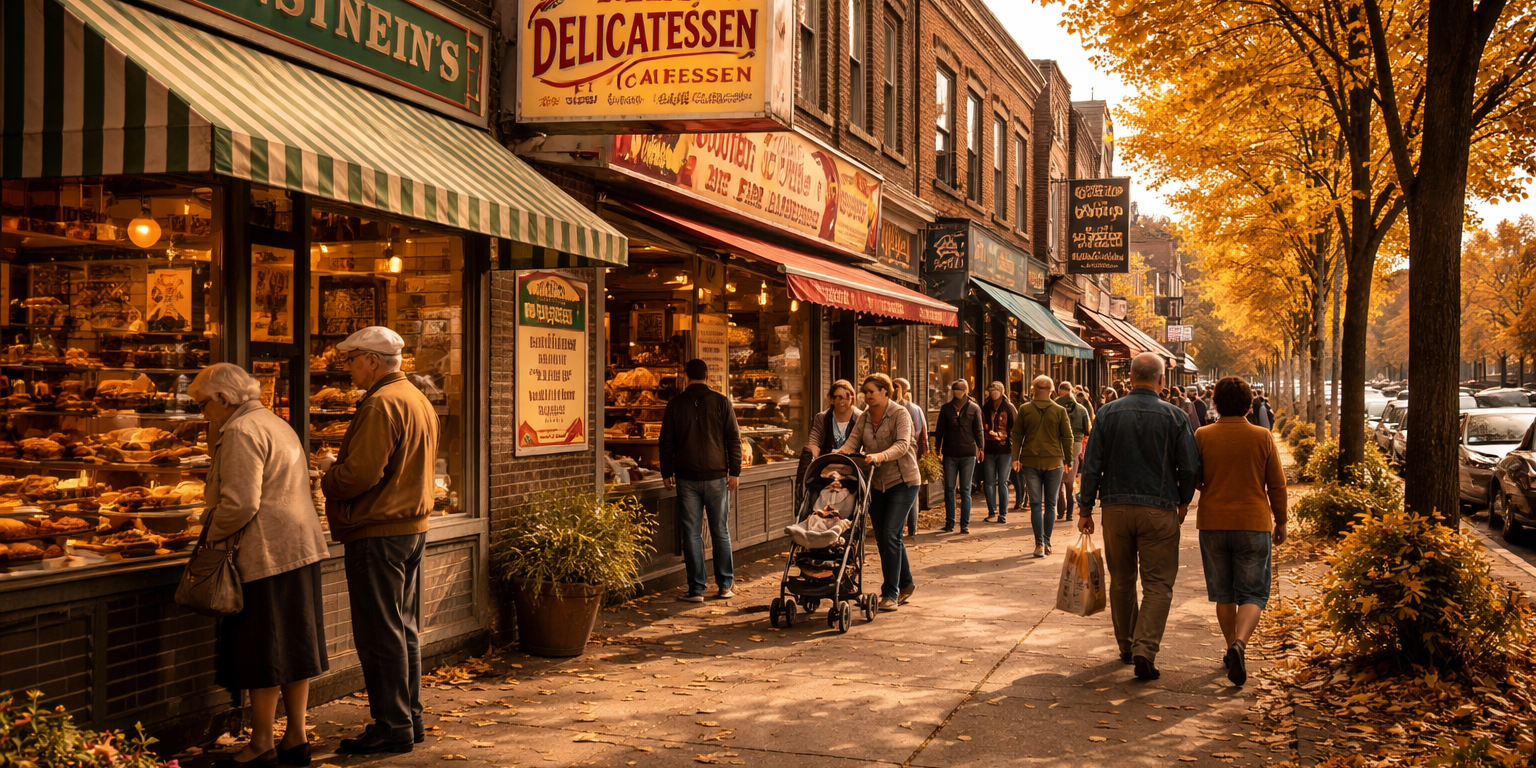
By the mid-twentieth century Murray Avenue had kosher butchers, delicatessens, bakeries and bookstores, and the neighborhood held congregations from Orthodox to Reform. It also holds an eruv, a symbolic boundary that lets Orthodox residents carry items on Shabbat; it covers all of Squirrel Hill and parts of neighboring Greenfield and Regent Square.
Why Squirrel Hill Stayed Urban
After World War II, Jewish families in many American cities moved to the suburbs and the old neighborhoods emptied. Squirrel Hill did not. No single cause explains it. The housing was solid and close to Oakland’s universities and hospitals (see how Oakland became the region’s education and medical hub), the congregations, schools and community center were already in place, and highways made the neighborhood easy to reach. Suburbs did draw people anyway: a 2017 Brandeis study commissioned by the Jewish Federation found 26% of the region’s Jews living in Squirrel Hill, with 20% in the South Hills and 9% in the North Hills, and the share has been moving toward the suburbs.
The neighborhood is also not only Jewish. Roughly 40% of residents were Jewish in 2010, according to a Wall Street Journal report. Carnegie Mellon and Chatham students, a growing Chinese and Chinese American community (about 17% of the population was Asian in 2017), and families who have been there for generations share the same streets. Frick Park, which opened in 1927 on the neighborhood’s eastern edge from Henry Clay Frick’s bequest (see Frick’s story), and Schenley Park bracket it with green space.
Fred Rogers and the Neighborhood
Fred Rogers, who made Mister Rogers’ Neighborhood in Pittsburgh, is on the list of notable Squirrel Hill residents, along with Mayors Sophie Masloff (the city’s first Jewish and first female mayor), Bob O’Connor and Richard Caliguiri, broadcaster Myron Cope, economist Herbert Simon, and the rapper Mac Miller. Rogers was not Jewish. The Neighborhood of Make-Believe was not a real place, and it would overreach to say Squirrel Hill inspired it, but the idea of neighbors looking out for one another is the one Pittsburghers tend to connect to the place.
October 27, 2018
On the morning of October 27, 2018, a gunman entered the Tree of Life building at Wilkins and Shady avenues during Shabbat services and killed eleven worshippers from three congregations that shared the building: Tree of Life, New Light, and Dor Hadash. Six people were wounded, including four police officers. It was the deadliest antisemitic attack in U.S. history. The gunman was convicted in June 2023 and sentenced to death in August 2023.
The phrase “Stronger Than Hate” spread from the community across the city and the country, and vigils drew thousands. Squirrel Hill had been a target before: in 1986, Neal Rosenblum, a 24-year-old rabbinical student from Toronto, was shot and killed in the neighborhood; a man was convicted of third-degree murder in 2002.
Rebuilding
The original sanctuary building has been partly demolished since 2024, with crews saving parts of it. The nonprofit leading the project, formed in 2022, announced in September 2026 that it is now called the Tree of Life Center for Humanity. Plans by Studio Libeskind and IKM Architecture include a 300-seat sanctuary and theater that keeps the historic stained-glass windows, a museum on antisemitism in the United States, classrooms, and a 10/27 Memorial designed with families and all three congregations. Backers had raised more than $51.5 million by September 2026 against a goal of $60 million, and Allegheny County approved up to $18 million in financing in June 2026. Reports in 2026 give the opening as 2028, with some earlier reports expecting parts to open for the High Holidays in 2027; check current announcements before planning a visit.
Murray Avenue Today
The synagogues are still in use and the JCC still anchors Forbes and Murray. Longtime residents share the sidewalks with graduate students and new families. Squirrel Hill is not without tension over housing costs and who the neighborhood serves, but its continuity is unusual for an American city neighborhood.
Frequently Asked Questions
Why is it called Squirrel Hill? Most likely for its gray squirrels; the exact origin of the name is not documented.
When did Squirrel Hill become a Jewish neighborhood? The major move came in the 1920s, from the Hill District and Oakland, though Beth Shalom started holding services there in 1917 and the Irene Kaufmann Settlement did not move until 1943.
Is Squirrel Hill still mostly Jewish? No. About 40% of residents were Jewish as of 2010, and it remains the region’s largest single concentration of Jewish residents, though a majority of Pittsburgh-area Jews now live elsewhere.
What will happen to the Tree of Life site? A new building and 10/27 Memorial are under construction and expected to open in 2028; see the section above.
Sources
Squirrel Hill Historical Society (squirrelhillhistory.org), “Squirrel Hill’s Jewish History” (Dec. 2018) and Beth Shalom centennial history; Rodef Shalom Congregation and Rauh Jewish Archives; Franklin Toker, Pittsburgh: An Urban Portrait; Pittsburgh Quarterly, “Song of Squirrel Hill”; Squirrel Hill Urban Coalition, “The Development of Squirrel Hill” (2009); Wikipedia, “Squirrel Hill (Pittsburgh)”; WESA, June 29, 2026; Axios Pittsburgh, May 14, 2026; TribLive, Sept. 9, 2026.