
What is a Pittsburgh left? It is the local habit of letting the first left-turning driver at a green light go before the oncoming traffic that would normally have the right of way, usually after the straight-through driver waves or flashes the headlights. Pittsburghers argue about it constantly: some call it courtesy and common sense on narrow streets, others call it dangerous, and Pennsylvania law is clear that the left-turning driver is supposed to wait. Nobody has found the moment it began. Here is what is documented about the maneuver: how it works, the best explanations for why it took hold in Pittsburgh, what the law says, and whether it is fading.
How a Pittsburgh left works
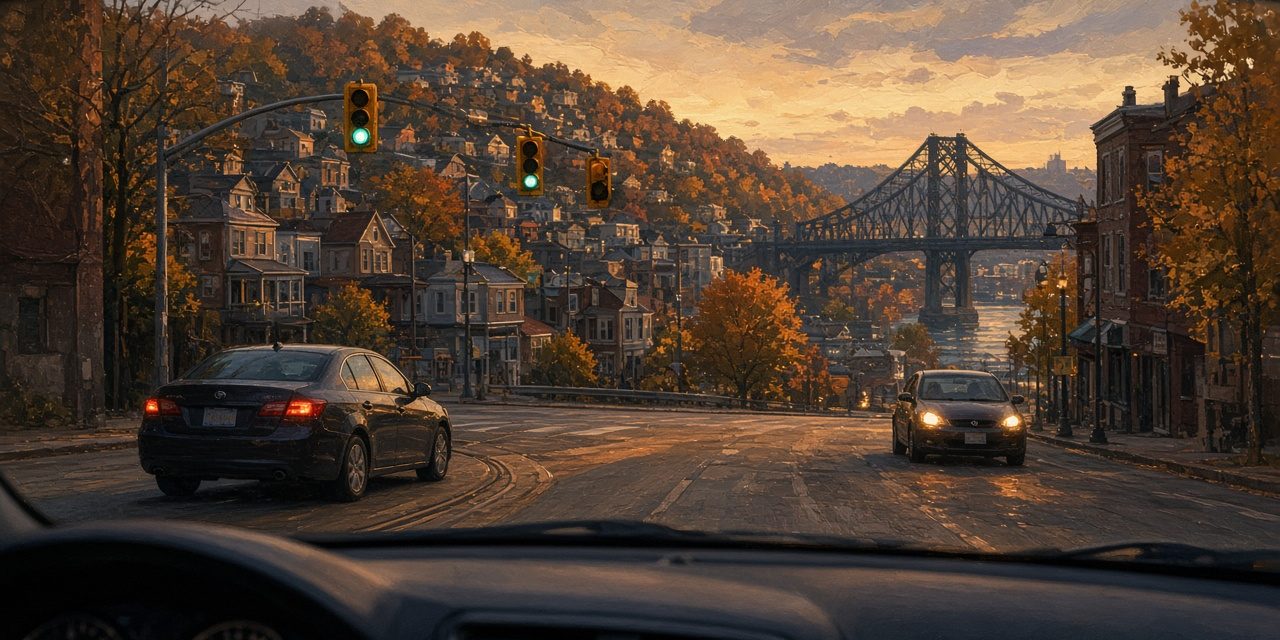
The classic version needs a particular kind of intersection. 90.5 WESA, in a 2020 explainer by Katie Blackley, describes it this way: two drivers meet at an intersection “and there is not a left turn lane or arrow. One driver is going straight and the other has indicated they would like to turn left. The driver going straight allows the left-turning driver to go ahead of him in order to alleviate traffic that may have built up behind the left-turning driver.” The signal, WESA says, is “typically … a wave or a quick flash of headlights.”
Pittsburgh City Paper’s Chris Potter, in a 2006 column, put the timing more precisely. In his description, the cars face off at a red light without a “left-turn only” lane or signal, and “the Pittsburgh Left occurs when the light turns green, and the driver turning left takes the turn without yielding to the oncoming car.” Done well, he argued, it is a trade: “In exchange for a few seconds of patience, the Pittsburgh Left allows traffic in both directions to move smoothly for the duration of the signal.”
What it is not
Not every aggressive left turn in Pittsburgh is a Pittsburgh left, and the sources draw that line carefully. Potter wrote his column after Steelers quarterback Ben Roethlisberger’s 2006 crash with a left-turning car at the foot of the 10th Street Bridge, when some coverage blamed a “Pittsburgh Left.” Potter noted that by all accounts the light had already been green in both directions when the crash happened, so it did not fit the term’s “purest definition,” a point the Pittsburgh Tribune-Review had made as well, as he quoted it. “Logically, though, not every left turn made in Pittsburgh can be a ‘Pittsburgh Left,'” he wrote. “After all, people make left turns in other cities too.”
There is also a difference between a left that is offered and a left that is taken. WESA cites a June 10, 1985, Pittsburgh Post-Gazette column by Peter Leo, “Right of way left to change,” which remembered the left being given “out of kindness or a sense of the common good” and complained about the “Pushy Pittsburgh Left,” in which the turning driver goes without the other driver’s consent. Pittsburgh Magazine, in 2019, made the same distinction: sometimes oncoming drivers wave the turner through, and “other times, the left-turning driver will, without invitation, dart into oncoming traffic.”
Where did the Pittsburgh left come from?
The honest answer is that nobody knows when or where it started. Potter’s 2006 column answered a reader who wrote, “No one can tell me where it comes from,” and Potter agreed that “no one can pinpoint the origins of the practice.” Pittsburgh Magazine called the origins “murky at best.” A Carnegie Mellon psychology professor the magazine interviewed in 2014, Kenneth Kotovsky, did not know why or when the practice began, the magazine reported.
What can be documented is that it is not new. Leo’s 1985 column, as WESA describes it, was “very clear that the practice has been happening for quite a while in Pittsburgh.” And Leo was already treating it as a local signature: “[The Pittsburgh Left] is so commonplace that we stand out in this, according to the testimony of befuddled newcomers,” he wrote. “We may be forced to share right-on-red with the rest of the country. But we’re No. 1 when it comes to the pushy left-on-green.” That 1985 column is the earliest specific reference found for this article; earlier uses may exist in newspapers that have not been searched.
Explanation one: streets built before cars
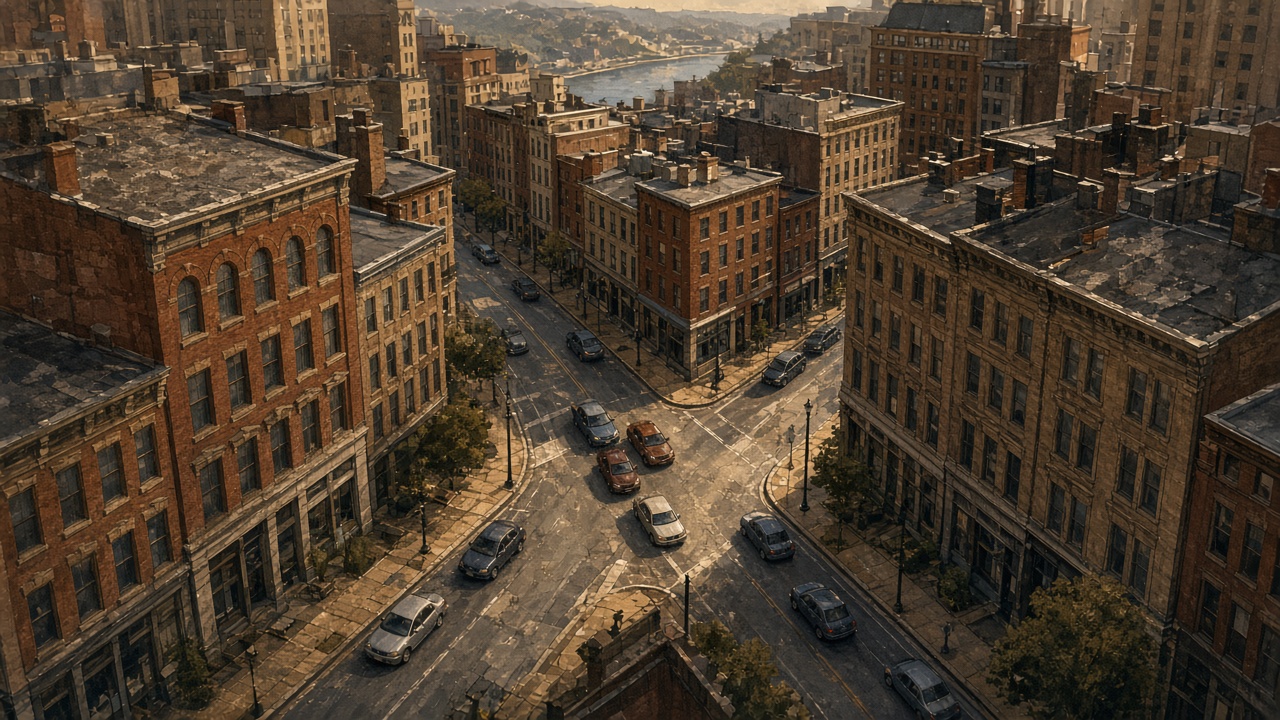
The explanation that every source offers in some form is the city’s layout. “Pittsburgh is an old city, many of whose streets were designed before automobiles held sway,” Potter wrote, noting that Downtown’s original street plan still provides the template for Downtown today. That plan was laid out in 1784. The flat land along the rivers went to the mills, he added, so “even neighborhoods with a lot of room, like the South Side, ended up being cramped.” The result was “street grids … constricted, with little room for amenities like left-turn-only lanes.”
WESA adds the history of how the city was assembled. “Pittsburgh developed from a hodgepodge of former boroughs and municipalities, and its hills and river valleys prevented planners from creating a traditional street grid,” Blackley wrote. A neighborhood like Allentown, annexed in 1872, has a grid of its own, but the pieces do not fit together. Alexander Stevanovic, a University of Pittsburgh civil engineering professor, told WESA that as cars spread through the 20th century, dense city streets weren’t prepared for the increase in traffic. “When you don’t have enough capacity, that’s when people are going to have to find their own ways to maximally utilize what they have,” he said.
Explanation two: a crowded city
Congestion made the problem worse. “With increased population during the height of the region’s manufacturing economy, roads became more congested,” WESA reported. “Adding a lane wasn’t always possible and it can be expensive to put a green turn arrow.” Mark Magalotti, a professor of practice in Pitt’s civil engineering department, told WESA that a similar behavior may show up in other older cities with narrow streets and few left arrows, such as Boston or New York, but probably not much in newer cities of the Midwest and West, where “the boulevards are wider” and “streets were designed for left turn lanes.”
Explanation three: a cooperative culture
Some people credit the city’s character. Kotovsky, the CMU psychologist, offered Pittsburgh Magazine a theory: “The conjecture is that [Pittsburgh] is somewhat high on communal values, so this kind of cooperation was possibly a bit more likely to evolve here.” Former Mayor Bill Peduto made a similar case to The Wall Street Journal, as Pittsburgh Magazine quoted him: “It embodies the kindness of Pittsburghers, saying, ‘No, you go ahead, you go first.'” Potter noted that the same hills and cramped streets behind the habit also help give Pittsburgh its “tight-knit” neighborhoods and “small-town” feel.
What about the streetcars?
Some people guess that the habit is connected to the trolley lines that once shared the city’s streets with cars. None of the sources read for this article make that argument, and no documentation of it was found, so it remains a guess. The streetcar network itself is well documented; the SteelCityHistory history of Pittsburgh’s lost streetcar network shows how far it once reached.
Is the Pittsburgh left legal?
No. Pennsylvania’s Vehicle Code, Title 75, Section 3322, “Vehicle turning left,” says:
“The driver of a vehicle intending to turn left within an intersection or into an alley, private road or driveway shall yield the right-of-way to any vehicle approaching from the opposite direction which is so close as to constitute a hazard.”
The state’s online driver’s manual repeats the rule in plainer words: “Drivers turning left must yield to oncoming vehicles going straight ahead.” It also warns that “the law does not give anyone the right-of-way at intersections; it only says who must yield,” and that “even when one driver is legally required to yield right-of-way, if they fail to do so, other drivers are still required to stop or yield as necessary to avoid a crash.” Pittsburgh Magazine’s summary was blunt: the Pittsburgh left “has no basis in law,” and “failure to yield to oncoming cars while navigating a turn is a traffic violation in the Commonwealth of Pennsylvania.”
Driving instructors teach it that way. Cindy Cohen of the Cindy Cohen School of Driving told WESA that she makes students aware of the Pittsburgh left but stresses that it is technically illegal. “I teach the students to stay behind the white line,” she said. “And to wait until it’s their turn.” Tim Rogers of Rogers Driving School in Ross Township told Pittsburgh Magazine that the drivers who wave you through are offering “more of a courtesy thing. They’re not required to let you do that,” and he pointed to a particular risk: two lanes of oncoming traffic, with only one driver waving.
Other places treat a similar move far more harshly. In Ontario, Canada, the provincial regulation on races, contests and stunts lists a version of it as a “stunt”: a left turn made at a signal when the light turns from red to green “in a manner that indicates an intention to complete or attempt to complete the left turn before the vehicle facing the opposite direction is able to proceed straight through the intersection.”
The case for and against
Fans of the Pittsburgh left say it keeps intersections from jamming. Even Leo, the 1985 critic, acknowledged that it “keeps traffic moving on a narrow road.” Potter cited a 1999 Surface Transportation Policy Project report that found the Pittsburgh area had the country’s fourth-lowest death rate from aggressive driving, and that most of the metro areas with lower rates were “older” and less oriented to the automobile. Potter went further, suggesting that quirks like the Pittsburgh left “may actually be saving lives,” though, as he described it, the report measured deaths from aggressive driving in general, not the maneuver itself.
Critics say the problem is that the system works only when everyone knows the rules. “The system only works if both drivers know about it,” Potter wrote. “No doubt that’s why newcomers find it so vexing.” WESA spoke with a transplant from central Ohio who said it took time to adapt and that he is “still not a fan.” Pittsburgh Magazine recalled Steelers running back Le’Veon Bell’s 2016 social-media rant about a driver who took a left without being offered it: “I never gave you the OK. I never gave you the go-ahead.”
Is the Pittsburgh left disappearing?
Several forces are working against it. Traffic signals are part of the story: in 2014, Pittsburgh Magazine wondered whether the state’s “Green Light-Go” program, which it said would set aside as much as $75 million for regional signal upgrades, some untouched since the 1950s, might make the move unnecessary. Population is another. WESA noted that the city “isn’t as populated and congested as it used to be, so need for the Pittsburgh left has diminished,” and that many newer residents arrived from elsewhere, unfamiliar with the custom. The SteelCityHistory history of Pittsburgh’s population decline covers that shift.
Then there are the robots. Pittsburgh has been a test bed for self-driving cars, and WESA asked how they handle the left. Carnegie Mellon research professor Jeff Schneider, who helped found Uber’s autonomous vehicle division in 2015, said, “We would never program our own cars to do something that … wasn’t legally the right thing to do,” but that they must be ready for other drivers who do it. An executive at Argo AI told WESA the cars would learn to expect it, not perform it.
Common questions
What does Pittsburgh left mean?
It means letting a left-turning driver go first when the light turns green, ahead of oncoming traffic that technically has the right of way, usually signaled with a wave or flash of headlights.
Is a Pittsburgh left illegal?
Yes. Pennsylvania law requires a left-turning driver to yield to oncoming vehicles that are close enough to be a hazard. An oncoming driver’s wave does not change that.
Why is it called a Pittsburgh left?
Because the habit is strongly associated with Pittsburgh, where Post-Gazette columnist Peter Leo was already calling it a local specialty by 1985. Similar moves elsewhere have other local names; Pittsburgh Magazine compares it to New Jersey’s “Jersey Slide” and the West Coast’s “California Lane Change,” which are different maneuvers.
Do other cities do it?
Possibly, in older cities with narrow streets and few turn arrows, according to Pitt’s Mark Magalotti, who mentioned Boston and New York. Pittsburgh is the city whose name stuck to it.
The Pittsburgh left belongs with the rest of the city’s local vocabulary; see the SteelCityHistory guide to Pittsburghese.