

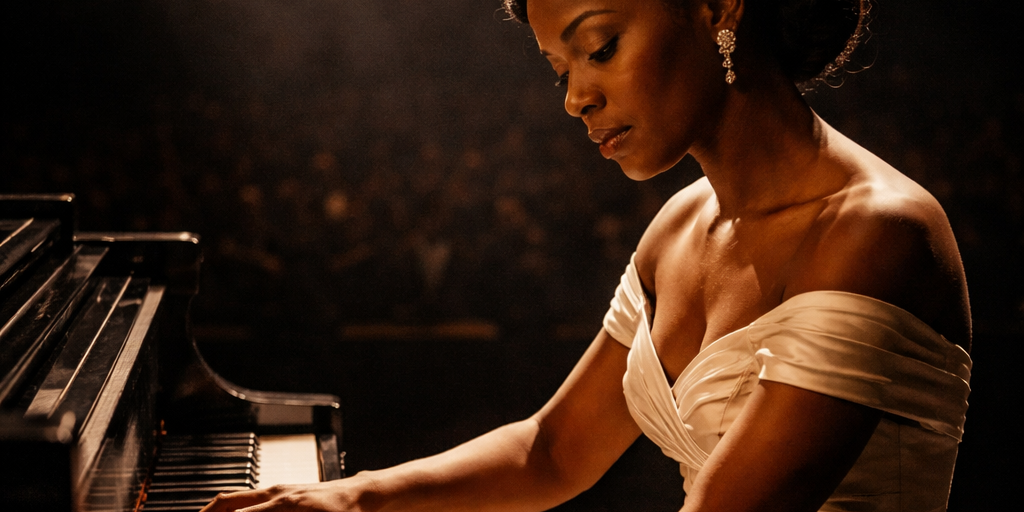
Mary Lou Williams Pittsburgh origins begin with a child sitting at a piano in East Liberty who could play anything she heard before she was old enough to read music. She was born Mary Elfrieda Scruggs in Atlanta, Georgia, on May 8, 1910, but her family moved to Pittsburgh when she was young, and it was Pittsburgh that recognized what she was before the rest of the world caught up. The neighbors in East Liberty called her the Little Piano Girl. They invited her into their parlors to perform and paid her for it. She was six years old, earning money as a musician, with no formal training and a facility at the keyboard that the people who heard her struggled to explain except by saying that she simply knew how to do it.
By the time she died in 1981, Mary Lou Williams had arranged music for Benny Goodman, Tommy Dorsey, and Duke Ellington. She had performed at Carnegie Hall. She had composed a mass that was choreographed by Alvin Ailey and performed at St. Patrick’s Cathedral in New York. She had been called perpetually contemporary by Ellington, who used the phrase to describe a quality he considered among the rarest in jazz: the ability to stay genuinely current across multiple decades and multiple stylistic revolutions without losing the core of who you were. She had mentored Thelonious Monk and Dizzy Gillespie, two of the architects of bebop, at a time when she was already a veteran and they were just arriving.
All of it started in Pittsburgh.
East Liberty and the Education of a Prodigy
The Pittsburgh that Mary Lou Williams grew up in during the 1910s and 1920s was a city in the middle of its industrial peak, and its Black community was building the institutions and the cultural life that would make the Hill District famous for generations. East Liberty, where she grew up, was a neighborhood on the eastern edge of the city with its own community fabric, its own churches and social organizations, and its own musical culture that both connected to and ran parallel to the better-known Hill District scene a few miles away.
Williams absorbed the music of that environment with an immediacy that was unusual even for children who grow up surrounded by music. She was playing by ear before she was formally taught, which meant that her musical instincts developed without the constraints that formal training sometimes imposes before a student has the technical vocabulary to push against them. She heard something and she played it back. She heard something more complex and she played that back too. By the time she received formal instruction, the foundational ear and the intuitive harmonic sense were already there, already developed, already hers.
Pittsburgh families of means would invite her to their homes to play for their guests. This was a practice that reflected the era’s complicated relationship with Black talent: recognition and exploitation in approximately equal measure, a child performing for white audiences for pay that would seem inadequate by any adult standard but that represented genuine money to a working-class Black family. Williams navigated these situations with the pragmatism that her circumstances required and absorbed from each performance the specific education that performing for real audiences provides: the understanding of what works and what does not, the refinement of stage presence, the development of an ability to read a room that served her for the rest of her career.
Learning What Nobody Could Teach Her
The formal musical education that Williams eventually received built on foundations that were already extraordinary. Teachers who worked with her recognized quickly that they were dealing with a student who was not learning music so much as recovering it, finding the theoretical framework for something she already understood intuitively. Harmony and theory were not revelations to her. They were confirmations.
She was absorbing everything Pittsburgh’s musical culture offered simultaneously. The church music of the Black AME congregations and Baptist churches provided one harmonic vocabulary. The popular music and early jazz coming through the neighborhood provided another. The stride piano tradition, which was the dominant style of sophisticated Black piano playing in the early decades of the twentieth century, gave her a technical framework and a performance approach. She was synthesizing all of these inputs through an ear that processed music in a way that most musicians spend entire careers trying to develop.
What emerged was a pianist who could play stride with authority, who could swing with the best bandleaders in the country, and who could arrange for large ensembles with an understanding of orchestral color and texture that most arrangers acquire only through years of trial and error. Williams appeared to arrive at this knowledge faster than the learning should have permitted, which is the defining characteristic of genuine musical genius.
Leaving Pittsburgh
By her teenage years, Williams was performing professionally, and the professional world of Black American music in the 1920s operated on a touring circuit that eventually pulled serious musicians away from wherever they started and toward the places where the work was concentrated. She left Pittsburgh as a young woman, as so many Pittsburgh-formed musicians did, carrying the foundation the city had built and heading toward the broader world.
Her marriage to saxophonist John Williams brought her into the orbit of Andy Kirk’s band, the Twelve Clouds of Joy, which was one of the better-known Black swing bands of the period. She began by working as an informal musical resource for the band and eventually became its arranger and pianist, a role that required her to produce the written musical arrangements that guided how the band played everything from popular songs to original compositions.
Arranging is not the same skill as playing, though the best arrangers are typically fine players first. It requires an understanding of how different instruments blend and conflict, how harmonic movement translates across different timbres, how a piece of music that works for a solo piano or a small combo needs to be reimagined to function for a full orchestra. Williams was exceptional at it in the way that she was exceptional at everything musical: not through laborious acquisition but through a faculty that seemed to understand instinctively what a large ensemble needed and how to give it to them.
The Arranging Career
The reputation that Williams built as an arranger during the swing era was considerable enough that bandleaders who could have hired anyone came to her specifically. Benny Goodman, the King of Swing whose orchestra was one of the most commercially successful and musically influential of the era, used her arrangements. Tommy Dorsey, another leading white bandleader of the period, sought her work. Duke Ellington, who had his own arrangement resources including Billy Strayhorn, commissioned work from her.
The fact that she was a Black woman arranging for the top white bandleaders of the swing era is worth sitting with for a moment. The music business of the 1930s and 1940s was not a meritocracy. It was a heavily segregated industry in which Black musicians were routinely underpaid, under-credited, and exploited in ways that the white musicians whose careers benefited from their work were not. Williams navigated this system and built a substantial career within it, which required both genuine excellence and the specific resourcefulness of someone who understood that the rules of the game were not designed with her in mind.
Her arrangements were credited, which was not always the case for Black arrangers whose work sometimes disappeared into the broader attribution fog of the band or the bandleader. She was known by name, sought by name, and paid, however inadequately relative to her contribution, for work done under her name. In the context of her era, these were not small things.
Evolving Through the Eras
What Duke Ellington meant when he called Mary Lou Williams perpetually contemporary was something specific and important. Jazz history is littered with musicians who mastered one style and then found themselves stranded when the style moved on. The transition from swing to bebop in the mid-1940s was abrupt and disorienting for many musicians who had built their careers on the older approach. Bebop demanded different harmonies, different rhythmic approaches, different relationships between players, and a different aesthetic philosophy. Many swing-era musicians simply could not make the crossing.
Williams crossed it. More than crossed it: she was involved in the development of bebop at a significant level, hosting informal sessions at her New York apartment where the young musicians who were building the new music gathered to play and discuss and work things out. Thelonious Monk, whose harmonic innovations were central to what bebop became, was among the regulars. Dizzy Gillespie, who was constructing the trumpet vocabulary of the new music, was another. Williams was not a passive host. She was a participant, a contributor, an elder figure who had mastered the previous tradition and was genuinely interested in what was being built to replace it.
Her 1945 “Zodiac Suite,” a large-scale composition inspired by astrological signs, was performed by the New York Philharmonic and represented a level of compositional ambition that most jazz musicians of any era had not attempted. It was not a novelty. It was a serious piece that demonstrated the range of what her musical mind was capable of when given the full scope it required.
The Spiritual Crisis
In the early 1950s, Mary Lou Williams withdrew from music. The withdrawal was not gradual. It was a genuine retreat, a step back from a career she had built over three decades, driven by a spiritual crisis that culminated in her conversion to Roman Catholicism in 1954. The jazz world she had inhabited was, by that point, consuming itself in the specific ways that music worlds at the height of their intensity sometimes do: drugs, exhaustion, the pressure of constant performance and constant innovation. Williams was watching people she cared about destroy themselves, and she needed a different relationship with her own life.
The Catholic Church provided a framework that her particular spiritual hunger required, and for a period she devoted herself almost entirely to charitable work, operating a thrift store that helped musicians in need rather than performing. Father Anthony Woods, a priest who understood her creative gifts and believed they were inseparable from her spiritual gifts, eventually helped draw her back to music. The return was not a capitulation to the pressures she had retreated from. It was an integration of the faith she had found with the music that had always been her deepest language.
Sacred Music
The compositions that Williams produced after her return to music in the late 1950s reflected the integration of her Catholic faith with her jazz sensibility in ways that were genuinely new. “Black Christ of the Andes,” composed in 1963 in honor of Saint Martin de Porres, was a jazz mass that brought the harmonic vocabulary of her entire career to bear on sacred text. “Mary Lou’s Mass,” completed in 1969, was choreographed by Alvin Ailey and performed at St. Patrick’s Cathedral in New York, a collision of jazz and liturgy in one of the most architecturally significant Catholic spaces in America.
These were not crossover gestures or commercial experiments. They were sincere attempts to do something that had not been done before: to bring the full weight of the jazz tradition into the service of Catholic liturgy in a way that honored both. Whether they fully succeeded is a question that critics and musicians have debated ever since. That they were attempted, with the seriousness and craft that Williams brought to everything, is itself significant.
Teaching and the Final Chapter
In 1977, Mary Lou Williams joined the faculty of Duke University in North Carolina, where she taught jazz history and piano until her death in 1981. She was seventy years old when she began teaching at Duke. She brought to the classroom the same comprehensiveness she had brought to every stage of her career: the child prodigy who had taught herself by ear, the arranger who had learned orchestration by doing it for the best bands in the country, the composer who had written for Carnegie Hall and St. Patrick’s Cathedral, the mentor who had helped shape bebop.
The Mary Lou Williams Center for Black Culture at Duke University carries her name today, a permanent institutional acknowledgment of what she contributed both to music and to the university that gave her a home in her final years.
She died on May 28, 1981, in Durham. She was seventy-one years old. A Grammy Lifetime Achievement Award was given posthumously in 1990.
What Pittsburgh Gave Her
The Pittsburgh jazz world that shaped Mary Lou Williams was the same world that shaped Billy Strayhorn, that fed the Crawford Grill’s stages, that produced the musical culture of the Hill District during its peak years. Pittsburgh did not produce these musicians by accident. It produced them because it was a city where Black musical culture was being taken seriously, where the church and the neighborhood and the informal gathering gave talented children the exposure and the encouragement that genius requires to become itself.
Williams took what Pittsburgh gave her and went further with it than almost anyone who has ever come from this city. She played and arranged and composed across seven decades. She shaped the music of multiple generations. She did it while being a woman in a field that treated women as novelties rather than masters, while being Black in a field that used Black creativity while protecting white access to the profits from it.
Pittsburgh produced her. East Liberty recognized her first. The rest of the world took longer, and still has not fully caught up.