
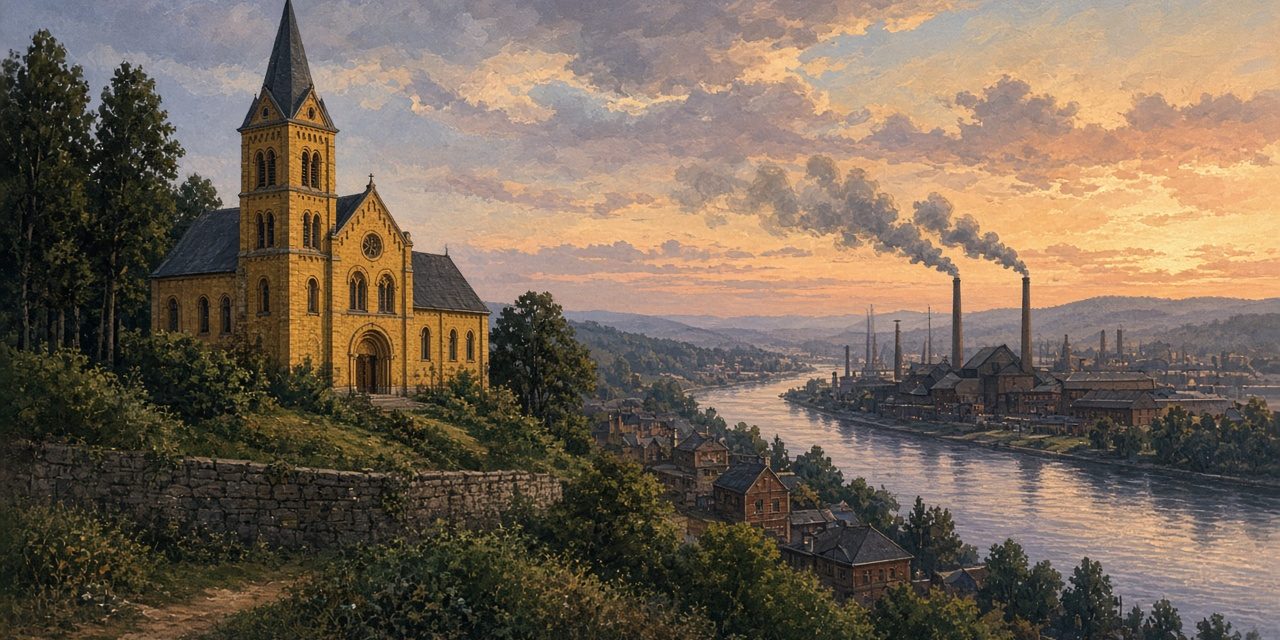
In the spring of 1937, Father Albert Zagar had paid off more than half of the $98,000 mortgage on his yellow-brick church in Millvale and decided to beautify it, according to a Time story published that year. The Maxo Vanka murals that came out of that decision are among the most unusual works of art in western Pennsylvania: twenty-five scenes of saints, immigrant millworkers, grieving mothers and soldiers, painted in two campaigns four years apart. The story behind them involves two churches with the same name, a painter with almost no mural experience, a ghost story, and a 1970 repaint that changed part of what he did.
Two St. Nicholas churches
There were once two St. Nicholas Croatian churches a few miles apart, and they are easy to confuse. According to the Diocese of Pittsburgh, the parish was founded in 1894 in what was then Allegheny City, now the North Side. A Pennsylvania state historical marker calls it the first Croatian Catholic parish in America. By 1900 it had outgrown its building, and the congregation split over where to build the next one. The pastor and the parishioners from Etna and Millvale bought land in Millvale. The rest built on the North Side, in Troy Hill. The Millvale church was dedicated on November 25, 1900. The Troy Hill church closed in 2004 and was demolished in January 2013 for the Route 28 expansion, a loss noted in the SteelCityHistory history of Troy Hill.
The Millvale church, the one with the murals, did not last in its first form either. It burned on March 26, 1921, and a plainer replacement was dedicated on May 30, 1922. Pennsylvania Heritage says some people blamed the fire on feuding within the parish, a claim the sources consulted for this article do not substantiate. The Society to Preserve the Millvale Murals of Maxo Vanka dates Zagar’s arrival as pastor to 1931.
How the painter was found
Accounts differ on how Vanka got the job. Time’s 1937 story said Zagar got in touch with him through Louis Adamic, the Yugoslav-born writer who was Vanka’s friend. Pennsylvania Heritage’s 2022 article gives another route: a May 1935 exhibition of Vanka’s paintings at Wunderly Galleries downtown, which members of St. Nicholas visited, and where, the magazine says, church member Frank X. Kolander and others suggested him. Both accounts may be true. Adamic was, by any account, the artist’s champion and publicist.
Vanka was born in Zagreb in 1889 (the National Catholic Register gives 1890), said, by his own account among others, to have been the illegitimate son of aristocrats, and spent part of his childhood with a peasant foster mother, according to Pennsylvania Heritage. He studied in Zagreb and Brussels, served with a Red Cross unit in Belgium in the First World War, and became a professor at the Zagreb academy. He married an American, Margaret Stetten, in 1931 and moved to the United States in 1934. Pennsylvania Heritage describes him as an odd choice for Millvale: he did not live there, was not a devout Catholic, was not a member of the congregation, and apart from one earlier project in Croatia was not an experienced muralist. The fee was about $5,000. Zagar asked only that some scenes be religious, and left the rest to the painter.
Spring 1937
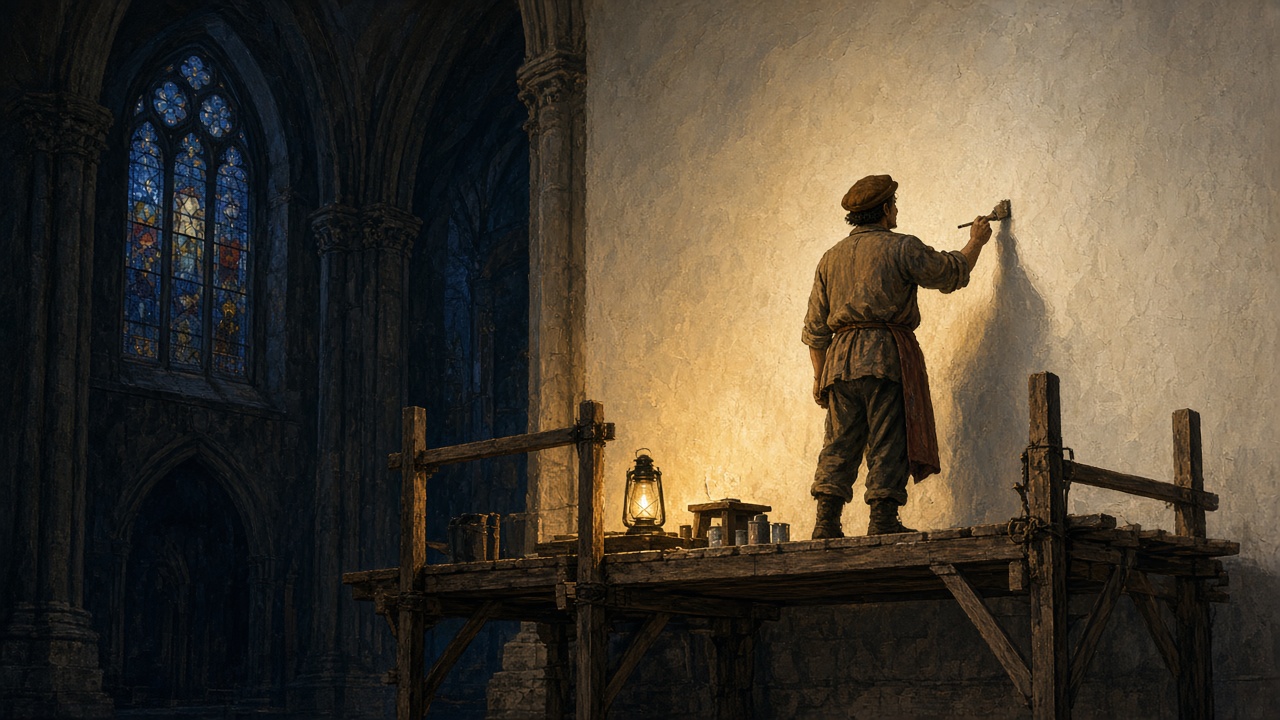
Time reported that Vanka moved into the parish house in April, that scaffolding went up in the church, and that he painted from seven in the morning until two or three at night, with Zagar keeping him company and praying. Croatian women attending early Mass could watch the work advance. By the end of May the back walls were done, and the women, Time said, stopped on their way out to weep and light candles.
The painting was described at the time as “dry fresco,” with paint applied while the walls were wet. Conservators who studied the murals in recent years came to a different conclusion. According to Belt Magazine, Vanka did not make true frescoes, because the walls had been plastered and set long before. He used a water-based paint that combined an animal protein and a plant gum.
The first cycle centers on the altar wall. Over it Vanka painted a monumental Madonna and Child, Time put her at 36 feet, in the red, white and blue of Croatian dress, with an inscription in Croatian that Pennsylvania Heritage translates as “Mary, Queen of Croatians, pray for us.” To one side, peasants kneel in a field at the Angelus. On the other, laborers in work clothes carry picks, shovels and lunch pails, one of them holding up a model of St. Nicholas Church, while Father Zagar kneels beside them. Behind them the old-country farm has become a mill valley, with smokestacks and a Pittsburgh skyline in the distance. A crucifixion and a pietà hang above the side altars, and Time reported that a Black mill worker was the model for the figure of Christ.
The two paintings on the back walls tie the old world to the new. In one, Croatian women in white stand around a soldier’s coffin, with rows of white crosses stretching toward a hillside church. In the other, weeping women mourn a young miner lying on coal rubble, his body on a Croatian-language newspaper, while other miners in the background head to work. The murals are known as The Croatian Mother Raises Her Son for War and The Immigrant Mother Raises Her Sons for American Industry. Pennsylvania Heritage reports that Vanka said the second scene was based on a mine disaster outside Johnstown in which 72 miners were trapped and one woman lost four sons. No source consulted identifies the disaster.
The ghost
The murals come with a legend. The tale, which Pennsylvania Heritage says has persisted since the work was done, is that a ghost, a former pastor in the version the magazine repeats, appeared to Vanka during his long nights on the scaffold. Adamic wrote it up as “The Millvale Apparition” in Harper’s Magazine in April 1938, and an Associated Press story in 2025 said Vanka reported “often seeing a ghost.” It is a story people have told about the church, not a documented event. Time’s account of the same weeks, which has Zagar sitting up with the painter at night, does not mention a ghost.
Painted for a parish, not a government
The murals are often grouped with the New Deal murals of the 1930s, and the comparison is not wrong. Pennsylvania Heritage describes 1930s Pittsburgh as a center of radical mural painting, much of it federally funded, with workers shown on a monumental scale. University of Pittsburgh art historian Barbara McCloskey points out that Vanka’s cycle falls outside the usual literature on government art because a private religious institution paid for it, and that its “moral intensity and socially critical perspective” went beyond the idealized image of America in much of federal art. McCloskey compares the antiwar scenes to Goya, to Picasso’s Guernica, which was painted the same year as the first cycle, and to George Grosz, and finds the closest echo of Vanka’s attention to racial inequality as well as class in the plays of August Wilson and the collages of Romare Bearden. Those are one scholar’s comparisons, not the artist’s stated influences.
1941
Time called the first cycle “one of the few distinguished sets of church murals in the U.S.” The murals were dedicated in June 1937, and Croatian immigrants praised them, Pennsylvania Heritage says.
By 1941 the world had changed. Zagar called Vanka back, by then living in Bucks County, and the second cycle responded to the war in Europe. On the south wall, a figure of Justice faces Injustice, who wears a gas mask, wields a bloody sword and carries scales in which gold outweighs bread. On the opposite wall, Mati, a 15-foot Croatian mother, hangs chained to a cross, with a linden tree, the symbol of Croatia, sprouting at her feet. Under the choir loft, the Virgin Mary stands between two soldiers and snaps the bayonet off a rifle, and a green-skinned Christ on the battlefield is pierced by a soldier’s bayonet, with barbed wire for a crown of thorns. Above the exit, a top-hatted figure in The Capitalist reads the stock report over an elaborate dinner while a beggar crawls at his feet. Nearby, a poor immigrant family says grace over bread and soup, with Christ unseen at the table, a scene the National Catholic Register sets against it.
Zagar defended the combination. “It’s religion, expressed in our social life,” he said in 1941, according to the AP. “At the same time, it’s completely Catholic.”
Vanka finished in November 1941, weeks before Pearl Harbor. Pennsylvania Heritage’s judgment is that the rapid shift to war mobilization and patriotism left no room for an antiwar statement, and that the murals, though praised, got less attention than they would have in another year.
After Vanka
Vanka went back to Bucks County, where he continued to paint and teach. According to Pennsylvania Heritage he returned to Millvale only once, in 1951, to add minor decoration; Belt Magazine says he painted a banner across the choir loft. The AP reports that he drowned on a vacation off the coast of Mexico in 1963.
The murals did not stay exactly as he left them. The Society’s timeline records that new murals by Ivan Joko Knezevic, finished in 1970, altered a number of Vanka’s originals, and Belt notes that images at the bottom of the altar were added by another artist. The sources consulted do not agree on exactly which parts were changed. The church was listed on the National Register of Historic Places on May 6, 1980, with art and social history among its areas of significance and Vanka named in the record.
Damage came from time and weather: Pittsburgh smoke and soot, salts in the plaster and, after a storm, a leaking roof. The Pitt News reported in 2018 that a 1980s church play called Gift to America showed how bad the condition was when stage lighting hit the walls. Church members formed the Society to Preserve the Millvale Murals of Maxo Vanka in 1991. The Society’s timeline says the 2004 hurricanes damaged the church and murals. Professional conservation began in 2009. In June 2025 the AP reported that the scaffolding had come down after four months of work on the wall with the Moses scene, in time for the parish’s 125th anniversary Mass, and that most of the murals had now been conserved.
What remains
St. Nicholas is still an active parish, and its walls are open to the public. As of this writing the Society offers guided tours on Saturdays at 11 a.m. and 12:30 p.m., and on Mondays and Thursdays at 6:30 p.m. by reservation, at $20 a person. Check its schedule before going, because times change.
Vanka called the murals his gift to America. They also record what a parish of immigrants and a priest with a paid-down mortgage chose to put in front of themselves every Sunday: their mothers, their mills and mines, and the war.