
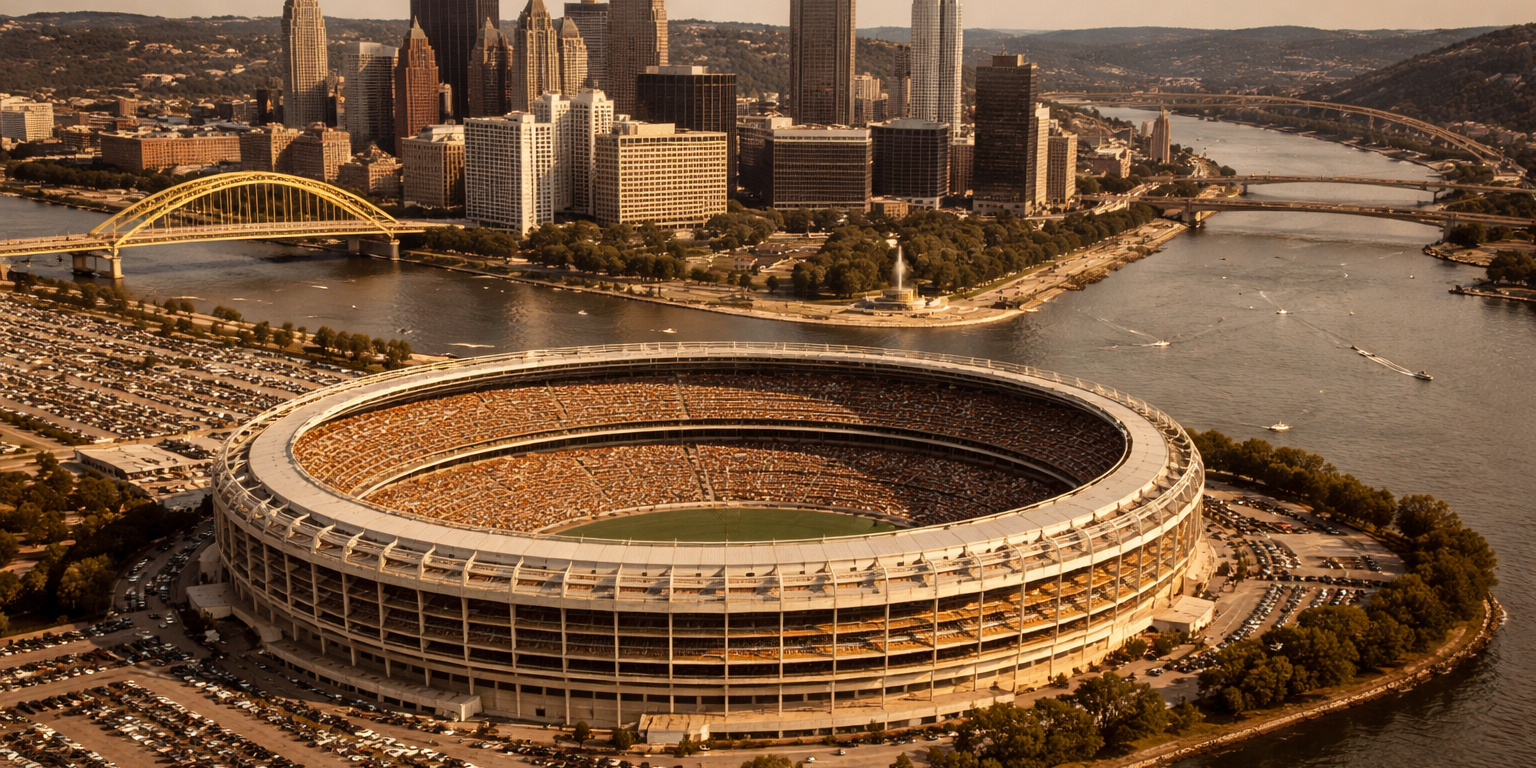
On the morning of February 11, 2001, thousands of Pittsburgh residents gathered on bridges, riverbanks, and rooftops before sunrise to watch a building die. Three Rivers Stadium Pittsburgh had stood at the confluence of the Allegheny and Monongahela rivers for thirty years, and at seven in the morning a series of precisely placed explosive charges brought it down in twenty-two seconds. The round concrete structure shuddered, folded inward, and collapsed into a cloud of dust that drifted slowly across the North Shore. People in the crowd cried. Some cheered. Many did both. A stadium that everyone agreed was architecturally ordinary, logistically outdated, and past its functional prime had somehow, across three decades of championships and heartbreaks, become one of the most beloved buildings in the city’s history. Watching it fall felt like losing something that could not be replaced even if what replaced it was objectively better.
That paradox is the whole story of Three Rivers Stadium.
Why Pittsburgh Built It
By the mid-1960s, Pittsburgh’s two professional sports franchises were both playing in facilities that had passed their useful life. Forbes Field, the Pirates’ home since 1909 on the edge of Oakland, was a beloved old ballpark in the way that things become beloved when people have spent generations making memories in them, but it was cramped, aged, and functionally limited. Pitt Stadium, where the Steelers played, was a college football venue that had never been particularly well-suited to professional football to begin with.
The solution being adopted by cities across the country was the multipurpose stadium: a large, circular venue that could serve both baseball and football by rotating its field configuration between sports. Cincinnati was building one. Philadelphia was building one. St. Louis had one. The design philosophy prioritized flexibility and capacity over the experience specific to either sport, and in retrospect that trade-off would come to define both the appeal and the eventual obsolescence of these buildings. But in 1965, when Pittsburgh committed to the project, the multipurpose stadium felt like the future.
The site chosen was the North Shore, where the Allegheny River meets the Monongahela to form the Ohio. The name wrote itself: Three Rivers Stadium, for the three rivers whose confluence had defined Pittsburgh’s geography and its industrial identity since the earliest days of European settlement. There was something satisfying about a sports stadium named not for a corporate sponsor or a politician but for the physical fact of the land itself.
Construction began in 1968 and proceeded over two years at a cost of approximately fifty-five million dollars. The result was a circular concrete structure seating around fifty thousand, expanded over the years closer to sixty thousand, with artificial turf that served the scheduling requirements of two sports and the interests of no one who had to play on it. The view from inside, looking out over the rivers and the downtown Pittsburgh skyline, was legitimately spectacular in a way that no interior photograph quite captured. You had to be there to understand why people kept coming back despite everything the building got wrong.
Opening Day and the Early Years
The Pittsburgh Pirates played the first game at Three Rivers Stadium on July 16, 1970. The Cincinnati Reds were the visiting team and won the game, which was not an ideal beginning, but the building was open and the city had a modern stadium for the first time in its professional sports history. The Steelers joined for the 1970 football season, and the stadium settled into its intended dual purpose.
Roberto Clemente played at Three Rivers from its opening through the final regular season game of 1972, his last before the plane crash on New Year’s Eve of that year that ended his life and his career simultaneously. For Pittsburgh baseball fans of that generation, the stadium is inseparable from the memory of Clemente in right field, the specific grace of his throws from the warning track to home plate, the way he played the angles off the curved outfield wall with a precision that seemed to require a different understanding of physics than ordinary outfielders possessed.
In October 1971, Three Rivers hosted the games that produced one of the more significant moments in baseball broadcast history. Game Four of the 1971 World Series, played on October 13, was the first World Series game ever played under the lights at night. The decision to schedule an evening World Series game had been controversial, driven by the desire to reach larger television audiences, and Three Rivers Stadium was where it happened for the first time. The Pirates won that game and eventually the Series, defeating the Baltimore Orioles in seven games with Clemente delivering one of the most complete individual World Series performances the sport has ever seen.
The Immaculate Reception
Fourteen months after Clemente’s death, on December 23, 1972, Three Rivers Stadium became the site of the most famous play in the history of professional football. The Pittsburgh Steelers trailed the Oakland Raiders 7 to 6 in an AFC Divisional Playoff game with twenty-two seconds remaining when Terry Bradshaw threw a pass that deflected in disputed circumstances and landed in the hands of Franco Harris, who caught it just above the artificial turf and ran it into the end zone for a touchdown.
The roar that went through Three Rivers Stadium in that moment has been described by people who were there as unlike anything they experienced before or since in a sports venue. The play was not just a touchdown. It was the moment that announced the arrival of a team that would spend the next decade redefining what a football dynasty looked like. Without the Immaculate Reception, there is no Steel Curtain. Without that play in that stadium on that December afternoon, the entire arc of 1970s Pittsburgh sports history unfolds differently.
Three Rivers Stadium was present for all of it.
The Championship Decade
The Pittsburgh Steelers won four Super Bowls in six years between 1974 and 1979, and Three Rivers was the home that launched every one of those championship runs. The AFC Championship games that preceded each Super Bowl, the regular season victories that built the momentum, the home crowd that understood it was watching something historically significant: all of it happened inside that circular concrete building on the North Shore.
The atmosphere at Three Rivers during the Steelers’ championship years was specific and physical in a way that people who were not there sometimes struggle to fully imagine. The stadium was loud in the manner of enclosed concrete structures: sound bounced around and accumulated rather than escaping into open air. When Mean Joe Greene sacked a quarterback, when Franco Harris broke through a defensive line, when Lynn Swann caught a ball no one should have been able to catch, the crowd’s response came back off those concrete walls and doubled on itself. It was not background noise. It was weather.
The Terrible Towel, introduced by broadcaster Myron Cope in 1975, found its natural home in that building. Fifty thousand gold towels spinning in unison inside a circular stadium created a visual effect that television could approximate but not fully capture. You had to be standing in the upper deck to understand what it actually looked like.
The Pirates matched the Steelers’ glory in 1979, when the We Are Family team won the World Series in seven games and brought a second championship to Pittsburgh inside the span of a single calendar year. The home games of that World Series, played at Three Rivers against the Baltimore Orioles, carried the specific electricity of a city watching its baseball team refuse to accept defeat. When Willie Stargell came to the plate in those games, the stadium responded with a reverence usually reserved for something more solemn than a sporting event.
The Architecture Nobody Loved
Three Rivers Stadium was never beautiful. Architectural critics of the era and historians since have classified it alongside Cincinnati’s Riverfront Stadium, Philadelphia’s Veterans Stadium, and the other multipurpose concrete bowls of the late 1960s and early 1970s as among the least aesthetically successful sports facilities ever built. The circular design that served scheduling flexibility served neither baseball nor football particularly well. The artificial turf was hard on players’ bodies and visually sterile. The sightlines for baseball were compromised by a configuration designed to accommodate football, meaning that left field and right field seats required neck angles that the sport’s designers never intended.
None of this stopped people from loving it. The building’s deficiencies were catalogued and acknowledged and then entirely set aside in favor of the accumulated emotional weight of what had happened inside it. Pittsburgh fans did not love Three Rivers Stadium because it was well designed. They loved it because it was theirs, and because the things they had witnessed there over thirty years could not be fully separated from the physical space where those things had occurred.
This is a distinction worth understanding. A stadium is not just a facility. It is a vessel for memory, and the memories Three Rivers contained by 1990 were among the richest any sports venue in the country could claim. Four Steelers championships. Two Pirates World Series titles. The Immaculate Reception. The first World Series night game. Roberto Clemente. Willie Stargell. Franco Harris. Mean Joe Greene. The building held all of it, even if it held it in concrete that was showing its age and bathrooms that had never been adequate and seats that were not designed for the bodies of people who had been eating Pittsburgh food for thirty years.
The Decision to Replace It
By the early 1990s, both the Pirates and the Steelers were making the case that Three Rivers Stadium could not serve their needs into the twenty-first century. The argument was partly about revenue: modern stadiums with luxury boxes, club seating, and improved concession facilities generated significantly more income than the aging Three Rivers configuration allowed. It was partly about the player experience: the artificial turf that had seemed modern in 1970 was by 1990 recognized as inferior to natural grass for athlete health and performance. And it was partly about the fan experience: newer baseball-only and football-only stadiums being built in other cities provided sight lines and intimacy that a multipurpose facility structurally could not match.
The negotiations over new stadium funding were extended and contentious, involving the city, the county, the state, and the two franchise owners over the better part of a decade. The eventual resolution produced public funding commitments that were controversial at the time and remain subjects of debate. What is not debated is the outcome: Pittsburgh would build two separate stadiums, a baseball park and a football stadium, both located on the North Shore near the site of Three Rivers, and the old building would come down.
The Last Games
The Pittsburgh Pirates played their final game at Three Rivers Stadium on October 1, 2000. The Steelers followed with their final game on December 16, 2000, against the Washington football team. Between those two dates, the stadium hosted the closing ceremonies and tributes that mark the end of a building’s functional life: the retired numbers, the former players in attendance, the careful cataloguing of milestones and records and moments.
The tributes were genuine. The nostalgia was earned. But there was also, underneath the sentiment, an acknowledgment that the building had run its course. The new stadiums being constructed just a short distance away promised experiences that Three Rivers, for all its history, could not provide. Pittsburgh was not abandoning its past in tearing down Three Rivers. It was making room for a different kind of future.
Twenty-Two Seconds
The implosion on the morning of February 11, 2001 was precisely engineered to bring the structure down in a controlled collapse that would not damage the surrounding construction sites where PNC Park and what would become Heinz Field were already taking shape. The charges were set, the countdown was broadcast publicly, and at seven in the morning Three Rivers Stadium ceased to exist.
What rose from the cleared site over the following months was two separate stadiums that have, by almost any objective measure, delivered on their promise. PNC Park is widely regarded as one of the finest baseball facilities in the country. The football stadium on the adjacent site provides a significantly better game experience than Three Rivers ever could.
And yet. Talk to someone who watched the Steelers in the 1970s from the upper deck of Three Rivers, who remembers the sound of that crowd after the Immaculate Reception, who saw Willie Stargell’s home run in Game Seven of the 1979 World Series land somewhere in the artificial turf, and the new stadiums will be described as perfectly adequate. The thing they replaced, imperfect and outdated and gone for more than twenty years, will be described as something else entirely.
That is the honest measure of what Three Rivers Stadium was to Pittsburgh. Not the architecture. Not the sightlines. Not the turf. The thing itself, present at the intersection of a city’s greatest sports decade, holding the memories that no demolition crew can touch.