
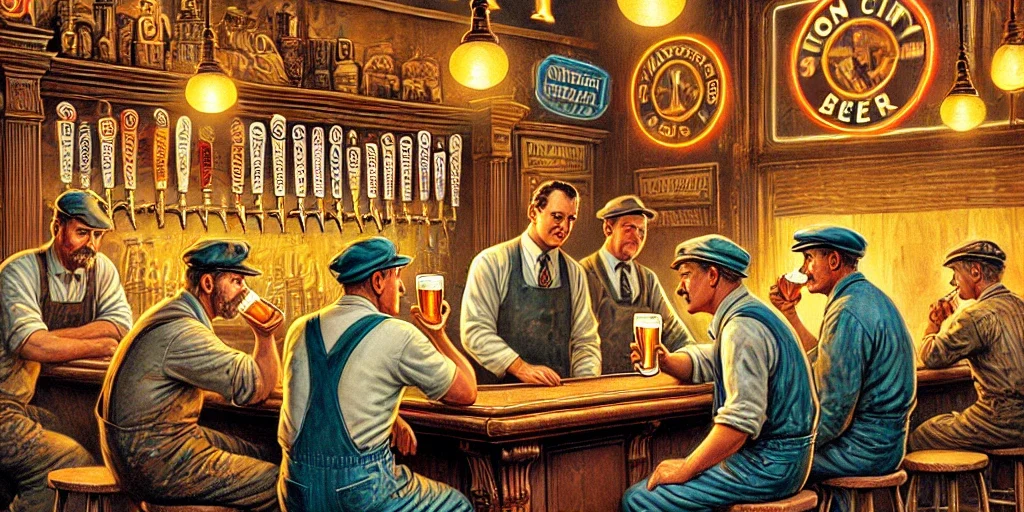
Before the breweries and gastropubs of today, Pittsburgh’s drinking culture was forged in the smoke and fire of the steel mills. For decades, steelworkers spent grueling hours in blistering heat, shaping molten metal into the backbone of America’s industrial empire. And when the shift ended, they headed straight to their neighborhood bars—places where they could shake off the grime, share stories, and unwind with an Iron City Beer in hand.
These were no-frills, working-class institutions—dimly lit, cash-only, and built on camaraderie. While many of these legendary bars have disappeared along with the mills, a few remain, standing as testaments to Pittsburgh’s blue-collar past. Let’s take a trip through some of the most iconic steelworker bars that kept the city’s labor force fueled and its stories alive.
Redbeard’s (Mount Washington)
Redbeard’s is better described as a neighborhood sports bar than a mill bar. Its Mount Washington location on Shiloh Street closed on December 21, 2024, after about 30 years, when the owner chose not to renew the lease; a second location on Sixth Street Downtown remains open. I could not find a source for the claim that it began as a South Side hangout for Jones & Laughlin workers, so treat that older description as unverified.
Gooski’s (Polish Hill)
Though not exclusive to steelworkers, Gooski’s has long been a bar where the working class of Pittsburgh mingles with artists, musicians, and locals looking for a strong drink and an unpretentious atmosphere. Nestled in Polish Hill, a neighborhood built by Eastern European immigrants who worked the mills, Gooski’s (3117 Brereton Street) still has the rugged feel of an old working-class bar—cheap beer, punk and metal shows, and the kind of jukebox selections that make you want to stay all night.
Jack’s Bar (South Side)
Jack’s Bar is a Pittsburgh institution. Often called the South Side’s oldest bar, it sits on East Carson Street in a neighborhood that grew up beside the Jones & Laughlin mills (see the rise and fall of Pittsburgh steel), and is known for cheap drinks, big pitchers and a rainbow glass-block front. I could not confirm a founding date. Today, it’s an eclectic mix of old-timers and younger patrons, but it still carries the same working-class soul that made it a steelworker’s go-to spot for decades.
The Squirrel Hill Cafe (Squirrel Hill)
Known locally as “The Squirrel Cage,” this unassuming bar near Forbes and Murray avenues began as a fruit-and-candy shop and became a restaurant and lounge in 1934, just after Prohibition ended. In the late 1950s, one bartender recalled, day-shift commuters waited at the door at 7 a.m. from a nearby streetcar stop. The origin of the “Squirrel Cage” nickname is murky, but it seems to come from the vertical bars on the front window. It was never a mill bar in the strict sense, but it is a long-running working-people’s tavern in a neighborhood with its own long history (see Squirrel Hill history), and it still serves what one longtime bartender calls “mostly still a shot and a beer.”
Chiodo’s Tavern (Homestead, Closed 2005)
The best-documented steelworker bar in the Mon Valley no longer exists. Chiodo’s Tavern was a century-old hotel bar on Eighth Avenue at the foot of the Homestead Grays Bridge. Joe Chiodo ran it from 1947, first as an after-shift shot-and-a-beer stop for workers from U.S. Steel’s Homestead Works and the Mesta Machine Co., and later, after the mills closed, as a place known for its “Mystery Sandwich” (a burger with kraut, kielbasa and sauce) and for walls covered in mill signs and hard hats. Chiodo sold the building in 2005 and it was torn down; a Walgreens later stood on the site. Its story is told in more detail in our piece on Braddock, Homestead and the Mon Valley, and the Homestead mill history behind it is in the Homestead Strike of 1892.
The Decline and Legacy of the Steelworker Bars
As Pittsburgh’s steel industry collapsed in the 1980s, many of these bars saw their patrons vanish along with their jobs. Some reinvented themselves, some closed their doors forever, and a few held on as reminders of a bygone era. What remains, however, is the spirit of these gathering places—where hard work was respected, where a round was always shared, and where stories of Pittsburgh’s industrial past live on. Some of these same bars even brushed up against Pittsburgh’s darker history — playing host to whispers of mob deals, numbers rackets, and the city’s notorious gangsters and crime stories.
Today, the city’s drinking culture has evolved, but a trip to one of these legendary bars is like stepping into history. They may not be filled with soot-covered workers anymore, but the ghosts of Pittsburgh’s steel empire are still there, lingering in the dim lights and the clinking of beer bottles. So next time you raise a glass in one of these establishments, remember: you’re not just drinking a beer—you’re drinking a piece of Pittsburgh’s history.
Sources and related reading: CBS Pittsburgh, “Pittsburgh’s Most Iconic Bars” (2017) and “Redbeard’s on Mount Washington set to close after 30 years” (Dec. 12, 2024); 90.5 WESA, “They Wrote the Book on Pittsburgh’s Iconic ‘Squirrel Cage’ Bar” (Oct. 20, 2020); Pittsburgh Union Progress, July 5, 2024, on Chiodo’s Tavern. For older taverns see Pittsburgh’s oldest bars. Bars open and close; confirm hours before you go.