
At Van Meter, on the morning of December 19, 1907, Maria Campbell was in her kitchen preparing lunch for her husband, William, the Darr mine’s foreman. He usually came out before noon and ate at their house, about 50 yards from the mine mouth. According to a 2023 reconstruction by the Pittsburgh Union Progress, built from the newspaper dispatches of the time, she felt the ground move and the windows broke. Across the Youghiogheny River in Jacobs Creek, the Baptist minister, Rev. F. B. Williams, saw a plume of dark blue smoke rise from the mine opening. That was the Darr Mine disaster. It killed 239 men and boys, according to the state’s count, and it remains the deadliest coal mine disaster in Pennsylvania history.
The mine, and the town across the river
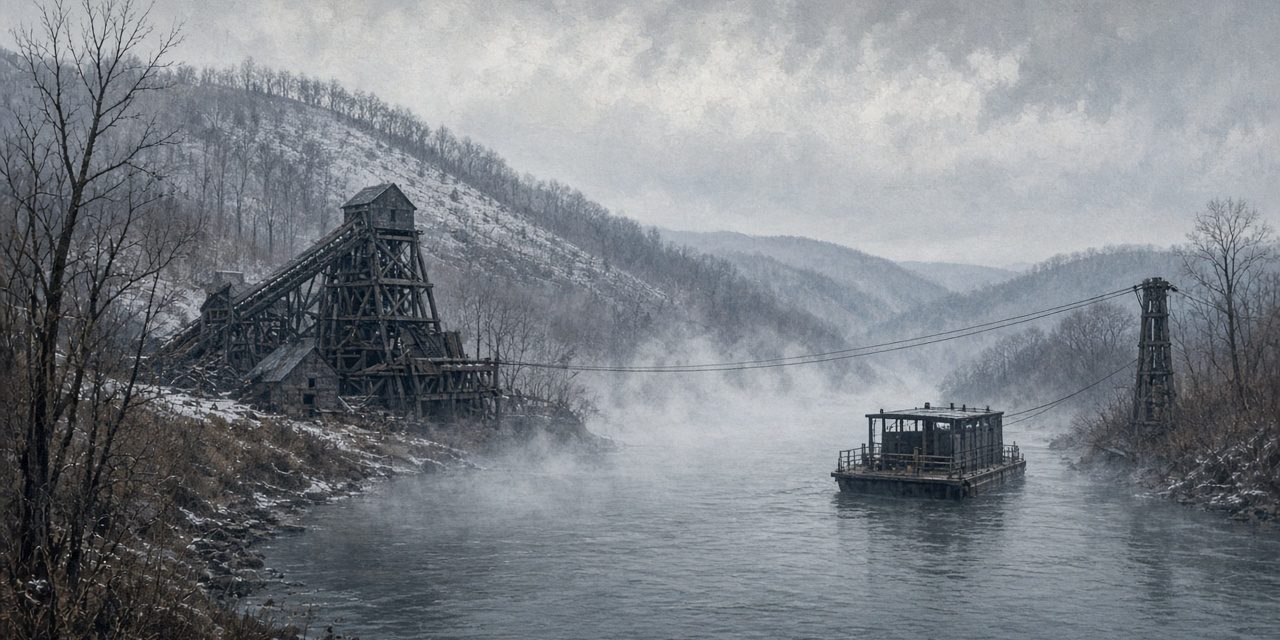
The Darr mine belonged to the Pittsburgh Coal Company and sat on the west bank of the Youghiogheny in Rostraver Township, Westmoreland County. It was one of the older mines in the district. A local-history blog says coal was being mined there as early as 1850, though I found no stronger source for that. Many of the men lived in Jacobs Creek, a patch town on the other bank, and crossed the river to work in a “sky ferry,” a cable car that held six people at a time. Others lived in Van Meter, next to the mine.
The workforce was largely immigrant. The state marker at Olive Branch Cemetery says “many Hungarian immigrants.” The Union Progress lists Hungarian, Italian, German, Scottish, Polish, Russian, Slovenian, American and English victims, and other accounts add Rusyn, Slovak and Austrian. How many were Hungarian depends on who is counting. The Union Progress says about 60 of the dead were Hungarian, while the American Hungarian Federation says over 140. I could not reconcile those figures, and the names, which were recorded inconsistently in 1907, may be the reason.
What the explosion did
The blast came at about 11:30 a.m., according to the state mine inspectors’ report, which says it was felt within a radius of several miles. A federal report puts it at about 11:20. The force wrecked the ventilation stoppings inside the mine, which made the rescuers’ progress very slow. The state report says only one man escaped alive, a man on his way to the engine room for oil. The federal report says the one survivor was within 100 feet of the surface on an old manway in a wet part of the mine that the explosion did not reach. Other accounts name two survivors, Thomas A. Williams and Joseph Mapleton, a pumpman, and a caption in the Union Progress says Williams was one of three. Both official reports say one man survived, but they describe him differently, and later accounts name more than one, so the count is unsettled.
At Monongah, West Virginia, a 1907 explosion at the Fairmont Coal Company’s Nos. 6 and 8 mines had killed about 360 men on December 6, thirteen days earlier. It remains the worst mining disaster in American history. Darr was the second worst. Naomi, near Fayette City, had killed 34 on December 1. The marker says more than 3,000 miners died in December 1907. This article is about Darr, but those dates are why newspapers of the time treated the news as one more blow in a terrible month.
Was it gas, or dust, or both?
Fact: The best scientific account is a Bureau of Mines-era U.S. Geological Survey bulletin on explosive mine gases and dusts, written after investigators went underground at Naomi, Monongah and Darr. Chemists collected samples within days and weeks of the explosions. In several Darr entries, the author writes, firedamp (methane) was so heavy, 75 to 100 feet from the face, that the investigators did not think it safe to go on even with safety lamps. One sample taken in early January 1908 held nearly 8 percent methane. These samples were taken after the explosion, so they show the mine’s condition afterward, not that morning.
The same bulletin describes the dust. In the exploded part of the Darr mine, a coating of fine coal dust covered the ribs and faces, and in places slabs of charred, coked dust a foot square could be peeled from the coal. One entry led to an older, lower part of the mine near the river where the workings were always wet. The explosion spread dust 600 feet down that entry, and beyond that point the coal was clean and shiny. That fits the federal report’s description of the one survivor, who was in a wet, unexploded part of the mine. In short, the investigators found evidence of both gas and dust, and the explosion was carried through the mine by dust.
What started it? The official answers do not agree
Disputed: No one saw the spark, and the findings published after the disaster do not agree on the cause.
One set of findings, printed in the state’s 1907 report, was signed by 14 mining and electrical engineers, miners and mine experts; the state report itself notes that eight of the 14 were Pittsburg Coal Company officials. It says the fire boss had fenced off two entries, Nos. 3 and 4 right butt off 28 entry, on the morning of the explosion and before it, because of danger from falling roof. It says the explosion’s course ran from that fenced-off section into other parts of the mine. Five bodies were found in No. 3 butt, “200 feet or more beyond said fenced-off portion.” The signers concluded that miners had been in a forbidden section “without the knowledge, consent, or approval of the owners,” that the explosion started there, and that the owners “are in no way to blame.”
The state mine inspectors, sixteen of them, reported that the explosion began near the face of No. 9 left butt entry off No. 27 face entries, which is not one of the fenced-off entries, and said the cause “may have been” flame from a shot, an open light, or an accidental explosion of dynamite. They also said they disapproved of the system of workings at Darr, which did not provide efficient ventilation. They recommended a four-entry system, flameless explosives, shot firers who fire after the men have left the mine, wetting down the dust, locked safety lamps and more fire bosses. And they wrote that had “the well-known safeguards” been used, “this calamity would not have occurred.” The wording of their report matches what a federal historical summary quotes from the state inspectors’ report. I could not place the two locations on a mine map.
The coroner’s jury, in January 1908 according to the Union Progress, said the 239 victims died “from an accidental explosion of gas ignited by an open lamp at a point which we are unable to locate owing to a difference of opinion between inspectors and experts,” and found that “the bituminous laws of Pennsylvania were fully obeyed by all those having charge of the Darr mine.” The state’s chief of the Department of Mines wrote that he and the inspectors “fail utterly to agree with the jury” on that point, and that if the fire bosses and mine foreman had performed their duty, the men would not have entered the mine when it was unsafe. The state report prints both documents so that readers can draw their own conclusions.
There was also a question about how gassy the mine was. The state’s 1907 report called it a mine that “was never deemed a very dangerous mine” because it gave off only a small percentage of gas, and said it was worked with open lights. The foreman, William Campbell, was a different kind of witness. His widow later said he had worried for months about gas and ventilation and had pushed the company to sink a new ventilation shaft. A 1957 United Mine Workers Journal article, quoted by the American Hungarian Federation, says the men were about 40 feet of coal short of reaching it. Campbell died in the explosion.
The rescue, and the crowd
Men from Van Meter began digging through debris at the entrance within minutes, the Union Progress says, and cleared an opening in about 15 minutes. Rescue parties led by mine inspectors then went in. The mine’s own ventilation fan was still working, according to a local-history blog, but roof falls, blown-out stoppings, afterdamp and dust slowed them. The first bodies, five of them, were found about a mile in, near the foreman’s shanty. Federal investigators used breathing helmets with compressed-air cylinders in the mine, and the Pennsylvania Environmental Protection Department, quoted by the American Hungarian Federation, says Darr and Monongah were the first deep-mine rescues in the United States to use self-contained breathing apparatus, a claim I could not confirm elsewhere.
Outside, thousands gathered. The Union Progress cites a report of nearly 6,000 people and says the State Police held a rope line. Women and children waited in the cold. The Pittsburgh Press described some who “stood shuddering in the cold, with stolid faces, hardly seeming to realize that they were about to become widows, orphans or friendless.” Bodies were taken to a blacksmith shop and then a large tent, the “death tent.” By Christmas Eve, 124 had been recovered, and a funeral for 12 miners was held on the Van Meter train platform. Families told reporters about what they recognized: Anna Hough identified her 18-year-old son Arthur and found her husband Solomon as well. “That’s Sol’s shirt,” she said. “I washed it on Monday.” Anna Sharpenberg’s 16-year-old son Joseph died in the mine. Two more men, Carl Mherling, 31, and Josiah Veatch, 30, were found more than two months later.
Some newspapers wrote that the scene was disorderly and that there was heavy drinking in Jacobs Creek. The Connellsville paper said such reports were exaggerated. One detail explains some of the mood: many Orthodox and Greek Catholic miners were off that day, December 19 on the Gregorian calendar being the Feast of St. Nicholas on the Julian one. The Union Progress reports that coal executives said fewer than 200 men were counted in the mine, and the Federation says nearly 200 men stayed home. It is remembered locally as the Miracle of St. Nicholas. It did not reach the 239 families who lost someone.
How many died?
Disputed: The usual figure is 239, which is what the state inspectors’ report and the Pennsylvania Historical and Museum Commission marker say. The federal bulletin says 238. The first headlines were worse: the New York Times reported 250 entombed, and early estimates by officials went up to 500. A Gazette Times list from the first day named 126 men known to be at work. The count rose as bodies were found over weeks, and a local historian, Chip Norton, told a 2007 commemoration that other estimates were much higher and that some victims were never identified. The honest answer is 239 officially, with some uncertainty.
Relief, and what it cost the families
On December 26, a meeting in the office of Pittsburgh’s mayor formed the Darr Mine Relief Committee, according to its published report. It raised about $97,000, including $25,000 from the Carnegie Hero Fund (our Andrew Carnegie post covers his giving) and $20,000 from Pittsburgh Coal, with the rest from about 3,000 other contributions. The American Hungarian Federation says families got a $150 death benefit, some up to $249, and were asked to leave company-owned houses. The coal company paid $12 for each casket, according to a PBS documentary.
The relief committee’s report shows how the families were seen. It describes them as “many of them shiftless and ignorant,” in a document written to praise its own work. The report says complaints of neglect reached the newspapers and the governor. Many widows left. Some had little choice but to leave town with their children and hope to remarry, and others went back to the old country, PBS says. The Hungarian community stepped in to help orphans and widows, according to the Federation.
After Darr: federal and state safety reforms
The year 1907 pushed coal-mine safety into national politics. Congress created the U.S. Bureau of Mines in 1910. In 1908, the USGS created a Mine Accidents Division and a rescue-research station in Pittsburgh, according to the Pennsylvania account quoted by the Federation. Pennsylvania passed its Bituminous Mine Law on June 9, 1911, which required certified mine foremen and fire bosses, and safety lamps in gassy workings. A state commission of two operators, two miners and the chief of the Department of Mines had been drafting that law under a legislative resolution from 1907. A NIOSH history says Pittsburgh Coal abandoned open lamps after Darr. Sources I read tie the 1911 law to the December 1907 disasters, but I did not find a text crediting Darr alone. For the larger story of coal in the region, see our post on Pittsburgh’s coal mining boom.
What remains
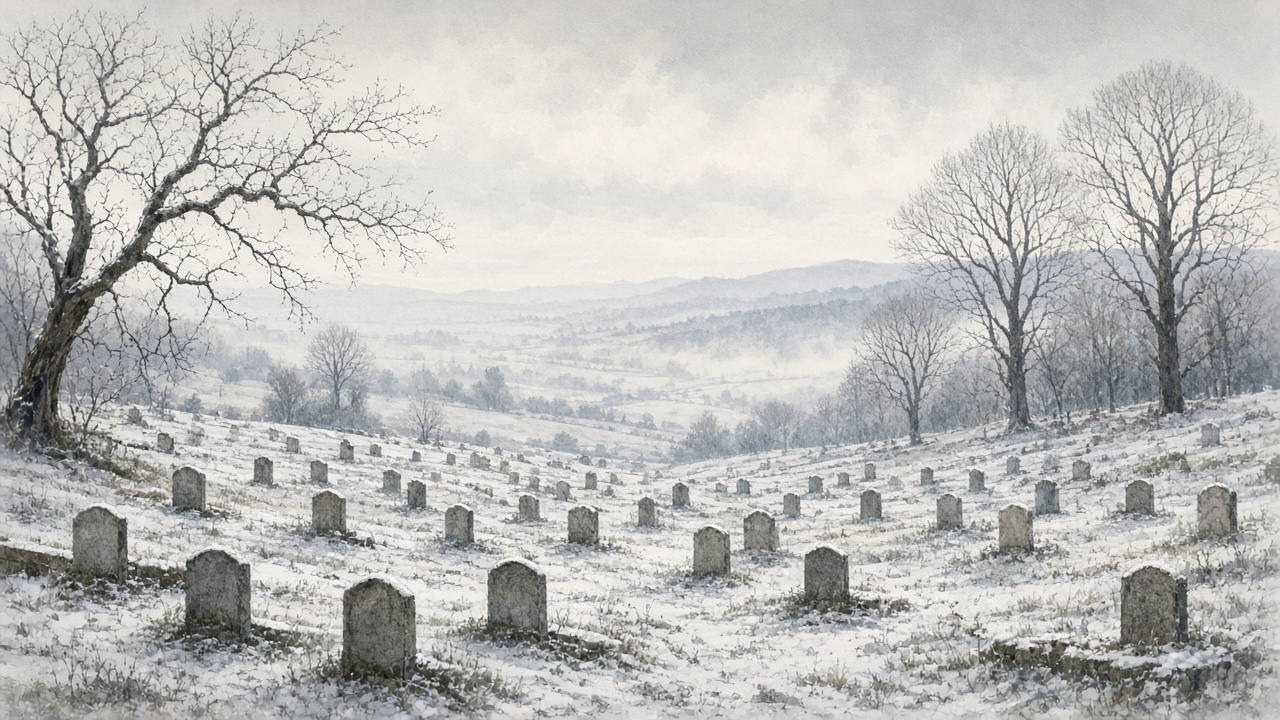
At Olive Branch Cemetery on Route 981 near Smithton, 71 Darr victims lie in a common grave, 49 of them unknown, according to the state marker, which was put up in 1994. An older monument, placed there in 1909 by the Hungarian-American Federation and “partially funded” by Emperor Franz Joseph, according to the Federation, reads, “To the Memory of the Martyrs.” Other victims are buried in cemeteries across Westmoreland and Fayette counties, according to a local-history blog. A memorial stands near the old morgue site in Van Meter, the Federation says, and the blog describes another by the Great Allegheny Passage. Erosion has filled the mine’s entrance, and the Union Progress found faded flowers there in 2023. St. Nicholas Orthodox Church in Jacobs Creek holds a service each year on the anniversary, according to a local-history blog. The Rostraver Township Historical Society keeps the local record, and a PBS documentary tells the story through descendants.
A 2007 centennial gathering heard that 100,000 miners had died in U.S. mining accidents since Darr, according to a United Mine Workers official quoted by the Federation. Whatever the cause of the explosion was, the men who died at Van Meter went to work that Thursday.