
How did Pittsburgh get its name? The usual answer rests on a letter, and so does the city’s birthday, November 27, 1758. The letter, from General John Forbes to William Pitt, is datelined “Pittsbourgh. 27th Novemr. 1758.” It is the document that says, in Forbes’s words, “I have used the freedom of giving your name to Fort Du Quesne.” But the full text, as published in transcription, raises a question about when that sentence was written. A line near the end says, “This far I had wrote at Fort Du Quesne upon the 27th: Novemr. since which time I have never, either been able to write, or capable to dictate a letter,” and the letter is signed “Philadelphia. 21st. January 1759.” The story of Fort Duquesne 1758 and the naming of the city is messier than a single date suggests.
The ruins
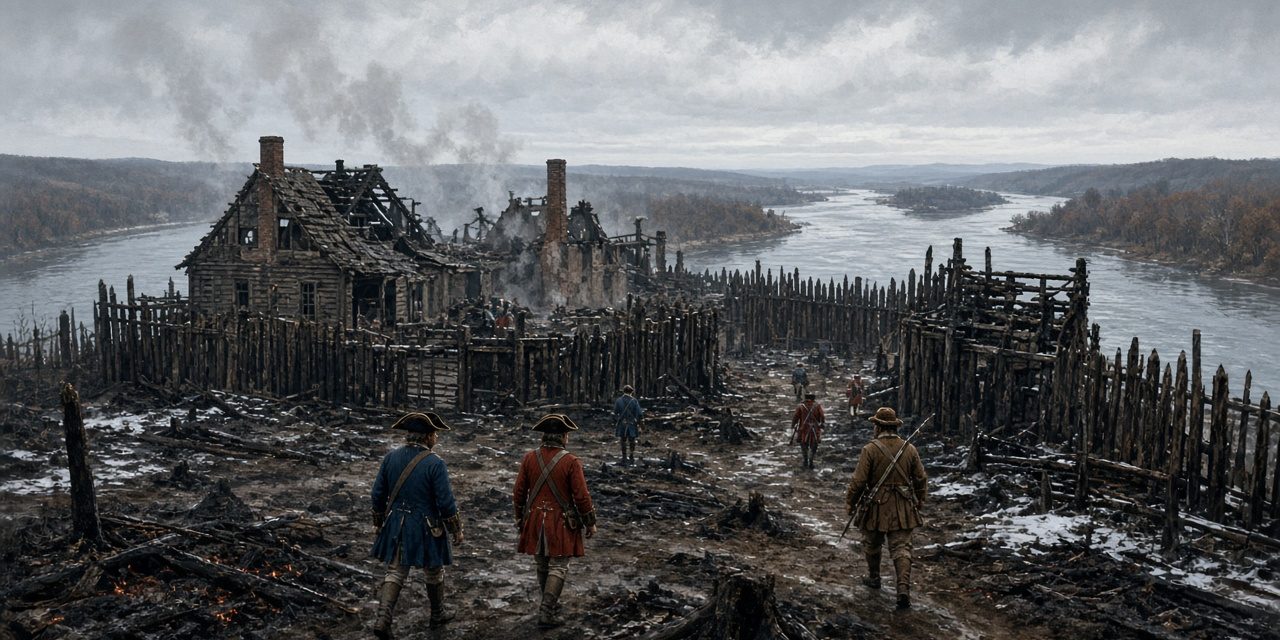
The French had left the fort a smoking ruin. Sources disagree on the day. In the Pitt letter, Forbes says the enemy burned and abandoned the fort “on the 25th” and that he “took possession next day.” The Heinz History Center’s Fort Pitt Museum blog says the French blew up their powder and left on November 24 and that Forbes’s army arrived on the 25th, and the Mount Vernon encyclopedia gives the same sequence. The sources do not resolve this, and the article does not choose.
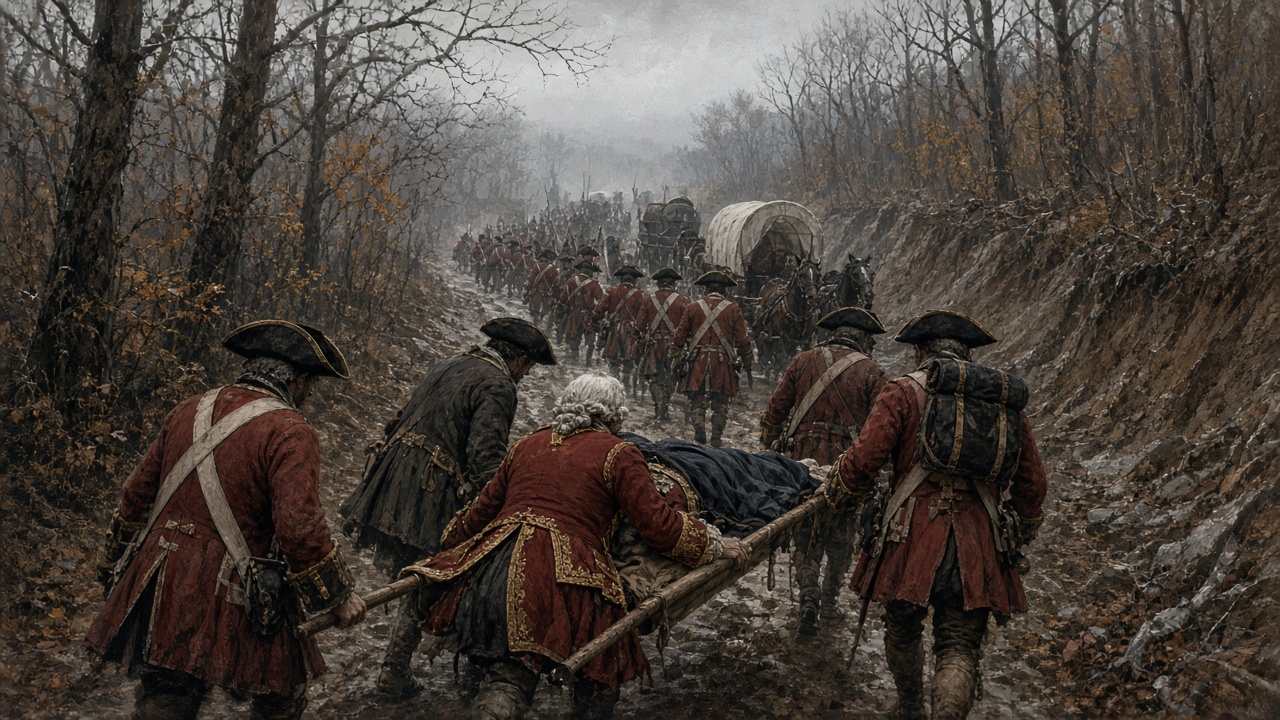
The army was in poor shape. Charles Morse Stotz, in a 1970 Western Pennsylvania History article on the Fort Pitt Museum, quotes a letter that Colonel Henry Bouquet wrote on November 25: “The men are greatly reduced, deficient of every necessary, half naked, without shoes, and without means of getting any. We have neither Tents nor Bagage, but are in good spirits.” Forbes himself had been carried on a litter for much of the campaign. Stotz says November 26 was observed “by the General’s Orders, as a Day of publick Thanksgiving to Almighty God for our Success,” and the Heinz blog, citing the Joseph Shippen orderly book, says a feu de joie, a volley of muskets and artillery, was ordered for the 27th.
What the letter says
The Pitt letter is not mainly about a name. Forbes opens by announcing that it “has pleased God to crown His Majesty’s Arms with Success over all His Enemies upon the Ohio.” He explains that he is sending Brigade Major Halkett to give a fuller account, that the season and his short provisions kept him from marching on to Lake Erie, and that he has had no orders or advice about what to do with the conquest. Then he asks to go home: his “Physicians and all our Hospital People unanimously agree that I must go directly for England for to save my life.” He asks to have his rank restored, complaining that “so many people put over my head” has made “the deepest impression on my mind.”
The naming comes at the very end: “I have used the freedom of giving your name to Fort Du Quesne, as I hope it was in some measure the being actuated by your spirits that now makes us Masters of the place. Nor could I help using the same freedom in the naming of two other Forts that I built… the one Fort Ligonier & the other Bedford.” He hopes Pitt will take them under his protection, “in which case these dreary deserts will soon be the richest and most fertile of any possest by the British in No. America.”
Two things stand out. First, he says he named the fort for Pitt, along with Ligonier and Bedford. The name of the place came with it, but the sentence does not say so. Second, the sentence follows the passage about not having been able to write since the 27th, which suggests it was added later than the dateline. The letter does not say when. The 1958 bicentennial book Pittsburgh: A Bicentennial Tribute, in an available excerpt, says Forbes did not write that sentence until he was in Philadelphia in January, and adds that his staff knew the name had been chosen earlier. The original, not seen for this article, is held by the National Archives at Kew among Forbes’s letters to Pitt (catalogued as CO 5/50, part 3, May 11 to November 27, 1758). The text quoted here is the 1927 Colonial Dames compilation, as reproduced online.
An earlier use
Forbes may have used the name a day sooner. A history of Pennsylvania’s frontier forts, in a transcription available only in excerpt, says that on November 26 Forbes reported the capture to Lieutenant Governor William Denny in a letter dated from Fort Duquesne, “or now Pitts-Bourgh,” and that the name of the intended fort, Fort Pitt, had been decided before the capture. A Western Pennsylvania History article gives the same dateline. The Denny letter itself was not available for this article.
Another account puts the formal naming on December 1, when Forbes issued orders for the posts: “Late Fort Duquesne = Pittsburgh,” Loyal Hannon “Fort Ligonier,” and Ray’s Town “Fort Bedford.” That text was found only as quoted on a regional history blog, which cites Douglas Cubbison’s book on the Forbes campaign. Cubbison’s book was not checked for this article. Forbes’s Ligonier and Bedford are the subject of the SteelCityHistory article on Fort Ligonier Days.
Why November 27?
The date got its status from later generations. Chris Potter wrote in Pittsburgh City Paper in 2007 that, starting in 1858 and every fifty years afterward, the city has celebrated November 27, 1758 as its birthday. He also noted, a little wryly, that most of the letter concerns Forbes’s health and promotion and that the naming comes “almost as an afterthought.” Some popular summaries place the letter on the 25th and spell the name differently. The transcribed text is dated the 27th and spelled “Pittsbourgh,” which does not match that. How the spelling later settled on the final h is a separate story, told in the SteelCityHistory article on why Pittsburgh is spelled with an h.
There is also a tradition that George Washington, who had looked over the Forks five years earlier, suggested the name. A Western Pennsylvania History article mentions it as a tradition, and no document supporting it was found.
Aftermath
Forbes left the Forks on December 3, 1758, for Philadelphia. The Heinz blog says about 200 troops under Colonel Hugh Mercer stayed to build a temporary fort. Forbes died on March 11, 1759. The spelling varied from letter to letter. The big fort that carried Pitt’s name came afterward, and the surviving Fort Pitt Block House was, Stotz says, finished in 1764 as one of Bouquet’s redoubts; see the SteelCityHistory article on the Block House. For the larger French and Indian War setting, see the SteelCityHistory history of the Forks before the city.
Readers who want to judge the letter for themselves can find the full text in the Colonial Dames of America’s 1927 compilation, Letters of General John Forbes, which a Carnegie Library of Pittsburgh online exhibit reproduces, including the closing signature line.