
The banana split Latrobe celebrates every August has a state seal on it. In August 2013 the Pennsylvania Historical and Museum Commission dedicated a marker at 805 Ligonier Street, and its text says that in 1904 “the first documented Banana Split was created by apprentice pharmacist David Strickler,” sold “here at the former Tassell Pharmacy.” What the marker does not mention is that the earliest printed use of the words “banana split” that researchers have turned up is dated September 28, 1905, and it describes a soda-fountain booth in Boston.
Those two facts do not cancel each other out, and neither one settles who made the first banana split. Together they make a better story than the plaque does.
The Latrobe version
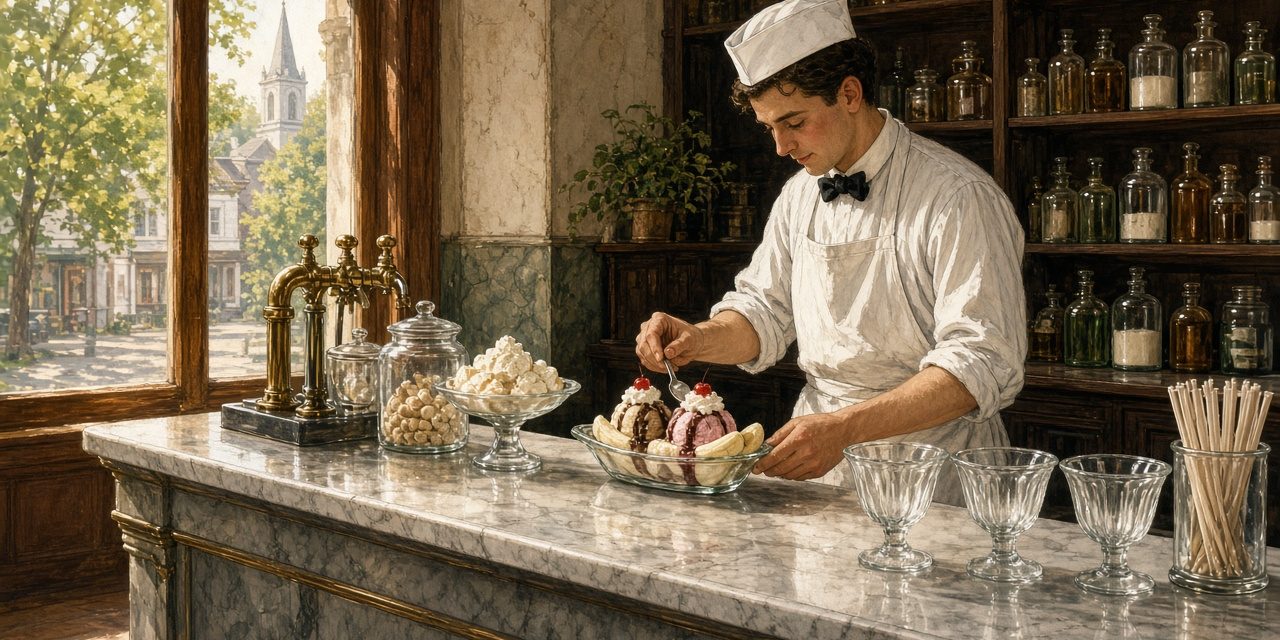
The story as Latrobe tells it is simple. David Evans Strickler, then about 23, worked behind the soda fountain at Tassell Pharmacy, a Ligonier Street drugstore owned by Mary Tassell. Strickler had a reputation as a tinkerer. He split a banana lengthwise, laid it in a dish and set three scoops of ice cream between the halves, with syrups, nuts, whipped cream and a cherry on top. Joseph “Ice Cream Joe” Greubel, a Latrobe restaurateur, told NPR in 2007 that it originally cost ten cents, twice the price of the pharmacy’s other sundaes. Strickler is also credited with ordering a long, narrow glass dish to hold it, the “banana boat” that became the dessert’s trademark. Students from nearby Saint Vincent College are said to have taken a liking to it and carried the idea home.
Strickler later bought the pharmacy. According to Peter Jensen Brown, who has searched the Latrobe Bulletin’s archive, he became sole owner in 1914, and the store carried his name until it closed in October 2000. The festival’s own history page says Strickler died in 1971, at 90. All of that is ordinary local history. The 1904 date is where the trouble starts.
What the paper trail holds
When the commission approved the marker in 2013, its announcement said “documentation supports 1904 as the earliest recorded date.” The commission’s own magazine, Pennsylvania Heritage, names the documentation: a letter. In 1959 Strickler wrote to the television panel show I’ve Got a Secret, hoping to appear, and said he “made the first banana split.” The letter also gives the ten-cent price and mentions the special dish. Brown reports that Strickler was not chosen for the show. So the letter exists because a 78-year-old pharmacist wanted to be on television, and it was written fifty-five years after the date it claims.
A second item that Latrobe’s supporters have pointed to is a receipt or order form for the glass boats. The Pitt News called it “the most convincing piece of evidence” in 2004 and said the order went to the Westmoreland glass company in 1905. NPR’s Nancy Baggett wrote in 2007 that she tried to verify the receipt’s existence and found that “nobody seemed to have it, or any of the original glassware.” As described, the order is dated 1905, not 1904.
The earliest public claim Brown found in the Latrobe Bulletin is a postscript in a 1933 drugstore ad: “This store originated the ‘Banana Split,’ now sold everywhere!” Brown, who writes the Early Sports and Pop Culture History blog, reported in 2023 that his search of the digitized paper turned up banana splits advertised in Latrobe in 1911, but by a competitor, Showalter’s Pharmacy.
The page from Boston
The National Association of Retail Druggists held its convention at Mechanics’ Hall in Boston from September 18 to 22, 1905. Fountain makers and syrup houses set up booths on the exhibition floor. The trade journal Pharmaceutical Era covered the exhibits in its issue of September 28, and on page 305 it describes the booth of the Murray Company, a syrup maker that supplied a big “Constellation” fountain built by the Puffer Manufacturing Company: “A ‘banana split’ was the piece de resistance of their menu.”
It is a throwaway line in a trade report, and it does not claim anyone invented anything. It shows the name in use, in public, in front of a roomful of druggists from across the country who could take it home. The October 1906 issue of another trade magazine, Soda Fountain, goes further. As later authors quote it, the magazine said the banana split “first came into public notice at the Boston convention of the N.A.R.D.,” and it carried remarks from Stinson Thomas, chief dispenser at a Boston department store. Thomas described splitting a banana, adding ice cream and crushed strawberries, and giving the dish away until it became his fountain’s best seller “a little more than a year” earlier. That 1906 article is known mostly through excerpts, including those in Richard Wissolik’s 2004 book Ice Cream Joe, a history of Greubel’s Valley Dairy restaurants. Brown wrote that he had not seen the full issue.
The dessert did not come from nowhere, either. Brown turned up an 1897 Buffalo Enquirer recipe for bananas split lengthwise and topped with whipped cream, and a few banana-and-ice-cream desserts advertised in 1903 and 1904 that are not clearly the same dish. Pharmaceutical Era itself printed a sundae recipe in March 1905 that called for crushed banana over ice cream. What the 1905 name added was a label that stuck. For a while the dish also went by “banana royal,” and the two names were used almost interchangeably into the 1910s.
Where the Latrobe account strains
Brown went through the Latrobe Bulletin and reported two problems with the usual Latrobe story and one detail that cuts the other way. Those issues were not available for this article, so these points rest on his citations.
First, the Bulletin of May 17, 1905, reported that “Miss Mary Tassell is installing a handsome soda water fountain in her drug store.” On Brown’s reading, the shop had no soda fountain before that, which would make a 1904 invention at the fountain difficult. Rival Latrobe drugstores had advertised fountains for years.
Second, the Latrobe story has long said that a friend, Howard Dovey, carried the recipe to medical school in Philadelphia, where classmates spread it to Atlantic City and beyond. The Bulletin printed that version in 1964. Brown found that Dovey did not enter medical school in Philadelphia until the fall of 1907.
The detail that helps Strickler is that the Bulletin of May 27, 1905, names him as the assistant to the new fountain’s expert dispenser. He was in the right place in 1905, a few months before Boston.
None of this proves Strickler did not make a banana split. He could have created one in the summer of 1905, and his memory, fifty-four years later, could have been off by a year. But then the dessert would have had to travel from a small-town drugstore to a national convention in Boston in a little under four months, by Brown’s count, and Brown called that a stretch. Wissolik, for his part, wrote in 2004 that he had considered a Boston origin and decided for Strickler on the evidence he had, “until someone comes up with new evidence,” as Brown quotes him.
And Wilmington, Ohio?
The rival most often named is Wilmington, Ohio, which holds its own Banana Split Festival each June. Its story, as Ohio Magazine tells it, begins on a winter day in 1907, when restaurant owner Ernest Hazard ran a contest among his employees to attract students from Wilmington College. Hazard’s winning entry had three scoops of ice cream between banana halves, with chocolate, strawberry and pineapple toppings, and his cousin Clifton named it the banana split. The festival dates to the mid-1990s.
The date is the weakness. 1907 is two years after the Boston convention, and no source consulted here points to a Wilmington document that predates it; the account is local tradition. Wilmington’s organizers seem to take that with good humor. In 2007, when the town marked what it called the dessert’s 100th birthday, a shop owner told NPR, “We think the controversy is fun.” A third claim, from Columbus, Ohio, concerned a soda-fountain worker named Letty Lally, but Pennsylvania Heritage says experts concluded she had made a banana royal, not a split.
How a claim becomes a festival
Whatever the evidence says, Latrobe’s claim has acquired a lot of institutional weight. In 2004, on the supposed centennial, the National Ice Cream Retailers Association presented the city with a certificate naming it the birthplace of the banana split, and the University of Pittsburgh, where Strickler studied pharmacy, held a “From Pitt Came the Split” event. Greubel, who said he had talked with Strickler himself, worked with Pitt on that event, according to the festival’s history page, and was among the Latrobe residents who petitioned for the state marker. He served as the festival’s honorary chair from 2015 until his death in 2017.
The marker dedication in August 2013 was a weekend-long celebration, sponsored in part by the Dole Food Company, whose mascot, Bobby Banana, made an appearance. The Great American Banana Split Celebration has been held in Latrobe since 2013, most recently on August 21 to 23 in 2026.
Ed Marks, a former ice cream retailer and soda-fountain collector whom NPR quoted, described the pattern: “Often, claims just fizzle out.” He added: “A number of different places have said they originated the banana split, but those who generate the most interest — like Latrobe and Wilmington — tend to get the credit.”
What can be said
The claims fall into three tiers. The first is established: Strickler worked at Tassell’s soda fountain, he later owned the pharmacy, and by 1933 his store was advertising itself as the origin of the banana split. The second is probable: the name “banana split” was in public use in Boston by September 1905, and two trade-press sources point to the convention there as where it first spread. The third is the part that remains a claim, including Strickler’s 1904 date, the Dovey and Philadelphia route and the receipt for the glass boats.
The state’s marker says “first documented.” Among the sources cited here, the 1904 date rests on Strickler’s own recollection in 1959. The earliest printed banana split found so far is the one on page 305 of Pharmaceutical Era, and the full volume is scanned on the Internet Archive, where anyone can read the Boston page.
The marker stands on Ligonier Street, on the site of a pharmacy that operated under one name or another until 2000. Whoever made the first banana split, Latrobe is the place that has put in the work of remembering it, with a marker, a festival and a century of repeating the story.
For another Latrobe story, see the SteelCityHistory piece on Fred Rogers, who was born there, and for another Western Pennsylvania ice cream invention, the Klondike Bar, see the SteelCityHistory look at Isaly’s.