

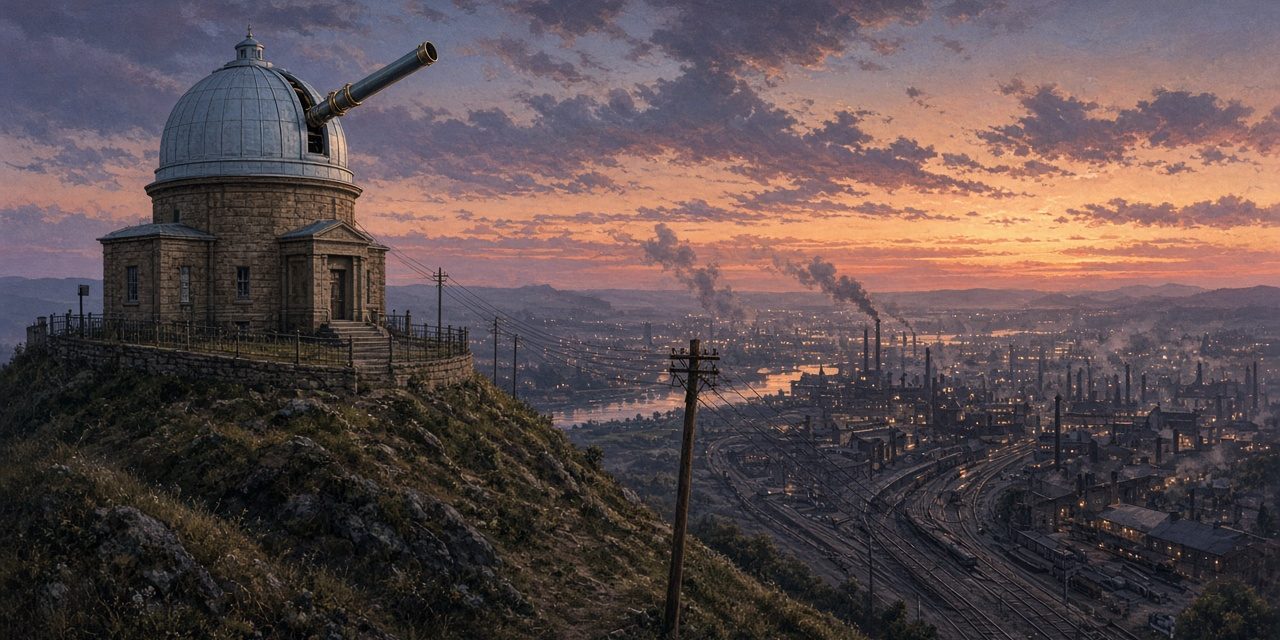
William F. Allen, who ran the railroads’ General Time Convention, stood on the roof of the Western Union building in New York on Sunday, November 18, 1883, and described what he heard. The bells of St. Paul’s struck noon on the old local time. A few minutes later, “obedient to the electrical signal from the Naval Observatory,” a time-ball dropped, Trinity’s chimes rang twelve strokes, and “local time was abandoned, probably forever.” The Allegheny Observatory in Pittsburgh had been selling railroads their time for fourteen years by then, and a common summary says it set the nation’s clocks that day. The record is more interesting than the summary. Allegheny helped make railroad time possible, and Pittsburgh itself did not give up its own time for another three years.
A telescope club in debt
The Heinz History Center says the observatory was founded in 1859 as the home of the Allegheny Telescope Association, a club that fell into debt and in 1867 donated the instrument and building to the Western University of Pennsylvania, today’s University of Pittsburgh. The university hired Samuel Pierpont Langley as director and professor of astronomy. The Heinz article says the place was in disrepair, without a research library or proper equipment, and that Langley had to find a way to pay for repairs. The Observatory’s own history says that, with help from the Pittsburgh industrialist William Thaw, he improved the equipment, including a small transit telescope used to watch stars cross the meridian. With it, he could determine the time exactly.
Selling the time
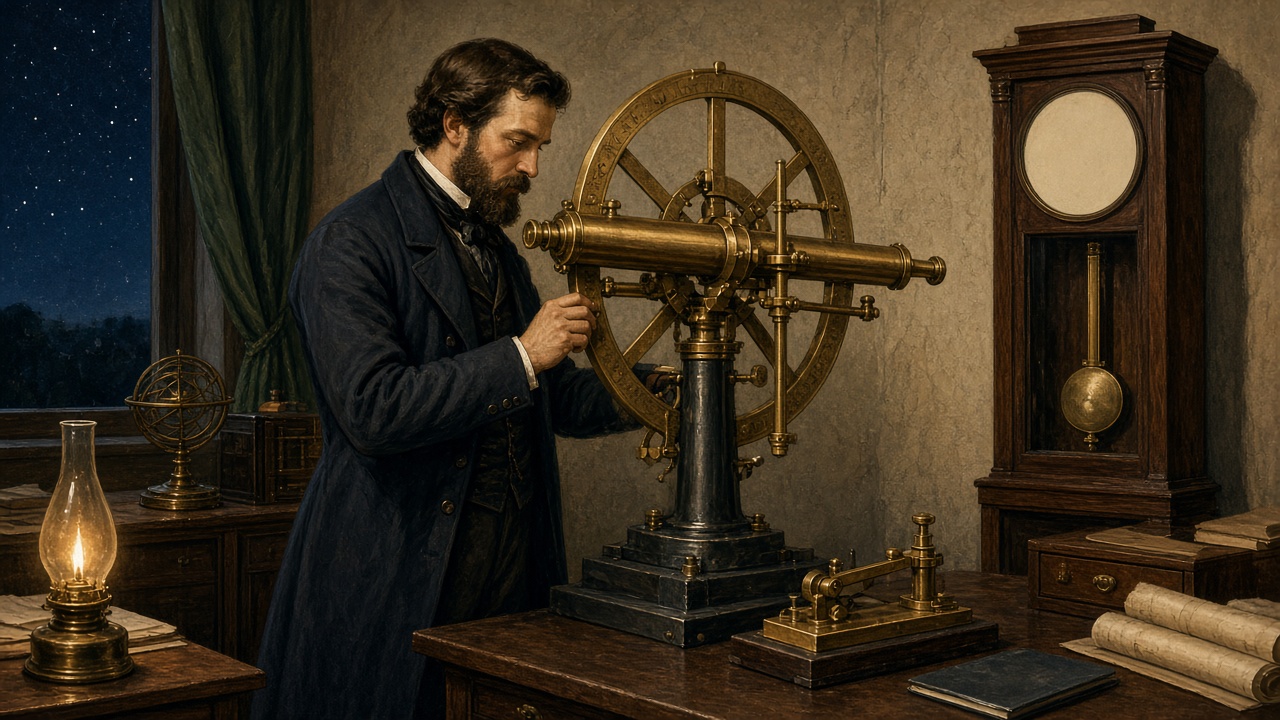
Langley’s idea, according to the Observatory, was to sell it. Heinz says the observatory first sent time to Pittsburgh jewelers who wanted to set their watches correctly, and that in 1869 the Pennsylvania Railroad became the first railroad to subscribe to what became known as the Allegheny Time System. Subscribers paid nearly $3,000 a year, the Observatory says, which helped finance research, pay salaries and maintain the building. By 1883, according to the Observatory, the signals went out over more than 4,700 miles of telegraph to cities and railroads in the United States and Canada. Heinz adds that by 1890 the service had earned more than $60,000.
An April 1878 article in Harper’s, reproduced online by a railroad-history site, describes how it worked. The author, who says he was responsible for the system’s initiation and superintendence, followed the telegraph wires from the railroad’s offices to the observatory on the “table-land on the north of the Ohio.” A transit telescope fixed in a stone-piered room caught stars as they crossed the sky, and an observer pressed a key as each did so, which recorded the instant on a chronograph. A standard clock made by the Howard Company of Boston, corrected by those observations, sent its beat over the wires. In stations hundreds of miles away, the article says, a telegraph sounder ticked every second, with a short silence at the end of each minute. Lines ran to the turret clock of the Pittsburgh municipal hall, which struck a bell every third hour, and to the stores of jewelers, who set their regulators by it. Other wires ran to the Pennsylvania Railroad’s lines, “from Erie on the north to Baltimore on the south, and from New York to Chicago.” The article also says that Philadelphia’s exact time was sent over the railway telegraph from nightly observations at Allegheny.
The author was careful to explain that the observatory’s clock did not follow the sun. “The sun is in fact a most irregular time-keeper,” he wrote, arriving “sometimes a quarter of an hour before” noon and “sometimes a quarter of an hour after,” so that “a watch which kept no better time than the sun does would be a poor one indeed.”
What Langley wanted, and what the railroads did
The historian Ian Bartky, in a 1989 article in Technology and Culture, found that Langley was an early and persistent advocate of a single time. In a pamphlet dated Pittsburgh, December 1, 1869, “Proposal for Regulating the Clocks of Railroads,” he urged a common railway time for the country east of the Mississippi, “doing away with all the discrepancies which perplex travellers, all the added trouble to the superintendents in preparing schedules, and all the facilities for making error.” Bartky notes that by the time of the Harper’s article above, Langley’s emphasis had shifted to accuracy rather than uniformity.
Langley was one of several astronomers doing this. Bartky names observatories at Harvard, Albany, Ann Arbor, Cincinnati, Chicago and the U.S. Naval Observatory that were also transmitting time. His larger point is that standard time did not come mainly from a railroad need for order. Railroads, he argues, ran on their own regional times and bought them from astronomers, and the push for uniform time came from scientists who needed simultaneous observations. William Allen, the editor of the Travelers’ Official Guide, devised the plan the railroads adopted in 1883: five zones, each an hour apart. He found that the central meridian of the eastern railroads fell almost exactly on the 75th meridian west of Greenwich, near Philadelphia, which Bartky lists at 75.10 degrees west.
So Allegheny’s contribution is real but narrower than the slogan. Langley supplied the Pennsylvania Railroad, and others, with time from Pittsburgh, and argued for one time long before the railroads did. The zones themselves were Allen’s plan. And Allen’s own account of the noon of November 18 in New York names the Naval Observatory. Some modern summaries say the Allegheny Observatory also sent a noon signal over railroad lines that day; the sources consulted do not document it.
November 18, 1883, and Pittsburgh’s clocks
The railroads’ conversion took place at noon on Sunday, November 18. Cities in the eastern part of each new zone saw noon twice, which is where the “day of two noons” comes from. Bartky says most large cities moved their civil time to match the railroads, because the shift was only a few minutes.
Pittsburgh was not one of them. A degree of longitude changes local time by four minutes, Bartky writes, and Pittsburgh lies about five degrees west of the 75th meridian, which by that arithmetic puts local sun time roughly twenty minutes behind the new Eastern standard. Bartky counts Pittsburgh among the cities, with Detroit, Savannah and some in Ohio, where citizens objected where the shift was large. He reports that in December 1884 Allen said every railroad but two short lines around Pittsburgh was running on standard time, and that after January 1, 1887, when Pittsburgh and its railroads adopted Eastern time, Allen considered his railroad task finished. The city that sold the railroads their time kept its own for three more years.
What happened to the time service
The sources disagree about the end. The observatory’s own history says the need for the service “became so great” that the Naval Observatory began providing signals with public money in 1883. Heinz says only that the observatory was supported by its time service until the Naval Observatory began distributing accurate time for free, and gives no date. Langley became Secretary of the Smithsonian in 1887; the Observatory lists him as its director until 1891. Congress made standard time law in 1918.
What remains
The Allegheny Observatory still operates for the University of Pittsburgh. Its history says Langley’s transit telescope, clocks and telegraph are still on display there, so check the observatory’s website for public programs before going. The story of the railroads that depended on it is in the SteelCityHistory history of Pittsburgh’s railroads and Union Station.