
The George Ferris Pittsburgh story ends in a hospital bed. On November 22, 1896, the engineer whose name is on every Ferris wheel died of typhoid fever at Mercy Hospital. He was 37. The wheel he had built for the 1893 Chicago World’s Fair had made him famous, and by the account most often repeated it had also left him in debt, in court and alone. Some of that account holds up well, and some of it comes from a single source or from a sentence that has been copied from one article to the next.
An inspector of steel
Ferris was not a showman. According to the Pennsylvania Historical and Museum Commission’s marker essay, he came to Pittsburgh as a young bridge engineer to inspect steel for the Kentucky and Indiana Bridge Company, and then set up G. W. G. Ferris & Company here as inspecting engineers. A sourced biography at Ferris Wheel Heritage, which draws on an 1887 Rensselaer alumni register and his partners’ 1897 memorial in the Engineers’ Society of Western Pennsylvania’s proceedings, dates the firm to 1886, when he was 27. Inspection was work for a city that made steel: his firm’s job was to check the metal that bridges and other structures were built from. In 1886 he married Margaret Ann Beatty of Canton, Ohio, and the marker essay says they settled on Arch Street in Allegheny City, now part of Pittsburgh’s North Side. The story of that city is told in the SteelCityHistory history of Allegheny City. In 1889 he formed a second firm, Ferris, Kaufman & Company, with Gustave Kaufman. The Engineers’ Society records credit that firm with a Ninth Street Bridge in Pittsburgh; which span that was could not be determined for this article.
The wheel
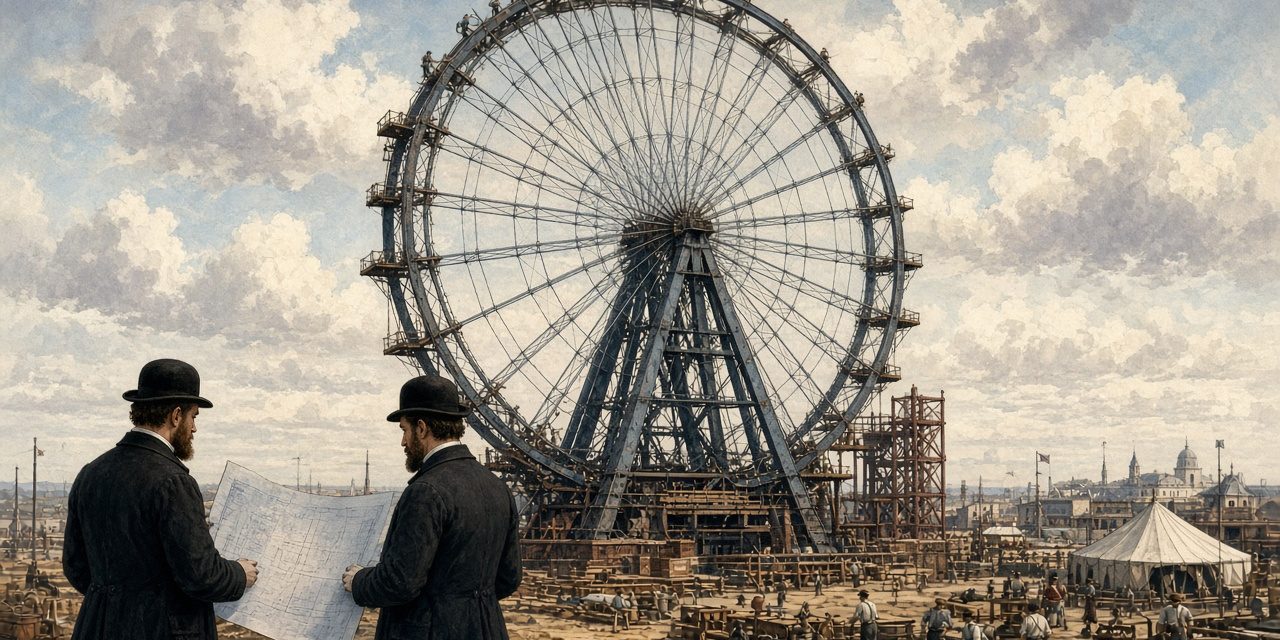
By the usual story, at an engineers’ dinner in Chicago, the fair’s director of works, Daniel Burnham, challenged American engineers to produce something to rival the Eiffel Tower, and Ferris sketched a giant wheel on a napkin. The napkin is a tidy detail. The Ferris Wheel Heritage biography notes that Luther Rice’s 1901 account has Ferris sketching at a dinner with friends, while Ferris himself, in 1893 newspaper interviews, said he sketched the plan at a Chicago chop-house lunch. Both tellings are on the record. Nor did he invent the idea. The marker essay says William Somers had a patent for a “Roundabout” in early 1893 and had built three smaller wooden wheels in 1892, but that Ferris was the first to build one in steel, on so large a scale.
The wheel opened to the public on June 21, 1893. The marker essay says more than 1.4 million people paid 50 cents to ride, and that it earned $725,000 against a cost of $400,000. Trouble followed. The Heritage biography, drawing on Weingardt, records a patent suit served on Ferris the day after the opening, a date it says is not independently confirmed, and the marker essay says he sued the exposition over the wheel’s profits. The patent suit’s outcome is itself disputed. The biography, relying on Richard Weingardt’s 2009 biography Circles in the Sky, says it was dismissed in July 1894, with costs of $26.50 to Ferris, and that he never patented the wheel; a New Jersey paper of November 1893 reported that a court had found infringement and royalties due.
What sources say about his ruin
This is the part of the story most often told as a simple fact. The marker essay says Ferris “soon declared bankruptcy and lost his companies. Then his wife left him.” Pennsylvania Heritage magazine says much the same: he “lost his companies, his wife, and his health.” Weingardt, as summarized by the Heritage biography, says that by November 1896 Ferris had sold his engineering firms to his partners, which is not the same as bankruptcy, and that by 1896 the couple had separated. The biography says it found no contemporary court filing confirming a separation, and no record of a bankruptcy filing was found for this article either. The safest reading is that his business and marriage had both come apart by the time he died, and the exact legal form of either is unclear in the available sources.
The wheel itself had been taken down in 1895 and rebuilt on Chicago’s North Clark Street, where Pennsylvania Heritage says Lincoln Park neighbors campaigned against it. It was dynamited in 1906.
Typhoid in Pittsburgh
Typhoid fever was not an unusual way to die in the Pittsburgh of the 1890s. A 2004 paper by Collins, Mueller and Tarr says that more than 350,000 people in 75 upstream communities discharged untreated sewage into the Allegheny River, from which most Pittsburgh residents drew their water, and that the city had the highest typhoid death rate of the nation’s large cities, well over 100 deaths per 100,000 people between 1873 and 1907. A Western Pennsylvania History article counts 8,149 typhoid deaths in Pittsburgh from 1883 to 1908. The first filtered water was delivered in December 1907. None of this establishes how Ferris was infected, and no source found for this article does, so this article does not claim that the water killed him. It does show that his diagnosis would have been a common one.
The date is also less certain than the confident “November 22” suggests. Contemporary papers, as cited by the Heritage biography, put it on the 22nd, and that is the date given by Pennsylvania Heritage. His partners’ memorial also uses the 22nd. The family’s genealogical record gives the 28th, the cover date of the trade journal that printed the obituary. The marker essay says the 26th, and a Penn State library biography says the 21st. This article uses the 22nd because the newspapers and the partners agree. The same marker essay adds kidney failure to typhoid, and the Penn State biography speculates about kidney disease and says that “some believe” Ferris took his own life. No available source supports suicide, and the Heritage biography, citing contemporary obituaries, gives typhoid.
The ashes
Ferris was cremated after a service on November 24, 1896. Papers in early 1898, as cited by the Heritage biography, reported that his ashes were still being held by a crematory against unpaid funeral bills. The marker essay says they stayed unclaimed for fifteen months, until his brother paid the debt. The family record still lists them as unaccounted for, so the sources conflict about whether anyone retrieved them. An 1898 Evening Star item, per the same biography, put a $25,000 insurance policy as already exceeded by claims, and Weingardt says his heirs were his mother and brothers, not his estranged wife. Where, if anywhere, his ashes are today could not be determined.
What remains
The house at 1318 Arch Street on the North Side, which the Pittsburgh History & Landmarks Foundation’s list calls the former George Washington Gale Ferris Jr. House, was designated a City of Pittsburgh historic structure in 2001. The city’s legislation file for the designation shows council passing the resolution on June 12 and the mayor signing it June 22, and the Foundation’s list gives June 28, so only the year is given here. The available portion of the resolution does not mention Ferris, so the connection rests on the Foundation’s list. The state’s “Ferris Wheel Inventor” marker was listed on ExplorePAHistory.com for the West Commons on Arch Street, marked “not yet reinstalled,” so check before looking for it. The family home in Carson City, Nevada, is on the National Register. For the death date and the story of the ashes, with the primary citations, see the Ferris Wheel Heritage biography, which lists its newspaper and memorial sources.
Ferris built the first steel wheel at that scale, and the marker essay credits him with setting the example for the amusement-ride designers who followed.