

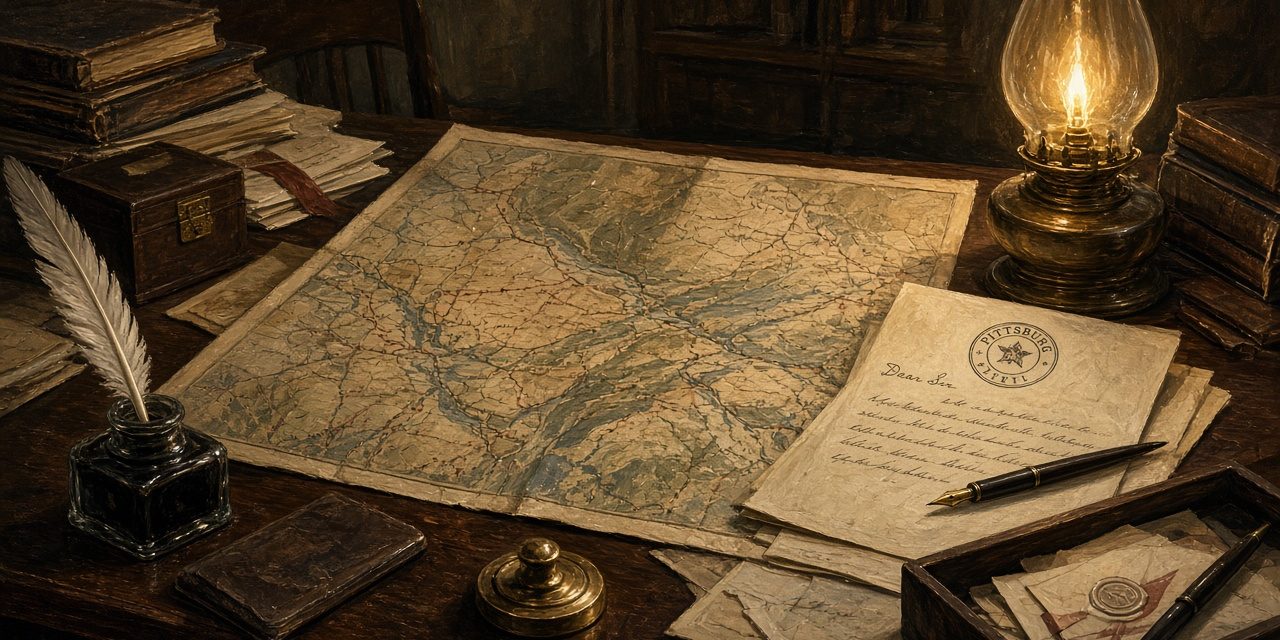
Why is Pittsburgh spelled with an h when nearly every other American “burg” is not? The short answer is that the city was named with the Scottish spelling in 1758 and has used it in its own records ever since, except that the federal government took the h away for about twenty years, from the early 1890s until 1911. The longer answer is messier and more fun: for most of the 19th century nobody agreed on the spelling, the h’s “loss” was not mourned by everyone, and its return was a campaign rather than a celebration. Here is the story of the letter, from a general’s 1758 dispatch to the newspaper that held out until 1921.
A Scottish general and a Scottish spelling
The name came from General John Forbes, the British commander whose letters in November 1758 announced the French abandonment of Fort Duquesne. Writing to William Pitt, the British statesman for whom the place was named, Forbes headed his letter “Pittsbourgh. 27th Novemr. 1758” and told Pitt, “I have used the freedom of giving your name to Fort Du Quesne.” That letter is quoted in the Carnegie Library of Pittsburgh’s online exhibit “How to Spell Pittsburgh,” compiled by the library’s Pennsylvania Department.
The library’s exhibit explains the ending. “Burgh” and “bourgh,” it says, citing the Oxford English Dictionary, are variants of “borough,” obsolete in ordinary English since the 17th century but still used in Scotland, as in Edinburgh. “General Forbes was a Scot and would have used this form,” the exhibit says, and it suggests he probably pronounced the name “Pitts-burro,” the way Edinburgh is pronounced. That pronunciation is the library’s educated guess, not something Forbes wrote down.
Even the founding spelling is less tidy than the legend. Writing in Pittsburgh Magazine in 2024, historian Virginia Montanez points out that Forbes sent at least two letters about the naming. In the November 27 letter to Pitt, she says, the h “is wedged up against the 2 in the date,” as if it had been squeezed in afterward as a correction, and a letter to Pennsylvania’s Lieutenant Governor William Denny a day earlier left the h off entirely. “So from the first days of her life,” she writes, “Pittsburg(h?) had a complicated name.” For what happened at the Forks that November and why the name was chosen, see the SteelCityHistory timeline of Pittsburgh’s history.
Town, borough, city, and a printer’s error
Pittsburgh’s founding laws mostly used the h. The Carnegie Library exhibit says the Pennsylvania legislature’s acts of April 22, 1794, which incorporated Pittsburgh as a borough, and March 5, 1804, which amended that charter, both spelled it with an h. The act of March 18, 1816, which made Pittsburgh a city, is where the trouble starts. According to the library, “through a printer’s error, the h was omitted from the printed copy, but the original charter included it.” The original charter was burned in the Court House fire of 1882, the exhibit adds, so the handwritten version can no longer be checked.
The Chamber of Commerce of Pittsburgh made the same argument in a 1908 report by its Committee on Education, later reprinted in its magazine Pittsburgh First. The committee wrote that the 1816 act used the h, that “in printing this Act in one of the law reports, the ‘h’ was evidently dropped by the printer,” and that the city’s first ordinance book and its seal, dated 1816, used the h throughout. Montanez reads the record less generously: in her account the legislature “seemingly incorporated Pittsburgh as a town with an H in 1804, but as a city without one in 1816,” while the city seal and the first council minutes had the h and the official county map of 1817 did not. The two accounts agree on the documents; they differ on how much weight to give the printed act.
Through the rest of the 19th century, the spelling was a matter of taste. The library’s exhibit says the predominant usage in directories and newspapers was Pittsburgh, with an occasional Pittsburg, and that municipal documents “always used the latter spelling,” meaning the version with the h. Montanez found the newspapers split. On a single day, March 2, 1889, she writes, a reader downtown could buy the Pittsburg Dispatch, the Pittsburgh Commercial Gazette, the Pittsburg Press or the Pittsburgh Post.
The federal government drops the h
The h lost its official standing in Washington, not Pittsburgh. The United States Board on Geographic Names was set up to make federal maps and publications use one spelling for each place, and among the departures from local usage it approved, according to the board’s policy statement as reproduced by the Carnegie Library, was “the dropping of the final ‘h’ in the termination ‘burgh.'” The board explained its reasoning:
“Concerning the termination ‘burg’ or ‘burgh,’ as Pittsburg, an extensive correspondence has developed the fact that in more than three-fourths of the places having this termination the final ‘h’ is not in local use.”
The same list of reforms included abbreviating “borough” to “boro,” dropping hyphens and possessives from place names, and spelling “center” the American way. The board wrote that it deemed it “desirable and advisable to induce uniformity in this matter.”
Sources give different dates for when the h came off, and the board’s own records explain why. President Benjamin Harrison created the board by executive order on September 4, 1890, and its decision to spell the city “Pittsburg” appears in the board’s first report, which Harrison sent to Congress on December 23, 1891. That is the date on a label for an artwork at the Senator John Heinz History Center, which says the board “removed the ‘H’ at the end of ‘Pittsburgh'” that day. The Carnegie Library exhibit gives 1890, the year the board was founded, and VisitPITTSBURGH and Montanez give 1891. The report does not say at which of the board’s meetings the decision was made. VisitPITTSBURGH adds that the board justified the change by pointing to the printed copies of the 1816 charter, apparently unaware that the original had the h.
The board’s spelling governed federal agencies, including the Post Office. The 1921 Pittsburgh First article says the Post Office Department, “following the United State Board of Geographic Names, had dropped the final ‘h.'”
Not everyone missed it
Pittsburgh’s own institutions split. VisitPITTSBURGH says the Pittsburgh Gazette, the Pittsburgh Stock Exchange and the University of Pittsburgh refused to adopt the federal spelling, and that official city documents kept the h. The Carnegie Library exhibit agrees that “throughout the period 1890–1911 city ordinances and council minutes retained the h.”
But Montanez argues that the familiar story, in which a united city grieved for its lost letter, is mostly myth. Some local voices welcomed the change. When the Pennsylvania Railroad’s lines dropped the h in 1891, she writes, the Pittsburg Dispatch crowed: “The Pennsylvania Company has sensibly decided that Pittsburg can get along without its final ‘h.’ The Dispatch discarded this superfluity long ago. Next!” The Pittsburg Times declared in 1892, as she quotes it, that it would not reopen the subject because doing so “might rouse anew … the cranks who have made life a burden with arguments on this subject.” A letter writer to the Pittsburg Press said the h spelling “wears the whiskers of time.”
Downtown advertising captured the confusion. Montanez found a page of the Pittsburgh Gazette from March 1, 1902, a decade after the federal change, on which a Horne’s advertisement spelled the city Pittsburg and a Kaufmann’s advertisement spelled it Pittsburgh. (For those two stores, see the SteelCityHistory histories of the Kaufmann’s clock and the Horne’s Christmas tree.)
The campaign to bring it back
The h came back through organized lobbying. The Chamber of Commerce’s Committee on Education reported on May 7, 1908, that “the only historically correct spelling of the word Pittsburgh, as designating the city located at the confluence of the Allegheny and Monongahela Rivers, is with the final ‘h.'” The committee traced the h through the Penn family’s “Manor of Pittsburgh,” surveyed in 1769, and the “Town of Pittsburgh” laid out in 1784, as well as the borough and city records.
Different sources give the credit to different people. Montanez calls the restoration the result of “a years-long campaign by the Chamber of Commerce.” The Heinz History Center’s label says local citizens “led by Postmaster William Hamilton Davis” began the campaign. And the decision itself was delivered to a U.S. senator. On July 20, 1911, C. S. Sloan, secretary of the United States Geographic Board, wrote to Senator George T. Oliver of Pennsylvania:
“At a special meeting of the United States Geographic Board held on July 19, 1911, the previous decision with regard to the spelling of Pittsburg without a final H was reconsidered and the form given below was adopted: Pittsburgh, a city in Pennsylvania (not Pittsburg).”
The letter ran on the front page of the Pittsburgh Gazette Times on July 22, 1911, under the headline “Pittsburgh Is Spelled with ‘H’ So Decides United States Geographic Board in Deciding Controversy,” according to the Carnegie Library’s transcription. The paper’s Washington correspondent, Robert Simpson, wrote that “hereafter the government of the United States in all its writings and publications will spell it Pittsburgh.” The Heinz History Center holds a colored-pencil drawing by local artist Nora Thompson, marked “Pittsburgh is spelled with ‘H’ / the Gazette Times / July 22, 1911,” that shows two police officers pulling a yellow “H” out of a sack, with a captured criminal beside them.
Holdouts, near and far
The federal decision did not end the argument overnight. Montanez writes that the h “was reinstated locally by many after the 1911 decision, but there were holdouts.” In 1918, she says, many businesses still left the h off their names and advertisements, the society magazine the Pittsburg Bulletin still lacked it in 1913, and “The Pittsburg Press refused to become The Pittsburgh Press until 1921.” The Library of Congress catalog record for the paper confirms the two forms of the title, “Pittsburg press” in its early years and “Pittsburgh press” later, though it does not give the exact changeover date.
Reaction outside the city was mixed too. Montanez quotes the Boston Globe calling the h “useless” and its return “unfortunate,” and the Daily Missoulian in Montana conceding that “Pittsburgh has grown to be too important to be misspelled.” The most stubborn holdout she found was the Altoona Tribune, which called the h “foreign and unfriendly” and “a verbal monstrosity” and, she writes, kept spelling the city without it until the paper’s last issue in 1957.
The Chamber of Commerce kept up the fight for years. In July 1921, Pittsburgh First urged “patriotic Pittsburghers” to mail the committee’s folder on the correct spelling with their letters to other cities. It reported that the Literary Digest, “for many years an offender,” had added the h, and that the publisher Frank A. Munsey had ordered his New York papers to do the same. The chamber had even counted its own mail: one lot of 100 out-of-town letters, it said, scored “77 correct; 23 without the ‘h.'”
The other Pittsburgs
The h now does a practical job: it separates Pennsylvania’s city from places named after it. VisitPITTSBURGH notes that Pittsburg, Kansas, and Pittsburg, California, still use the shorter spelling, while nearby municipalities such as East Pittsburgh use the h. The Chamber’s 1921 article made the same point: the h “distinguishes the Pittsburgh in Pennsylvania from other towns of the same name in various parts of the country.”
Common questions
When did Pittsburgh lose its h?
In federal usage, in the early 1890s. The U.S. Board on Geographic Names, created in September 1890, adopted the spelling “Pittsburg” among its first decisions, which President Benjamin Harrison sent to Congress on December 23, 1891. The city government never dropped it.
When did Pittsburgh get its h back?
On July 19, 1911, when the United States Geographic Board reconsidered its earlier decision at a special meeting. The decision was announced in a letter to Senator George T. Oliver dated July 20 and published in the Gazette Times on July 22.
Was Pittsburgh ever officially spelled Pittsburg?
Yes, for federal purposes, roughly from 1891 to 1911, and the printed copy of the 1816 city charter used that spelling. But the city’s own ordinances, council minutes and seal used the h, according to the Carnegie Library and the Chamber of Commerce.
Why do people misspell it?
Because the h is unusual. The naming board itself found that in “more than three-fourths of the places having this termination the final ‘h’ is not in local use.” Pittsburgh’s ending is, in the Carnegie Library’s account, the Scottish form of “borough,” which its Scottish namer would have used.
The h is not the only local quirk of language; see the SteelCityHistory guide to Pittsburghese.