
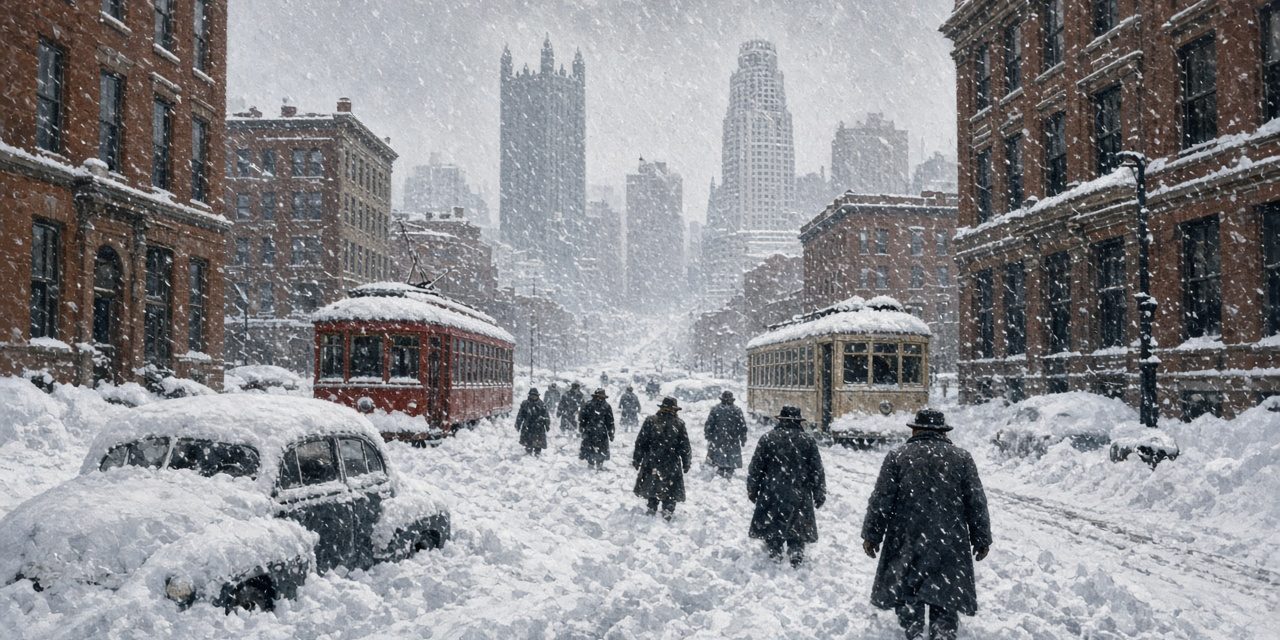
The Great Appalachian Storm of 1950 left Pittsburgh with a number that is still attached to it, 27.4 inches, and the number is correct. It is also only one of several figures you will find for the same storm, and the others are not mistakes so much as different ways of measuring a snowfall that did not stop when the official count did. The storm began on the day after Thanksgiving, buried the city, and left a record the National Weather Service in Pittsburgh still lists as the largest snowstorm in the city’s history. The more interesting story is what people did while it fell. The storm’s wider name comes from the weather record: NOAA’s National Centers for Environmental Information says the slow-moving system, which dropped heavy snow across the central Appalachians from November 22 to 30, 1950, is known as the Great Appalachian Storm of 1950.
One storm, four totals
The National Weather Service’s Pittsburgh office lists 27.4 inches for November 24 to 26, 1950, the largest storm on its list of records. The same table lists November 24 at 14.0 inches and November 25 at 10.1, and a snow depth on the ground of 22 inches on November 26. Weather Underground’s weather historian Christopher Burt gives a longer window: 30.2 inches from November 23 to 29, of which 27.4 fell in three days and 22.1 in 24 hours. The National Centers for Environmental Information also says 30.2. The National Weather Service office in Jackson, Kentucky, says 30.5. A Heinz History Center photo caption says 30½ inches fell on November 25, and a Post-Gazette retrospective says 31.
The NWS table’s own numbers show the pattern: 27.4 minus 14.0 and 10.1 leaves 3.3 inches for the 26th, and the longer totals include more snow after that. The Weather Bureau’s daily readings were not available for this article, so it is not clear exactly how the larger figures were assembled, and the Heinz caption’s “on November 25” cannot describe one day’s snowfall, since the NWS table gives 10.1 inches for that date. When you read “27.4 inches,” it is the official three-day record. When you read “30,” it is probably a longer window.
Even the start time varies. The Valley News Dispatch reported that snow began at 5 a.m. on Friday, November 24 in the Alle-Kiski Valley, while a WPXI retrospective says the snow started late Friday. The cold was severe. According to weather maps in Burt’s account, Pittsburgh was at 9°F in blizzard conditions at 2:30 p.m. on November 25, while Buffalo, about 150 miles north, was at 54°F with rain.
A storm that surprised everyone
Burt, quoting the researcher Peter Lynch, says the storm “had not been well predicted in real time.” Some of this was the science of the time. The first numerical weather forecast had been run only months earlier. In 2000, researchers led by NOAA’s Robert Kistler re-ran the storm and concluded, as Burt quotes them, that it “was actually quite predictable.” The Pennsylvania volume of the U.S. Weather Bureau’s climatological data, as Burt quotes it, opened its report by saying that the elements on November 24 and 25 “affected more people in more diverse and violent ways than at any previous time in Pennsylvania history.”
Friday night
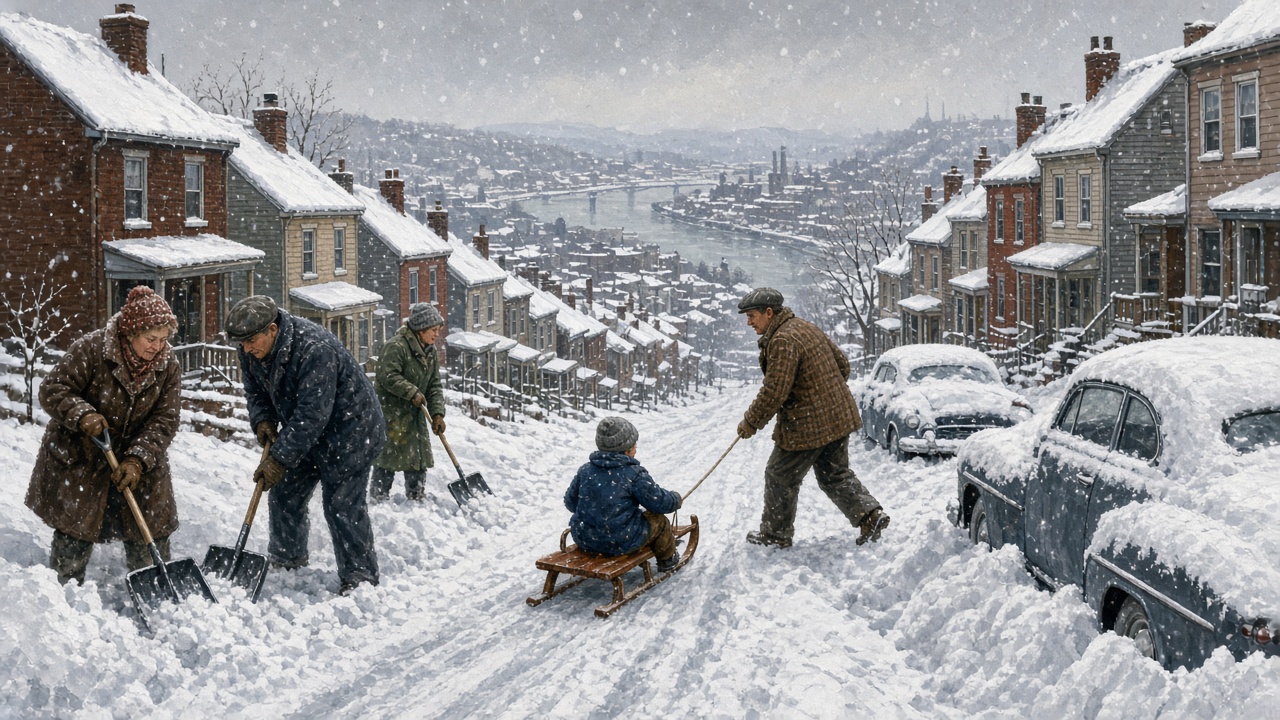
The Pittsburgh Post-Gazette’s “Digs” feature on the storm, built from the newspaper’s own 1950 coverage, begins with the Pittsburgh Symphony. A half-dozen musicians were snowbound, but the Friday night concert at the Syria Mosque in Oakland went ahead, starting late. Critic Donald Steinfirst reported that about 1,200 “hardy music lovers” came to hear Ravel, Haydn and Smetana. The same paper’s November 25 edition showed stalled vehicles and, in one photo, “happy Brookline youngsters” who had taken their sleds out early.
In Monessen, a Pittsburgh Steel official told the Monessen Daily Independent that hundreds of men could not leave the mill Friday night and kept working in their departments on overtime. A North Braddock man died when an icicle broke loose and struck him at U.S. Steel’s Edgar Thomson Works. Both details come from a 2020 Tribune-Review account that drew on the papers of the time. Charles Harris, a Pittsburgh firefighter, left home after Thanksgiving dinner to report to his station in Oakland; his wife, Doris, told the Tribune-Review in 2013 that “he didn’t come home for a week,” since none of the relief crews could get in.
Monday: the city stops
By Monday, November 27, the Post-Gazette reported that many industrial plants and most downtown stores were closed. The November 28 paper carried a photo of soldiers of the National Guard’s 304th Tank Battalion “helping to clear streets and keep order,” and WPXI says the Guard enforced travel restrictions downtown. A Post-Gazette photo caption shows drivers displaying passes that allowed them onto the roads, and another shows a Sherman tank pulling stalled trucks. The city’s car pound on Duquesne Way held 265 towed vehicles, and the city waived the fines and fees because of “circumstances beyond control.”
Getting to a hospital took ingenuity. Reporter Edith Rosenblatt wrote on November 28 that pregnant women reached hospitals “by sled, stretcher and even shank’s mare.” One woman and her husband walked from Holt Street on the South Side through the Armstrong tubes to Passavant Hospital at Reed and Roberts. A coal truck carrying fuel for the Jewish Home for the Aged in Squirrel Hill had to follow a bulldozer. The newspaper also reported that the inclines “roll on, never missing a trip,” and quoted the Monongahela Incline’s superintendent, W. Homer Ackard, as saying the only other time the line had stopped since 1870 was the St. Patrick’s Day flood of 1936. That is his claim as the paper reported it; for the incline’s history see the SteelCityHistory article on Pittsburgh’s inclines, and for that flood see the SteelCityHistory account of the 1936 flood.
Irwin, at the end of the Turnpike
Beyond the city, the Pennsylvania Turnpike’s western end was at Irwin, where drivers leaving the toll road could not climb the snow-covered grades of Route 30. The Valley News Dispatch’s 2020 look back says churches and homes took in the stranded, and a community playground became an emergency parking lot. Local writer Bob Cupp, quoted there, wrote that 38 people, including seven children, were crammed into one Route 30 house, and another 43, including 14 children, into the house two doors away. Truck drivers stranded Saturday night often could not move until the following Wednesday or Thursday.
The same article collects children’s memories. Mary Lou Townsend, who was four and living in Derry, recalled that she and her sisters “got lost in the snow in our backyard. It was deeper than we were tall.” Faye Dames Matty’s father, stationed at a Virginia base, made it to Shaler after news that she was about to be born, and walked the last mile when his car got stuck.
The game that moved
Pitt and Penn State were to play on Saturday, November 25 at Pitt Stadium. Penn State’s own news article says the team arrived Friday, just as the storm hit, and that with 23 inches of snow on the ground the Nittany Lions left Pittsburgh on Monday, November 27, “via Army trucks.” The game was rescheduled for Saturday, December 2 at Forbes Field, where Penn State won 21 to 20; Pitt finished the season 1 and 8. Sports-Reference also lists December 2. Not every source agrees: Penn State’s athletics box score page lists Friday, December 1, at 7 p.m. at Forbes Field, another statistics site lists December 3 at Pitt Stadium, the Valley News Dispatch said in 2020 that the game was delayed “until Monday,” and a Morning Call column said it was delayed a week. In Columbus, by contrast, Ohio State and Michigan played their game in the snow on the 25th, and Michigan won 9 to 3 in what became the “Snow Bowl.”
Back to normal, mostly
On Wednesday, November 29, a Post-Gazette front-page headline said “City and District Nearly Back to Normal.” The Heinz History Center’s caption says life did not return to normal until December 1. Warm weather in the first week of December melted the snow quickly, and NOAA says the Ohio River at Pittsburgh reached 28.5 feet, 4 feet above flood stage. The winter of 1950 to 1951 is the snowiest season on the NWS Pittsburgh list, at 82.0 inches.
Across the region, NOAA says the storm contributed to at least 160 deaths; Burt says the count ranges from 160 to 353 depending on the source. A WPXI retrospective says it killed more than 50 people, many from heart attacks after shoveling, without saying where, and no local count was found that could be checked. The storm was also hard on buildings, and WPXI says flat roofs were at particular risk. The NWS record still stands, and it is available in the Pittsburgh office’s table of snowfall records. The SteelCityHistory overview of Pittsburgh’s historic storms places it among the city’s other disasters.