
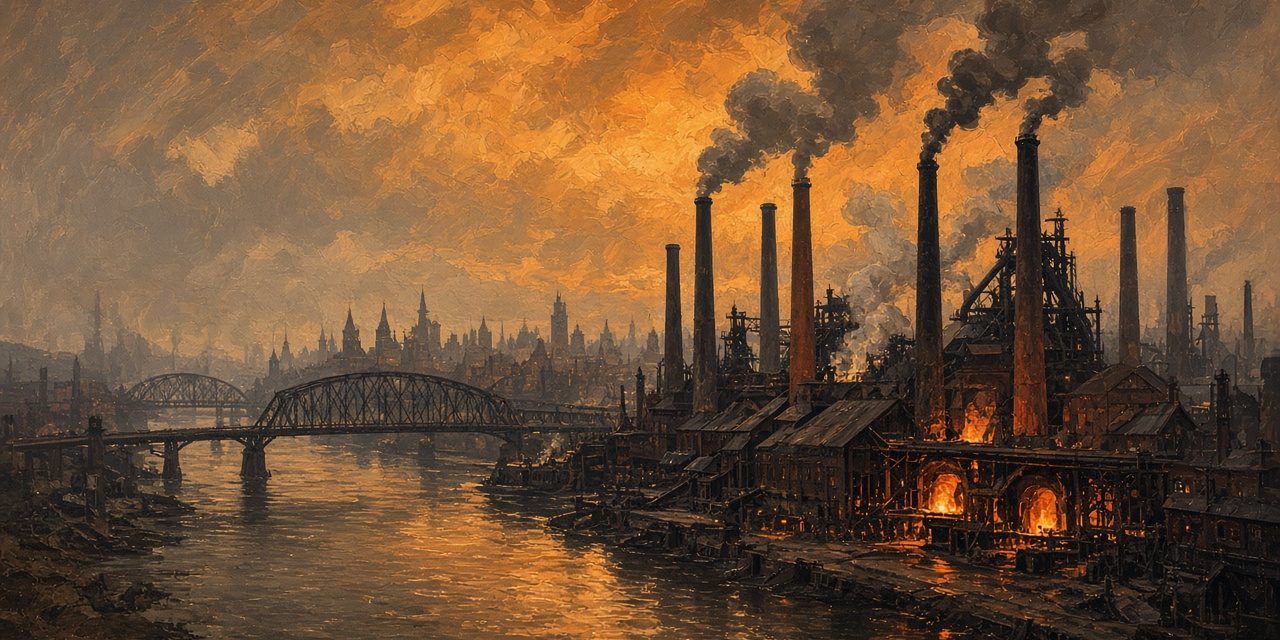
The short answer to why Pittsburgh is called the Steel City is that for much of the late 19th and 20th centuries the Pittsburgh district was the center of the American steel industry, and the city took up the name as a boast. The longer answer is more interesting. Pittsburgh was the Iron City and the Smoky City for decades before anyone called it the Steel City, the earliest known printed uses date from the 1890s, and it outlived the industry that earned it. Here is what the record shows about where the Steel City nickname came from, who were among the first to use it, and whether it still fits.
First it was the Iron City
Iron came first. Bob Regan, writing in Pittsburgh City Paper, dates the city’s iron industry to George Anschutz’s blast furnace of 1793, in what is now Shadyside, which failed after about a year. By the early 1800s iron makers and manufacturers dominated the town, and Regan says Pittsburgh was being called the “Birmingham of America” by 1815, after England’s great iron town.
The Iron City name is documented by the 1840s. Barry Popik, a contributor to the Oxford English Dictionary who collects early uses of American nicknames, says the Dictionary of Americanisms dates “Iron City” to 1853 and “Smoky City” to 1850. His own findings push “Iron City” earlier. A Pittsburgh weekly called The Iron City and Pittsburgh Weekly Chronicle began publishing on November 27, 1841, according to its library catalog record, and in 1846 a Massachusetts paper, the Pittsfield Sun, called Pittsburgh “emphatically the Iron city of the Western World.” The name stuck long enough to end up on a beer label, a story told in the SteelCityHistory history of Iron City Beer.
And the Smoky City
In the 19th-century lists of city nicknames that Popik collected, the name Pittsburgh gets is not usually Steel City. Lists printed in 1881, 1883 and 1884 in Michigan, Maryland and Montana papers give Pittsburgh as “the Smoky City.” An 1889 Boston Globe list gives “Iron City; Smoky City; Birmingham of America,” and an 1894 Lowell, Massachusetts, list gives just “Iron City.” As late as the mid-1890s, then, the nickname a reader elsewhere in the country would have known was not about steel at all. The smoke had its own long history, which is covered in the story of how Pittsburgh cleared its air.
How iron became steel
The industry changed first, and the name followed. Anne Madarasz of the Heinz History Center told The Pitt News that Pittsburgh’s reputation as the Steel City began in 1872, when Andrew Carnegie returned from Europe after learning the Bessemer process, and Regan writes that “within thirty years, the City of Pittsburgh was producing one-third of the nation’s steel.” The full rise and fall of the mills is told in the SteelCityHistory history of why Pittsburgh’s steel industry collapsed; this article stays with the name.
Who first called Pittsburgh the Steel City?
The earliest example Popik gives is a Boston Globe headline from November 17, 1893, over a story about a Pittsburgh minister: “Plutocrats of Steel City Called to Account.” That is a newspaper using the phrase as shorthand in a headline, which suggests it was already understood. Popik’s summary dates the term to the 1890s generally, and that is as precise as the available evidence allows. Earlier uses may yet turn up in digitized newspapers.
The clearest early statement comes from Carnegie himself. On November 11, 1898, the New York Times ran a front-page story headlined “Pittsburg the Steel City,” on a speech he gave at the Pittsburg Chamber of Commerce’s annual banquet the night before. Even in that story, the reporter calls the crowd the leading manufacturers, bankers and merchants “of the Iron City,” so the two names were in use side by side. Carnegie told them that, except for Colorado, “the Pittsburg district has the whole world to-day at its feet. Pittsburg is indeed the steel city.” Regan puts the point at which Pittsburgh became generally known as the Steel City in the early 1900s, and by 1909 the Washington Post could use “Steel City” in a headline with no explanation.
The 1890s quotations spell the city’s name Pittsburg, without the final “h,” and so does the Times headline; the spelling in this article follows each source.
The name goes national
The nickname got its most famous carrier in 1940. Before that season, Steelers.com says, Art Rooney renamed his football team, which had been the Pirates since 1933, to the Steelers, a name chosen through a contest run with the Pittsburgh Post-Gazette. ESPN, citing the Associated Press, reported that one of those who submitted the name, Joe Santoni, worked in the mills for Pittsburgh Steel; a Clarion newspaper says there were 21 winners in all. The team’s story is in the SteelCityHistory history of the Steelers’ founding.
Is Pittsburgh still the Steel City?
In name, yes; in the sense Carnegie meant in 1898, much less so. The big mills that earned the nickname mostly closed in the 1980s; the Homestead Works, where the 1892 strike was fought, rolled its last steel in May 1986, according to the New York Times. The towns left behind are the subject of the SteelCityHistory piece on Braddock, Homestead and the decline of the Mon Valley.
Steel did not disappear completely. Pitt economist Frank Giarratani told The Pitt News in 2012 that southwestern Pennsylvania still had 15 steel mills employing 15,000 people. The nickname has outlasted the big mills that earned it.