
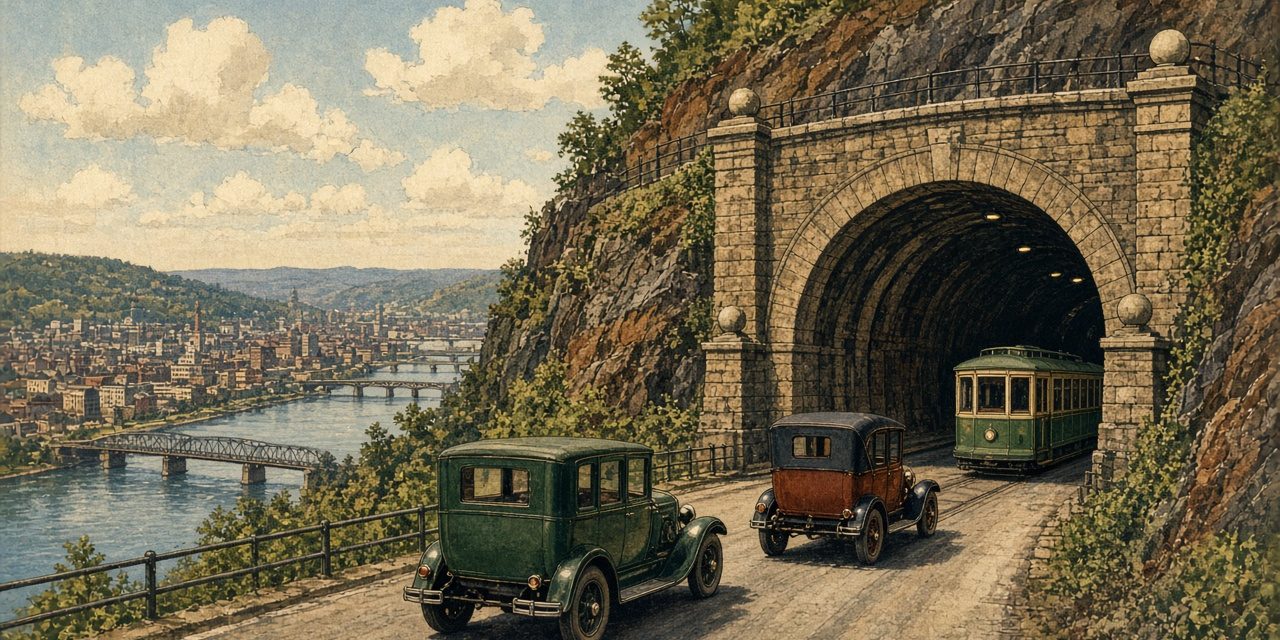
The Liberty Tunnel was built between 1919 and 1922 and opened to traffic on January 30, 1924. Allegheny County broke ground on December 20, 1919, set off the blast that joined the two ends of the outbound tube on May 11, 1922, and then let cars in about twenty months later, before the ventilation system was ready (American Society of Civil Engineers; Brookline Connection; Pittsburgh Quarterly). That last detail matters, because it explains the worst morning in the tunnel’s history.
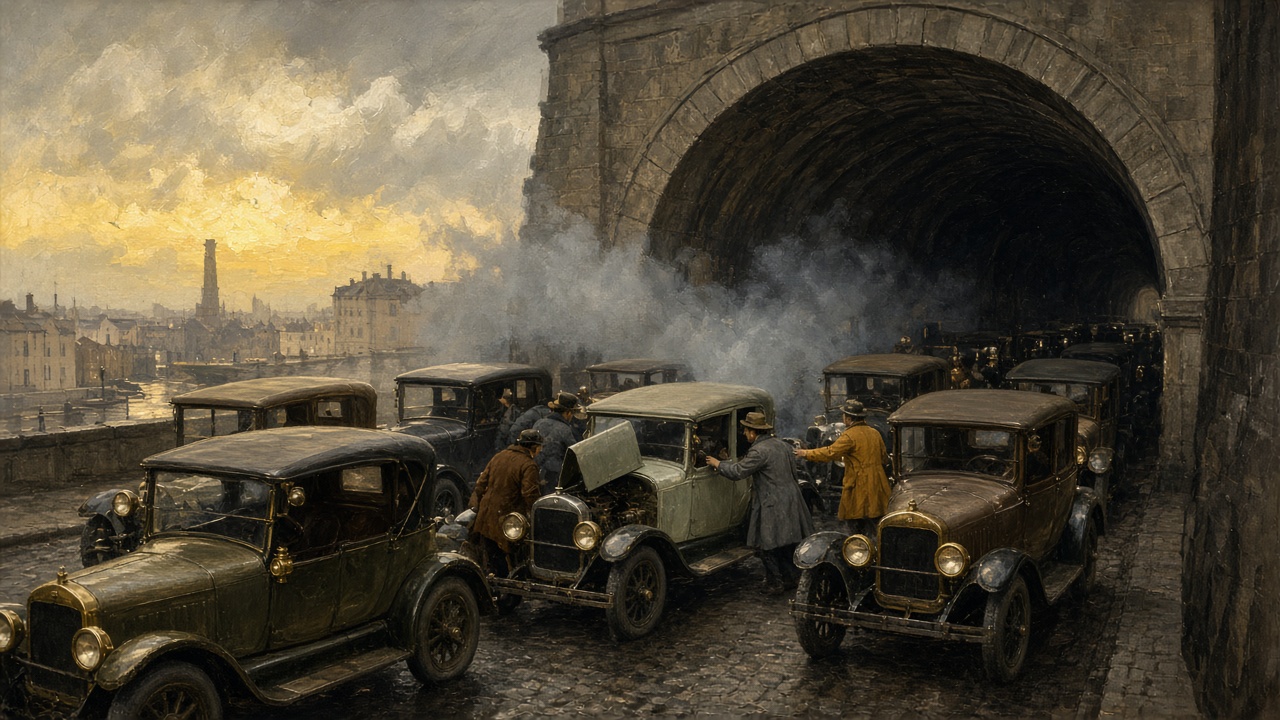
On May 10, 1924, a little over three months after the opening, Pittsburgh’s streetcar workers walked off the job at midnight. By the morning rush, South Hills commuters who normally rode the trolleys were driving instead. Pittsburgh Quarterly reports that a record 649 cars entered the city-bound tube between 7:30 and 8 a.m., and traffic stopped from one end of the tube to the other. Engines idled in a tunnel with no working ventilation system. Drivers began to pass out. Others abandoned their cars and ran for the portals.
The Pittsburgh Press reported that police officers went in with only handkerchiefs over their faces while firemen wore gas masks, and that “more than two score” people were in serious condition. All of them were eventually released (reprinted on the Brookline Connection). Pittsburgh Quarterly counts 33 people hospitalized. Nobody died, according to the accounts I found.
When was the Liberty Tunnel built? A timeline
- 1904: The Mount Washington Transit Tunnel opens for streetcars, which starts the South Hills suburban boom (Pittsburgh Quarterly).
- 1909: The South Hills Board of Trade persuades the county commissioners that a road tunnel would help the region (Brookline Connection).
- May 1919: After years of fighting over six or seven competing routes, the commissioners adopt the “low tunnel” plan (Pittsburgh Quarterly gives May 23).
- December 20, 1919: Groundbreaking, followed by a banquet at the Fort Pitt Hotel.
- April 1920: The first blasting of the bore. (Sources give April 8 and April 9.)
- May 11, 1922: The final blast joins the two halves of the outbound tube.
- September 8, 1923: The public is invited in to walk through the unopened tubes.
- January 30, 1924: The tunnels open to traffic.
- May 10, 1924: The carbon monoxide emergency.
- 1928: The Liberty Bridge opens, connecting the tunnel to downtown. The Library of Congress record says the bridge was completed in 1928 and “links Pittsburgh’s downtown area with the Liberty Tunnels, built through Mt. Washington in 1924.”
A mountain in the way
Mount Washington is about five miles long and rises roughly 400 feet. As Pittsburgh grew in the late nineteenth century, the mountain kept the South Hills sparsely settled, according to the Brookline Connection. Residents had to take one of the inclines, or take the long way around, to get to the city. The 1904 streetcar tunnel changed that, and Pittsburgh Quarterly says the debate over a road tunnel began in 1907 and ran for more than a decade. Supporters included South Hills real estate interests, and they argued that 2,000 wagonloads of goods a day were being hauled up and over the mountain.
The fight was mostly about where the portals should go. Pittsburgh Quarterly says the county commissioners’ final proposal went before a grand jury and then through years of legal challenges. The Brookline Connection adds that the county actually started digging a tunnel in 1915 in a different location, known as the Neeld Tunnel, and that the Pennsylvania Supreme Court ruled against the county’s authority and halted the work. (The two sources use the “Neeld Tunnel” name for different proposals, and I could not reconcile them. Both tie the name to the engineer, Almos D. Neeld.) When the “low tunnel” was finally approved in 1919, both the tunnel and the planned Monongahela River bridge got the name Liberty, with the recent victory in World War I in mind.
Blasting through Mount Washington
The contractor was Booth & Flinn, the same firm that had built the 1904 streetcar tunnel. According to the Pittsburgh Press as reprinted on the Brookline Connection, the December 1919 groundbreaking was informal, and the estimated cost was $4.5 million. Work stopped in late 1920 during a recession and restarted in 1921. Two separate tubes were drilled from both ends at once, in two 12-hour shifts, and crews competed to finish their daily footage first. The winning shift got to fly the American flag over its bore, and the loser flew a black one.
Not everyone on Mount Washington enjoyed the progress. The Pittsburgh Daily Post reported on October 31, 1920, that housewives near the portal were complaining of broken dishes, soggy cakes, and disturbed sleep from the blasting. Pittsburgh Quarterly says the rock that came out of the mountain was dumped in a ravine atop Mount Washington, which created the ground for McKinley Park.
The work drew praise from outside. On April 8, 1922, Clifford M. Holland, the chief engineer of the New York-New Jersey tubes that would become the Holland Tunnel, toured the Pittsburgh bore. The Brookline Connection quotes him calling it “the best rock tunnel I have ever seen.” The final blast came on May 11, 1922, when County Commissioner James Houlahen threw the switch. Pittsburgh Quarterly says the official record shows the two halves lined up within three-eighths of an inch.
The finished project cost $5,994,642.83, according to the Brookline Connection. Pittsburgh Quarterly says adding the ventilation system pushed the estimate from $4.8 million to just over $6 million, and that the dig took 388 working days, averaged 200 men a day, and moved between 300,000 and 400,000 cubic yards of rock with no serious accidents.
Opening a tunnel before its lungs were ready
Ventilation was the hard problem. Nobody knew how much carbon monoxide gasoline engines produced or how much a person could safely breathe in an enclosed space. The U.S. Bureau of Mines, whose research lab was in Pittsburgh, worked on it, and the engineers designing the tunnel collaborated with it. The result is why the American Society of Civil Engineers has recognized the Liberty Tunnels Ventilation System as a historic civil engineering landmark. Its research informed later tunnels, including New York’s Holland Tunnel, the Detroit-Windsor Tunnel, and Boston’s Sumner Tunnel.
The design is clever. According to ASCE, fresh air is pulled in at each portal, and traffic itself pushes air toward the exit. At the middle of each tube, vertical shafts about 200 feet high draw off the polluted air to a fan house on Mount Washington, where it is released through a tower, and fans push fresh air back down into the exit half. Wind breaks at the portals keep outside gusts from disrupting the flow.
The shafts took longer than planned. According to the Brookline Connection, work stopped in April 1923 when crews hit undocumented mine workings about 150 feet down. By January 1924, with the shafts unfinished, the county gave in to public pressure to open anyway. The Brookline Connection says the Pittsburgh Press reported on January 13 that Bureau of Mines official A. C. Fieldner had run a test with up to 200 cars and canaries in cages, and he warned that it would not be safe to open the tubes without forced ventilation. The county opened them on January 30. The public clamor was loud, and even Holland said he was shocked at the delay.
After the May 10 emergency, police limited traffic. Pittsburgh Quarterly says the tunnel reopened that afternoon with a limit of six vehicles entering per minute until the system was complete. Disputed: The sources do not agree on when the ventilation was fully working. Pittsburgh Quarterly says it became operational on September 1, 1925. The Brookline Connection says the shafts were operating by August and the restrictions ended on September 1, 1924, though its own captions elsewhere date the fan house to 1925. Architectural historian Walter Kidney, quoted on pghbridges.org, dates the mechanical plant to 1928. I could not find a primary document that settles it.
The tunnel that filled the South Hills
The Liberty Tunnel changed where Pittsburghers lived. The Library of Congress’s engineering record for the Liberty Bridge says the opening of the tunnels and the bridge “were instrumental in the development of Pittsburgh’s South Hills suburbs.” The Brookline Connection, drawing on newspaper reporting, says the populations of Brookline, Dormont, and Beechview more than doubled and Mount Lebanon grew by 500 percent, and that assessed property values in Dormont rose from about $4.27 million in 1915 to about $17.24 million in 1935. Those figures come from a secondary source relying on newspapers, so treat them as indicative.
The tunnel was overwhelmed almost at once. By 1932, pghbridges.org reports, it carried about 25,000 vehicles a day, over its design capacity. Horse-drawn wagons were allowed inside for years, though sources differ on when that ended: Pittsburgh Quarterly says 1932, the Brookline Connection says 1933, and PennDOT’s tunnel maintenance manager told 90.5 WESA the horses were outlawed in the early 1940s.
One smaller change came in 1939. The Brookline Connection reports that temporary antennas strung down the air shafts brought AM radio into the tubes, an effect radio engineers had considered impossible because of all the steel. KDKA’s engineers helped, according to that account. For more on the station, see our history of KDKA.
The South Hills growth probably also pulled downtown stores outward, though that is my reading and not a documented chain of cause. Gimbels opened a South Hills Village branch in 1965, according to a department-store history page. We cover what happened to the downtown store in why Gimbels closed.
Was it the first? Careful with “firsts”
You will see the Liberty Tunnel called the first automobile tunnel. ASCE’s wording is more careful: it was “America’s first twin-bore auto-exclusive tunnel, and one of the first automobile-only tunnels in the country,” and the longest automobile tunnel in America when it opened, at 5,889 feet. Wikipedia, citing a September 1913 Los Angeles Evening Express report, says Los Angeles had an earlier automobile tunnel: the roadway bore of the twin-bore Hill Street Tunnel (the other bore carried rail) opened September 9, 1913, about ten and a half years before. New York’s Holland Tunnel, whose two tubes are 8,558 and 8,371 feet long, took the length record when it opened in 1927. So “first” is safe only with qualifiers.
Pittsburgh’s other road tunnels
Mount Washington and the city’s hills have been tunneled many times, for streetcars, trains, and cars. The road tunnels that followed the Liberty Tunnel are these, with dates from pghbridges.org and 90.5 WESA:
- Armstrong Tunnel (1926-27): About 1,320 feet under the Bluff at Duquesne University, from Second Avenue to Forbes Avenue. Allegheny County built it, with Vernon R. Covell as chief engineer and Stanley L. Roush as architect. It is named for Joseph G. Armstrong, a county commissioner and former mayor. Legend has it that the bend in the middle was a mistake and the engineer was so ashamed that he killed himself. pghbridges.org points out that Covell went on building for years, and the bend more likely reflects geology, property lines, or street alignments.
- Squirrel Hill Tunnel (1953): About 4,225 feet, opened June 5, 1953, after construction that began in the mid-1940s and was delayed by the war. PennDOT’s tunnel manager told WESA that it was designed by Michael Baker and is really three structures: a cut-and-cover section, a bored section, and what PennDOT calls “the catacombs.”
- Fort Pitt Tunnel (1960): About 3,614 feet, opened September 1, 1960, as the last link in the Penn Lincoln Parkway West, after a groundbreaking on April 17, 1957. It is famous for the moment drivers coming from the west emerge into a view of the Golden Triangle.
- Wabash Tunnel: Built in the early 1900s as a railroad tunnel under Mount Washington for the Wabash-Pittsburgh Terminal Railway, about 3,342 feet long. Sources give 1903 or 1904 as its opening. Passenger service ended in 1931, freight stopped after 1946 fires destroyed the downtown terminal, and it reopened as a one-lane high-occupancy roadway on December 27, 2004.
- Stowe Tunnel (1909): About 500 feet in Stowe Township, and, according to WESA, the oldest tunnel owned by PennDOT.
The Fort Pitt Tunnel also gave the Liberty Tunnel a break. The Brookline Connection says traffic through the Liberty Tunnel dropped by 31 percent, from 58,000 to 37,500 vehicles a day, when the Fort Pitt Tunnel opened, though the relief was temporary.
What’s left of the Liberty Tunnel
All of it, more or less. The tubes are still the main road between downtown and the South Hills. Pittsburgh Quarterly reported in 2016 that they carry more than 63,000 vehicles a day, and says the original fan rotors are still doing their job. The sidewalk that tunnel-walkers once used came out in the 1975-77 renovation, according to the Brookline Connection. The portals were rebuilt in 2008-14 with decorative panels meant to resemble the original look, and a $30 million rehabilitation finished in December 2018, per the same source.
If you drive through the Liberty Tunnel and look up as you leave, you can see sky through the baffle chamber over the portal, as Pittsburgh Quarterly notes, just as drivers did in 1924. Most days it is just a commute. On one May morning in 1924, with a streetcar strike and a ventilation system that was not ready, it was a tunnel full of people trying to get out.
Related reading on Steel City History: Pittsburgh Inclines History and KDKA Radio History.