
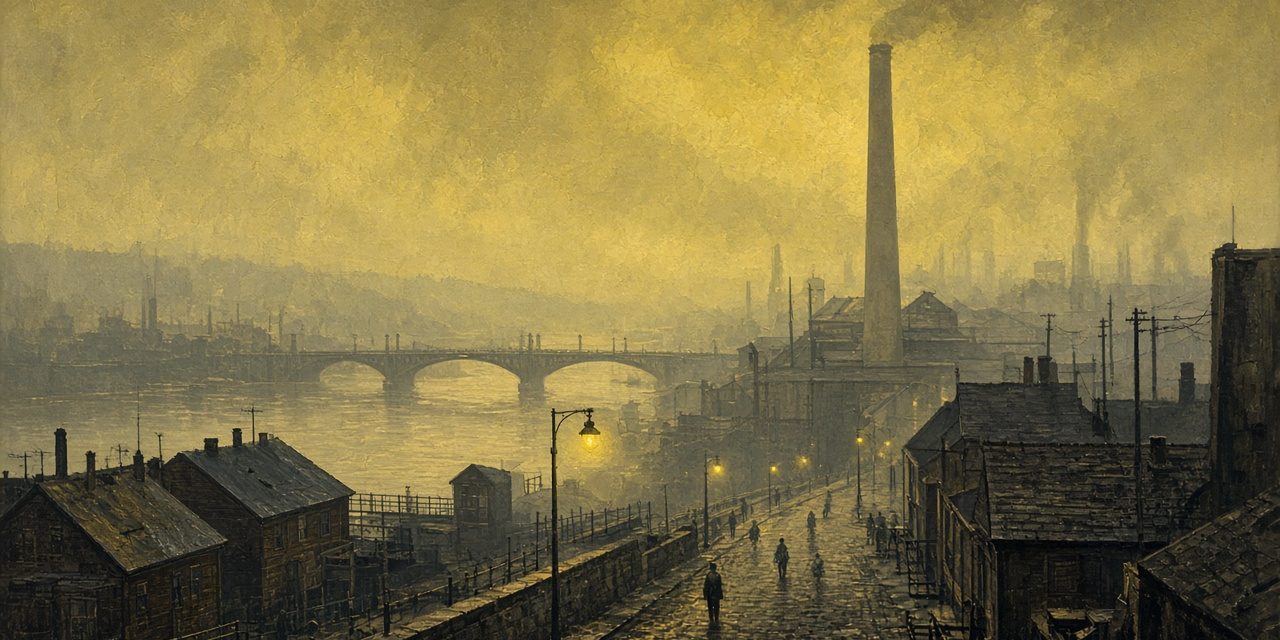
On the morning of Saturday, October 30, 1948, Alice Uhriniak, a 21-year-old telephone operator, walked to work at the Bell switchboard office at McKean Avenue and Sixth Street in Donora, Pennsylvania. The walk took her longer than usual. The air was thick and yellow-gray, and she could barely see the sidewalk. When she got inside, the switchboard was lit up and her supervisor was shouting, “Hurry up, hurry up! Get your set on! Everyone in town is dying!” That is the scene as the Donora Smog Museum’s account reaches us through a 2023 Pennsylvania Heritage article. By then, according to the same article, the first deaths had come before dawn.
What follows is the story of those days, of the town that lived beside the smoke, and of an argument that has never really ended. The number of people who died is documented. Who was responsible is not settled, and I’ll mark where each claim comes from.
A town built beside its own smoke
Donora sits on a horseshoe bend of the Monongahela River, about 25 miles south of Pittsburgh in Washington County, with hills rising at least 400 feet behind it. It was a product of the steel boom, founded around 1900. The museum’s account, told in Pennsylvania Heritage by museum co-founder Brian Charlton, is that the name combines Donner, for the industrialist William Donner, and Nora, for a Mellon bride, whom that account identifies as the wife of banker Andrew Mellon. The Pennsylvania Historical and Museum Commission’s page instead says “Nora Mellon, wife of R. B. Mellon,” so sources conflict on which Mellon. That is a local tradition and I did not find a document confirming it.
Along nearly three miles of riverbank stood the American Steel & Wire plant, a U.S. Steel subsidiary: blast furnaces, open hearths, rod and nail mills. Near it was the Donora Zinc Works, which opened in 1915 according to a 2018 public-health analysis of lake sediment cores. People who lived there knew what the works did to the land. Pennsylvania Heritage reports that vegetation in town and across the river in Webster died and stayed dead until the mills closed. Charlton says zinc workers talked about the “zinc shakes,” a fever and chill from breathing metal fumes. A 2011 student paper that cites oral histories describes four-hour shifts paid as a full day.
This was also a place where smoke meant pay. A 2018 article in the American Journal of Public Health says that in towns like Donora, smoke in the air “was often considered to be a sign of progress and prosperity.” It also says there had been an earlier warning. In December 1930, a fog trapped industrial emissions in Belgium’s Meuse Valley, and more than 60 people died. Medical journals warned that it could happen elsewhere. This was, in the words of that article, “roundly ignored.”
Five days in October
The weather turned on Tuesday, October 26, according to Pennsylvania Heritage: a clear sky, light winds, and a temperature inversion that put a lid of warm air over the cold air in the valley. The Public Health Service later dated the episode as October 27 to 31. Sources differ by a day on the start, which is why you will see both dates.
For a while, the fog was mostly a nuisance in a smoky town. By Wednesday, Pennsylvania Heritage says, streetlights stayed on all day. Mary Holowach, a steel weigher, walked to work on Friday and heard a co-worker’s heels but could not see her. “I know that’s you Margaret, but I can’t see you. Isn’t this terrible?” she said. Halloween parade and football accounts differ in details, and witnesses interviewed by the museum disagree about whether the Saturday afternoon game could be seen. The 2018 AJPH article says the Halloween parade went ahead on Friday the 29th and the high school football game on Saturday despite poor visibility. It shows how ordinary the haze seemed.
Then people began to die. Pennsylvania Heritage says the first victims died from about 1:30 a.m. on Saturday, and the AJPH article says the first death was at about 2 a.m. By noon, it says, most of the first 17 were dead. Doctors’ phones rang constantly. Donora had no hospital. According to Pennsylvania Heritage, victims were taken to a triage center in the basement of the old Donora Hotel, then the community center, at McKean Avenue and Seventh Street. The Red Cross, according to a widely repeated account, set up central switching of calls to an emergency center in the town hall on Saturday.
The fire department’s accounts are the most vivid. Volunteer firemen, among them Bill Schempp and Jim Glaros, went house to house on foot, carrying oxygen tanks, because the truck couldn’t get through. The museum told Pennsylvania Heritage what hit them hardest: families begged them not to leave once the patient was breathing again. The AJPH article says an emergency vehicle had to follow a man walking ahead with a flashlight. Fire chief John Volk and his assistant Russell Davis are credited, in accounts repeated on Wikipedia, with running out of oxygen and borrowing it from McKeesport, Monessen and Charleroi. I did not trace that account to its original.
The smog ended with rain. Pennsylvania Heritage and a 2011 student paper citing contemporary papers say it lifted on Monday, November 1. Other accounts, including Wikipedia’s, say Sunday, October 31. Both agree on the outline: the plants were told by town officials to cut operations on Sunday, and the rain came after that.
How many died?
This is the part that can be pinned down, with caveats. The Public Health Service preliminary report, issued in 1949 as a Public Health Bulletin, counted 20 deaths during the episode, aged 52 to 84. Sixteen of them had existing cardiorespiratory disease. The agency surveyed households and counted 5,910 people who were affected, which it put at 42.7 percent of the area’s residents: 2,148 mildly, 2,322 moderately and 1,440 severely. Older people were hit hardest; more than 60 percent of those 65 and over were affected.
Other numbers appear, and they are not errors so much as snapshots. A resident, coal miner Walter Gilmore, wrote in his diary on Saturday that “about 18 persons have died.” A 1948 industry-journal summary of an official report, in Chemical & Engineering News, gave 17 in Donora and 3 in Webster. Pennsylvania Heritage says 16 of the dead lived in Donora, 3 in Webster and 2 in nearby towns, which adds up to 21, so I would not rely on that breakdown. The 2011 student paper lists contemporary headlines that went from 17 to 19 to 20 within days.
The bigger dispute is about the later deaths. Wikipedia and Pennsylvania Heritage say about 50 more people died in the weeks after. A 2011 student paper says “dozens.” I could not find a primary source that establishes the figure, and the Public Health Service’s number was 20. Treat “50 more” as a claim, not a finding. A related story, that Stan Musial’s father died of smog-related illness, is repeated locally, but a genealogy listing I found puts his death on December 19, 1948, in St. Louis, so I did not use it, though I could not confirm the date either way.
Some of the long-term data is stronger. A 1961 follow-up by University of Pittsburgh researchers Antonio Ciocco and Donovan Thompson found more cardiovascular deaths than expected over the next decade among people who had reported heart or respiratory disease in 1948: 70 observed against 39 expected, according to the 2018 AJPH reanalysis. That article’s own comparison of cancer deaths in Donora and nearby Arsenal is the authors’ calculation from the 1961 data, not part of the original study, and I would treat it carefully.
What the 1949 investigation concluded, and what it did not
The Public Health Service sent about 25 investigators under chemist H. H. Schrenk. They ran a household canvass, interviewed hundreds of residents, reviewed autopsies and sampled air. A town committee, the steelworkers’ union, the state, and the company itself all asked for the federal inquiry, according to the AJPH article.
The preliminary report concluded that no single substance caused the illness. The air held sulfur dioxide, particulates and carbon monoxide. The authors wrote that the illnesses “could have been caused by a combination” of sulfur dioxide, its oxidation products and particles. Contaminant levels tracked how stable the air was. The Public Health Service did not name the zinc works as the cause. It did not say the weather alone was to blame. It recommended weather-based warnings and cutting plant emissions. A final report was never published, according to the AJPH article. A 2011 student paper says funding was cut.
It did not settle the fluorine question. Within weeks, the chemist Philip Sadtler, writing in Chemical & Engineering News on December 13, 1948, reported “circumstantial and actual proof” of acute fluorine poisoning from the smog. In 1950 the University of Cincinnati’s Clarence Mills criticized the federal study in Science, as the student paper puts it, for what it left out, and the AJPH article notes he warned of long-term effects. Dr. Devra Davis, an epidemiologist who grew up in Donora, argues that victims’ autopsies showed fluorine in lethal ranges. That is the view of some researchers, and it is how some local accounts tell it. The Public Health Service’s own bulletin said the contaminants could not be pinned to one cause, so the fluorine explanation is a theory with real support and no official finding.
Who was responsible
The company never accepted blame. Zinc Works superintendent Mercer Neal said, according to Pennsylvania Heritage, “We do not believe our smoke and fumes are harmful.” When it settled the suits in 1951, the company said it was ready to show at trial that a “freak weather condition” had trapped all the smoke from “homes, railroads, steamboats” and cars as well as its plants, as quoted in an account of the settlement. Local physician William Rongaus said in Life in November 1948, as Pennsylvania Heritage tells it, that he called it “murder.” Another point cuts the other way: a 2011 student paper cites a November 1, 1948, Pittsburgh Press piece arguing that Pittsburgh, which by then had smoke control, came through the same fog without deaths. I did not read that article myself, and Pittsburgh is not Donora, which had a bowl-shaped valley and mills on the riverbank.
The question of who was responsible, in law, was never tried. About 130 damage suits sought roughly $4.64 million. A New York Times headline of April 18, 1951 says the company paid $235,000 to settle them. Charlton says that because they were settled out of court, no executive was ever questioned on the stand. Pennsylvania Heritage says the zinc works closed in 1957 because a new smelting process made its method obsolete, and “by 1966, everything is gone.” For readers in Pittsburgh, the collapse of the steel industry is the larger frame for what happened to the town after the mills left.
Legacy: what Donora did and did not change
For the Pittsburgh side of the story, see our piece on the smoky-city era and the 1940s smoke-control ordinance.
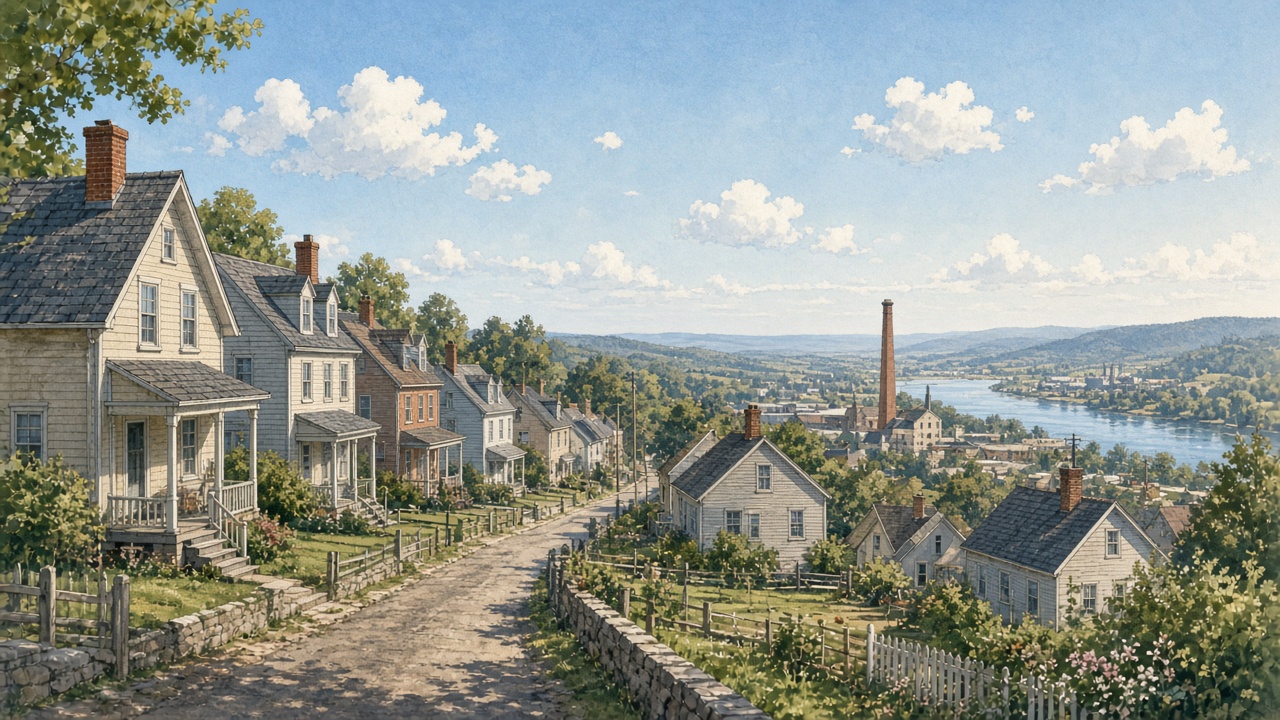
Donora is often said to have “started” American clean-air law. The record is more modest. In December 1949 President Truman called a national air pollution conference, held in Washington in May 1950, according to Pennsylvania Heritage. Congress passed the Air Pollution Control Act in 1955, which, per the EPA’s account, funded research. The Clean Air Act of 1963 was the first federal law on air pollution control: it set up a federal program in the Public Health Service and a conference procedure for interstate pollution, with enforcement left mainly to the states. The more powerful system came later, with the 1970 amendments, which created national air quality standards and went along with the creation of the EPA. A 2011 student paper argues that industry lobbying delayed stronger action for years. Donora was one of several pushes. The 1952 London smog, which killed thousands, did a great deal as well.
In Donora itself, little was said for years. The state historical marker went up in 1995, according to Pennsylvania Heritage, though other accounts say 1998. The Donora Smog Museum opened on October 20, 2008, in a former storefront at 595 McKean Avenue, close to where emergency crews worked. Its motto is “Clean Air Started Here.” Brian Charlton and Mark Pawelec run it, and the museum holds oral histories and the collection of glass-plate negatives made by the mill’s quality-control engineer, Bruce Dreisbach. In 2008, fewer than 6,000 people lived in the town. The 2018 AJPH article says lake sediment about six miles away still carries cadmium and lead from the zinc era above recommended levels.
Donora’s story belongs to a larger one about the river towns upstream and down. See the Monongahela River towns and the forgotten steel towns. If you plan to visit the museum, check its current hours first.
The smog lasted about five days. The questions it left behind are still being asked: how much a town owes the people who live in its smoke, how long a cause can stay “unproven,” and who pays when a place’s pay depends on what is hurting it. What is documented is that thousands of people in a town of about 14,000 fell ill over a few days in 1948, and that at least 20 died.