
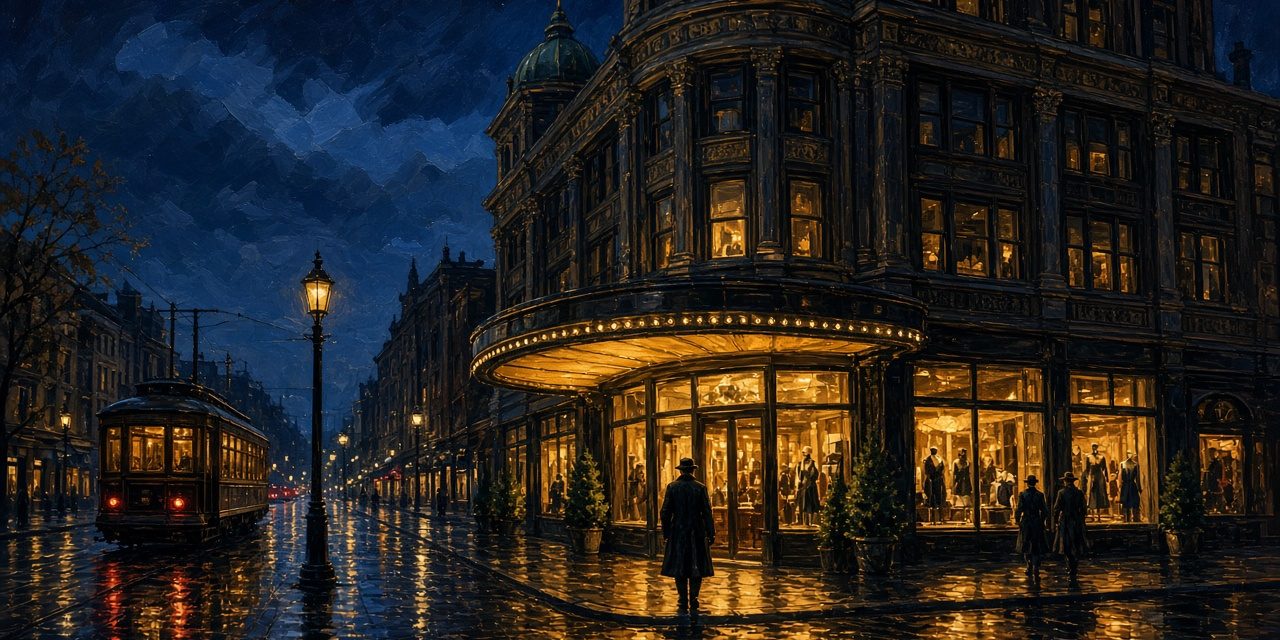
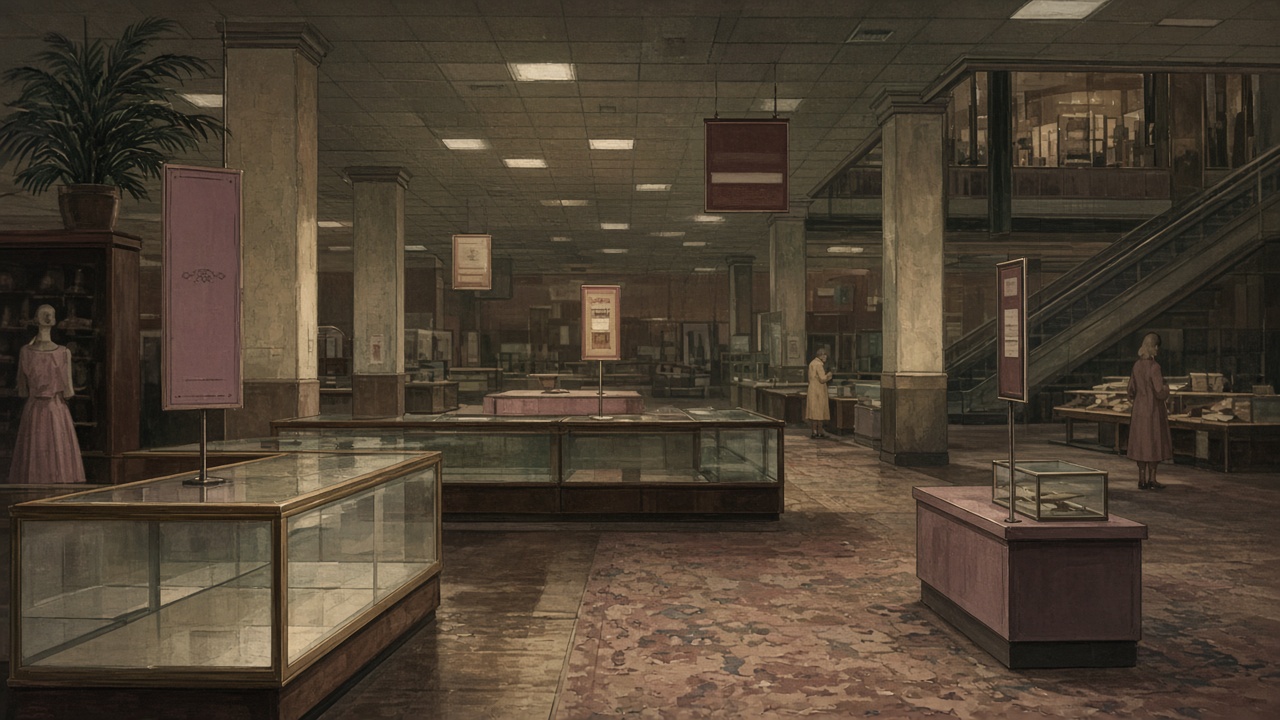
By the last day of Gimbels Pittsburgh, most of the floors in the big terra-cotta store at Sixth Avenue and Smithfield Street were dark and empty. Liquidators were running what was left. Michael Lisicky, in his history of the chain, quotes an employee who told the Pittsburgh Post-Gazette that the last announcement, “the store is now closed,” was “probably going to be very traumatic” (Lisicky, Gimbels Has It!, The History Press, 2011, citing the Post-Gazette of Sept. 12, 1986). The doors shut for good on Saturday, September 13, 1986.
The building had stood on that corner since 1914. For decades it was one of the three big names of downtown Pittsburgh shopping, along with Kaufmann’s and Horne’s, as a 1992 UPI story put it. And at least some of the people who worked there said they never saw the end coming. This is the story of why it closed, and the answer has as much to do with a corporate decision made in another state as with Pittsburgh shoppers.
A store that started as a family split
Gimbels was not founded in Pittsburgh. The building began as Kaufmann & Baer Co., a rival to the Kaufmann’s store a short walk away on the same street. According to the Post-Gazette’s history of the Kaufmann family and Pittsburgh Magazine, the break came in 1913, when Edgar J. Kaufmann took control of the original Kaufmann’s. Morris Baer and several Kaufmann cousins, who had not been offered an ownership stake, left and built their own department store. Pittsburgh Magazine says the new store’s ads had to say “no connection with any other store” because the names were so close (Pittsburgh Magazine).
They hired New York architects Starrett & van Vleck, who specialized in flagship department stores. The building opened in 1914, and Pittsburgh Magazine says it had what it calls the city’s first escalators (I found no second source for that) and an 18-foot fountain made of colored pottery. The Pittsburgh Post gushed that “unless some unheard of and radical improvement in store building and store furnishing is hereafter developed,” it would “probably be as fine a store as ever will be built.”
In December 1925 the New York-based Gimbel Brothers bought Kaufmann & Baer. The New York Times reported the purchase on December 3, 1925, noting that the store’s 1924 sales were declared to be more than $16 million. The name changed to Gimbels on January 3, 1928, according to Lisicky as cited by Wikipedia. The deal also brought a radio station that operated from the store, WCAE, which began broadcasting in 1922, in the same early years of radio that gave Pittsburgh KDKA.
What made Gimbels Pittsburgh different
Gimbels was never Kaufmann’s. Lisicky quotes former employee Kay Cushing Neuhausen saying that Gimbels was not as high-end as its rivals in ready-to-wear but had a style of its own, and former employee Kathy Weber calling the downtown store “a mini city within the store,” a place where “you never really needed to leave it.” It had a post office, an optical department, a restaurant, a bakery, a beauty salon, and a budget store, according to Lisicky. Pittsburgh Magazine remembers the bargain basement and a chocolate-and-pecan candy called Annaclairs.
For almost three decades the store also housed a more upscale tenant. The New York Times reported in 1949 that Saks Fifth Avenue would open its seventh branch inside the Pittsburgh Gimbels. Saks stayed on the sixth floor until August 1977, when it moved to its own building on Smithfield Street, per the Post-Gazette as cited on Wikipedia.
Following the customers to the malls
After World War II, Gimbels did what Kaufmann’s and Horne’s did and followed its customers out of town. A Department Store Museum page gives these branch dates: North Hills Village (1950s), Eastland in East McKeesport (1963), South Hills Village (1965), Monroeville Mall (1969), Beaver Valley Mall (1970), and Century III in West Mifflin (1979). I would treat the early dates loosely, since commenters on that page dispute the North Hills year.
The suburban stores did better than the downtown one. By 1986, according to Lisicky, the downtown and Eastland stores were bringing in only $43 in sales per square foot, against a national average of about $100. South Hills did $137 and Monroeville $124. Downtown had the most floor space and the weakest sales. I could read Lisicky’s book only in excerpts, so every figure and quotation attributed to him in this article is secondhand and unchecked against the book.
The reasons Gimbels Pittsburgh closed
No single cause closed the store, and I would be suspicious of any account that gives you only one. The sources I found point to four things that piled up.
1. A parent company that did not want to fix it. In 1973, according to Pittsburgh Magazine, Brown & Williamson, a British-owned tobacco conglomerate, bought the Gimbels chain. (Some sources say 1974.) Lisicky writes that Saks Fifth Avenue was the attractive part of the deal, while the Gimbels department stores were in a three-year sales slump and were deemed “troubled and mismanaged.” Brown & Williamson’s retail holding company, BATUS, kept the chain for another 13 years. In 1986 it put Gimbels up for sale, and a BATUS executive said in a statement quoted by Lisicky that a number of its retail businesses were “not positioned in keeping with our long-term objectives.” Very few buyers wanted the stores as stores. According to Lisicky, Gimbels’ real estate drew attention, and its retail operations did not.
2. Money. According to Lisicky, the Pittsburgh stores lost $2 million in 1985, and the sales-per-square-foot gap above was stark. Lisicky argues Gimbels had failed to position itself in a city that had transformed itself “from a steelworkers’ town to a city of technology leadership.” That is his interpretation, but the mid-1980s were the years Pittsburgh was absorbing the collapse of its mills, which we cover in our piece on why the steel industry collapsed.
3. A labor fight that played out in public. In March 1984, according to Lisicky, 95 Gimbels warehouse employees in Teamsters Local 636 were dismissed when contract talks broke down, and members of another Teamsters local accepted a lower pay scale and replaced them. The dismissed workers picketed the downtown store for about a year and a half. On October 23, 1985, Gimbels ran a full-page ad in the Pittsburgh Press making its case, and the picketing continued through the 1985 Christmas season. I would not call this the cause of the closing, but it was a public black eye in the store’s last years.
4. The shift to the suburbs, and a downtown that was changing. Pittsburgh Magazine says the downtown Gimbels “struggled against bigger rivals and suburban malls.” Belt Magazine‘s history of downtown retail notes that Frank & Seder closed its downtown store in 1958 and Rosenbaum’s in 1960, so the five-department-store downtown of the postwar years was already shrinking (Belt Magazine).
Put together, the Pittsburgh Gimbels was weak, and it belonged to an owner that was not going to invest to change that. Lisicky quotes Weber saying that until the closing was announced, “the mood was one of an uphill battle that we thought we were winning.”
May 1986: the day the name ended
The first public sign came on May 16, 1986, when BATUS announced it was selling three of the Pittsburgh stores to the May Department Stores Company, the parent of Kaufmann’s. The New York Times reported that the stores, at South Hills Mall, Monroeville Mall, and Beaver Valley Mall, would be converted to the new owner’s name and merchandise, and that May might later also buy the downtown Gimbels on Mellon Square. Lisicky says Pittsburgh chairman Daniel H. Levy broke into tears when he told employees. A month later, the Times counted four Pittsburgh stores sold to May.
The Gimbels name on those stores did not last long. Mall-history pages give August 23, 1986, as the closing date at South Hills Village and Monroeville, and August 13, 1987, as the reopening as Kaufmann’s after renovation. I found those dates only on mall-history sites, so treat them as commonly cited. Belt Magazine confirms that the Monroeville and South Hills stores became Kaufmann’s.
Many Pittsburghers were not in mourning that summer. Lisicky writes that in June 1986 many seemed more excited about the liquidation sale than about losing a retail tradition, and quotes furniture salesman Thomas Robinson, 25 years at the store: “I went to confession and the priest asked me, ‘When’s the big sale?'”
Six years of nothing, then a Heinz headquarters
The downtown building did not become anything quickly. A UPI story from November 1992 said the vacant store was about to be sold by the May Company to New York investor Richard Penzer. It quoted Golden Triangle Association director Jacques Kahn calling the empty building “a sore spot” and saying Gimbels “was a magnet for that corner of town” (UPI). So the old rival’s building had ended up with Kaufmann’s own parent company, and sat closed for six years.
Burlington Coat Factory moved into the old bargain basement, according to Pittsburgh Magazine, and Barnes & Noble took space on the lower levels, per SBN’s 2002 account. The upper floors stayed mostly empty for years. In 2001, H.J. Heinz leased much of the building for its North American headquarters, and the building became the Heinz 57 Center. The renovation cut a large skylit atrium through the middle. The Pittsburgh History & Landmarks Foundation designated the building a landmark in 1982, according to its plaque list as cited on Wikipedia.
What’s left of Gimbels Pittsburgh
You can still see it. In the sources I found, the terra-cotta building still stands at Sixth and Smithfield, a short walk along Smithfield Street from the Kaufmann’s clock. Pittsburgh Magazine notes that the marble elevator lobby is one of the few original interior features left, and that a garden still grows on the roof. The Gimbels name does not appear on the building.
The closing was not a story of Pittsburgh turning its back on downtown. A store that had come through the Depression and two world wars was ended by a corporate decision made in Louisville, where BATUS was based, and by a division that was losing money. The people on the sales floor, by their own account, thought it was a fight they were winning.
Related reading on Steel City History: KDKA Radio History and Why Did Pittsburgh’s Steel Industry Collapse?