
Introduction
Ohiopyle history begins in a small borough in Fayette County, Pennsylvania, southeast of Pittsburgh, where nature and the past intertwine. This guide traces the town’s journey from its Native American origins through George Washington’s frontier expeditions, the Whiskey Rebellion, the lumber and railroad boom and the resort era to its present status as a popular outdoor destination. The name itself, which comes from a Lenape phrase, describes what visitors still come to see: the frothy white water of the Youghiogheny River.
Native American Roots
Ohiopyle history traces back to the Monongahela culture, a Late Woodland people who lived in western Pennsylvania and neighboring states from about AD 1050 to 1635. They practiced maize agriculture and lived in well-laid-out villages, some with 50 to 100 structures, and left nearly 400 archaeological sites across the region, including along the Youghiogheny. They disappeared in the 1620s or 1630s. Many scholars blame European infectious diseases, while others believe warfare with or absorption into the Haudenosaunee or the Lenape played a part. (Learn more in our article on prehistoric Pittsburgh, from Meadowcroft to Monongahela.) Shawnee, Lenape and Seneca people later hunted here, until they were pushed out after the French and Indian War. The name “Ohiopyle” is derived from the Lenape phrase ahi opihəle, meaning “it turns very white,” a reference to the frothy waterfalls that still captivate visitors.
European Exploration and Conflict
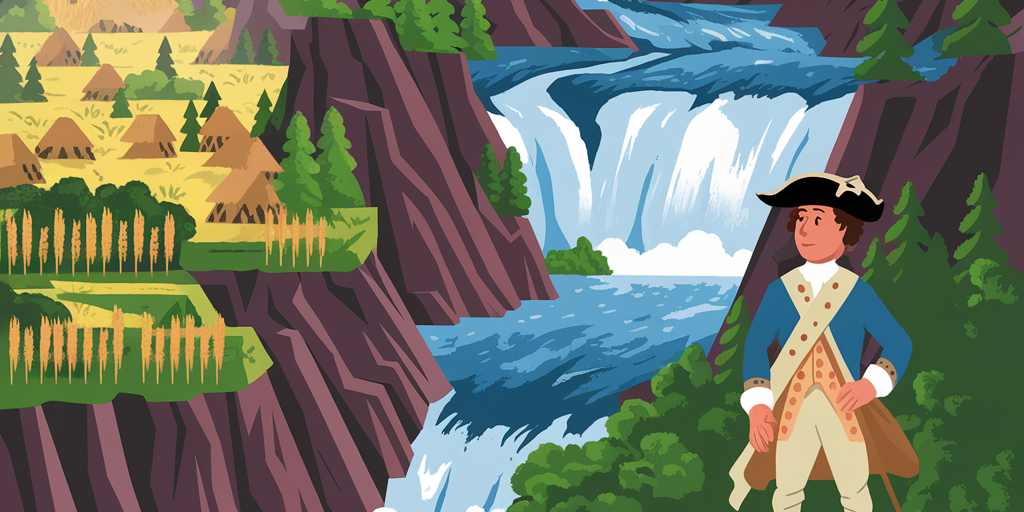
In 1753 a 21-year-old George Washington, employed by the British colonial government of Virginia, traveled through the Ohiopyle area on his mission to deliver a warning to the French. A year later, in 1754, he returned with about 150 soldiers to challenge the French. He reached Confluence and tried to find an easier route by river, exploring the Youghiogheny by canoe and on foot, but ran into Ohiopyle Falls. His journal reported rough, rocky water ending in a nearly 40-foot fall (the falls are about 20 feet high today), and he concluded the river could not be used to reach the Ohio. He went back overland to Great Meadows and built Fort Necessity, just southwest of today’s park. There, French and Native American forces overwhelmed him in July 1754, the only military surrender of his career. The clashes at Jumonville Glen and Fort Necessity are considered the opening shots of the French and Indian War. (For what happened at the Forks of the Ohio, see our timeline of Pittsburgh’s history and the Fort Pitt Block House.) After the war, the French left western Pennsylvania and settlers moved in, and the land was claimed by both Pennsylvania and Virginia until the dispute was settled in 1784.
The Whiskey Rebellion
By 1794, Ohiopyle history intersected with the Whiskey Rebellion, an uprising against a federal tax on whiskey that Congress passed in 1791. Farmers in western Pennsylvania attacked tax collectors, and when a federal marshal was attacked, President George Washington sent militia to put down the revolt. The Pennsylvania Department of Conservation and Natural Resources says the force marched along the old Braddock Road near Ohiopyle; other accounts put the total militia at about 13,000 men. No major battles occurred, but the show of force established that the federal government would enforce the law.
19th Century Growth
Ohiopyle’s first settlers were farmers, trappers and hunters, and the National Road, which passed near Ohiopyle beginning in 1811, connected the area to eastern markets. Lumbering became the dominant industry, along with cooperages, tanneries, salt mining and coal mining. Railroads reached Ohiopyle in 1871. The Baltimore and Ohio Railroad and later the Western Maryland Railroad had stations in the borough, and narrow-gauge lines climbed the surrounding mountains to bring timber down to sawmills near the falls. (See also our history of Pittsburgh’s railroads and the region’s coal boom.)
Then came the tourists. A round-trip ticket from Pittsburgh to Ohiopyle cost one dollar, and by the 1880s there were numerous hotels. The Ferncliff Peninsula had a boardwalk, a dance pavilion, a bowling alley, walking paths, tennis courts, ball fields, fountains and the Ferncliff Hotel. The automobile eventually ended the train-borne resort trade, and the buildings were removed and the forests allowed to regrow. Foundations can still be seen on the Ferncliff Peninsula.
20th Century and Today
The Western Pennsylvania Conservancy bought much of the land in the mid-1960s and sold it to the Commonwealth. Ohiopyle State Park opened in 1965 and was dedicated in 1971. It covers about 20,500 acres around more than 14 miles of the Youghiogheny River gorge. In 1963 Wilderness Voyageurs began the first commercial whitewater rafting east of the Mississippi River on the Youghiogheny; about 400 people rafted the Lower Yough that year, and more than 100,000 people were rafting, kayaking or canoeing it by 2007. The Youghiogheny is regarded as the busiest section of whitewater east of the Mississippi.
The park has more than 100 miles of trails and several waterfalls, including 36-foot Cucumber Falls. The 100-acre Ferncliff Peninsula, whose warm gorge microclimate supports unusual plants, was declared a National Natural Landmark in 1973. The Great Allegheny Passage rail-trail runs the length of the park and connects with the C&O Canal towpath to form a continuous trail of more than 300 miles between Pittsburgh and Washington, D.C. The borough, with just 38 residents in 2020, fills with weekend visitors, and it sits near Frank Lloyd Wright’s Fallingwater; see What Is Fallingwater? and the Laurel Highlands Hiking Trail.
Table: Key Milestones in Ohiopyle’s History
| Year | Event |
|---|---|
| AD 1050-1635 | Monongahela culture inhabits the area, practicing maize agriculture. |
| 1753–54 | George Washington passes through the area; in 1754 Ohiopyle Falls blocks his river route. |
| 1794 | Whiskey rebellion occurs, with Washington leading troops nearby. |
| 1811 | National Road constructed, boosting settlement and lumber industry. |
| 1880s | Railroads bring tourists, with hotels and recreational facilities. |
| 1965 | Ohiopyle State Park opens to the public, dedicated in 1971. |
| 2020 | Population recorded at 38, with significant weekend tourism. |
Wrap-Up
Ohiopyle history is a story of rugged beginnings and bold transformations, from Monongahela villages to Washington’s frontier misadventures, from lumber camps to tourist trails. Whether you’re a history fan or an adrenaline junkie, Ohiopyle’s past is as lively as its rapids. Plan a visit and see for yourself.
Key Citations
- Ohiopyle, Pennsylvania – Wikipedia
- About Ohiopyle PA – Ohiopyle Pennsylvania
- History of Ohiopyle State Park – DCNR
- Monongahela culture – Wikipedia
- George Washington Was Here: A Walk Through History in the Laurel Highlands
- Youghiogheny River History – Wilderness Voyageurs
- Whiskey Rebellion – Wikipedia
- George Washington and the Whiskey Rebellion – Mount Vernon
- The Whiskey Rebellion | American Battlefield Trust
- Ohiopyle State Park – Wikipedia
- Ohiopyle – Great Allegheny Passage
- The Pennsylvania Center for the Book – Ohiopyle State Park
- Why do they call it Ohiopyle? The fascinating origin – Ohiopyle Co.
Additional sources for this update: the Pennsylvania DCNR history page for Ohiopyle State Park (the 1753 and 1754 expeditions, the Whiskey Rebellion, railroads and resorts), and the National Park Service handbook on Fort Necessity and Washington’s 1754 journal for the Ohiopyle Falls account.