
On Saturday afternoon, July 20, 1901, well over a thousand steelworkers met in Vandergrift, a town on the Kiskiminetas River about 30 to 40 miles northeast of Pittsburgh, and passed a resolution. A national steel strike was nearly a week old. A Pittsburgh dispatch printed in the next morning’s Morning Oregonian said the workers from the Vandergrift, Leechburg, Apollo and Saltsburg plants of the American Sheet Steel Company had come together. The resolution said they had “received only the fairest treatment” from the company, that their wages were “entirely satisfactory,” and that they asked “to be permitted to work nonunion as we have been doing since 1893.” The same dispatch said that at a hall in McKeesport that same day, the head of the Amalgamated Association of Iron, Steel and Tin Workers was telling strikers to hold out. Vandergrift’s history involves a company that wanted loyal workers, a landscape architecture firm famous for improving cities, and a continuing argument among historians over which of those two things drove the town.
Why a steel company hired a landscape architect
The Vandergrift Pennsylvania history that the borough itself tells begins with the Apollo Iron and Steel Company, whose works were upriver in Apollo. Its head, George McMurtry, needed room to expand. (The National Park Service calls him chairman; the borough calls him president.) The borough’s history page says he was “beset with labor problems,” and that a strike and lockout at the Apollo works, ended by hiring replacement workers from the surrounding countryside, helped drive the decision to build somewhere new. The new location was a farm of about 650 acres on the Kiskiminetas, according to the borough. The workers’ 1901 resolution says the mills had been nonunion since 1893, which fits that account, though I did not find a source that dates the Apollo dispute itself.
According to the National Park Service, McMurtry traveled to Europe to study planned factory villages. He partnered with J. J. Vandergrift, a director of the company, for whom the town was named. His idea, the Park Service says, was that workers would buy their houses rather than rent them. Renting was what George Pullman had done at his company town near Chicago. A scholarly review of the standard book on Vandergrift says McMurtry was “well schooled in the shortcomings” of model towns like Pullman’s that rented housing to workers.
In 1895 McMurtry asked Frederick Law Olmsted to plan the town. Olmsted Sr. had effectively retired, so his son John Charles Olmsted led the design for the firm. In the firm’s job files at the Library of Congress it is job number 204. The borough’s history page ties the phrase “something better than the best” to his request.
What the Olmsted plan looked like
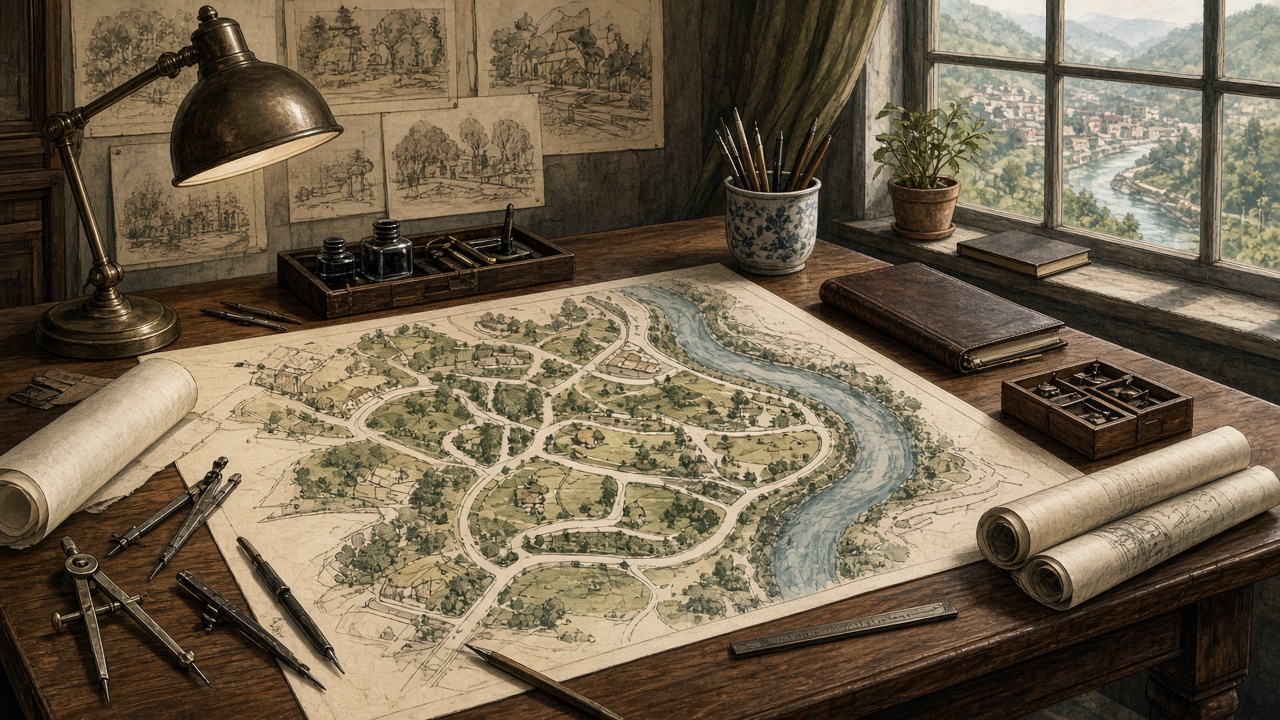
The plan was a break from the usual mill-town layout of houses crowded against the works. According to the National Park Service and the Cultural Landscape Foundation, John Charles Olmsted put the railroad and mill on the flat land by the river and placed the houses and the main business street on higher ground, above the smoke and noise. Streets were wide, paved and drained, the lots were deep single-family lots, and small parks were set along curving streets that followed the hillside. The firm’s July 1897 general plan for the town of Vandergrift is in the New York Public Library’s digital collections, and it is the best way to see the layout for yourself, with its contour lines and lots.
The company built first and sold later. The borough’s history says the mill was built, the streets graded and the utilities installed, which it lists as water, gas, electric and sewer lines. Streets and sidewalks were paved, trees were planted and street lights were put up. By the borough’s account, churches were offered free lots and half of the cost of construction. Only then were lots offered to the workers. “In 1895, this was a unique idea in America,” the borough says, “that a company would build a town entirely in advance and then turn over its control to the workers.” That last phrase is a claim I could not verify, and the question of how much control the workers had is the center of the debate below.
Where the plan changed
The plan was carried out quickly, and not entirely as drawn. The Cultural Landscape Foundation says the intended lot sizes were reduced to fit more houses, and roads were narrowed, although the engineered drainage and paving stayed. Lots sold fast when bidding began. According to the review of the standard book, the company later adopted a grid pattern when the town grew.
The Olmsted town was not where everyone lived. The Foundation says Vandergrift Heights and East Vandergrift were developed, not by the Olmsted firm, with smaller lots and fewer amenities “for the lower-paid and foreign-born workers.” That is a significant caveat for a “model town.” The Olmsted plan was not built for every worker. Vandergrift Heights was merged into Vandergrift in 1915, according to the borough, and West Vandergrift was annexed in 1957.
Did the town help break a strike?
Fact: On July 20, 1901, workers at Vandergrift and the neighboring plants publicly rejected the union. The Morning Oregonian dispatch also said steel manufacturers pointed to nonunion mills at Vandergrift, among others, as still running “full.” The scan is blurry; I read the crowd as about 1,800 men.
Disputed: The borough, Wikipedia and the Cultural Landscape Foundation all say the town paid off for McMurtry in 1901. The borough says he “used Vandergrift’s worker-residents to break the first major strike against the United States Steel Corporation.” The Foundation puts it more mildly: his workers supported him “because they liked their modern town.” Historian Anne Mosher, whose 1995 article and 2004 book Capital’s Utopia are the standard scholarship, argues that the company wanted tighter control over workers in their homes as well as at the factory. Reviewer Henry McKiven, writing in H-Urban, says she “does not provide conclusive evidence that social control was McMurtry’s central concern.” He suggests workers may have wanted a decent town and a home of their own, and that welfare capitalism was more a bargain between employer and workers than a plot. Both readings fit the one dispatch I could read. Workers said they were well treated, and the company clearly valued that.
The workers’ own words in 1901 are worth reading closely. They said no union could make their condition “any better or more honorable” than it was, “since we are subject to no one man’s dictation.” At McKeesport that same day the Amalgamated’s president was urging strikers to stand together. Our Homestead Strike post tells what happened when that argument turned violent nine years earlier, and our steel saga covers the industry’s larger story.
How big the town got, and what happened to it
Census figures show how quickly it grew: 2,076 people in 1900, 3,876 in 1910, and 9,531 in 1920, peaking at 11,479 in 1930. Wikipedia says that in the early twentieth century Vandergrift had the largest sheet steel mill in the world. The town’s own history says a delegation from the British Parliament came to study it, and that a model of it won two gold medals at the 1904 World’s Fair in St. Louis. I could not check those two claims. As the review of Mosher’s book notes, the later growth also brought more absentee landlords, renters and boarding houses, so in that account the home-ownership ideal was diluted as the mill expanded and skilled jobs shrank.
The mill changed hands. According to the borough, Allegheny Ludlum bought it in 1988, and the 2020 census counted 5,075 residents, fewer than half the 1930 figure. Our post on why Pittsburgh’s steel industry collapsed covers the wider decline.
What you can still see
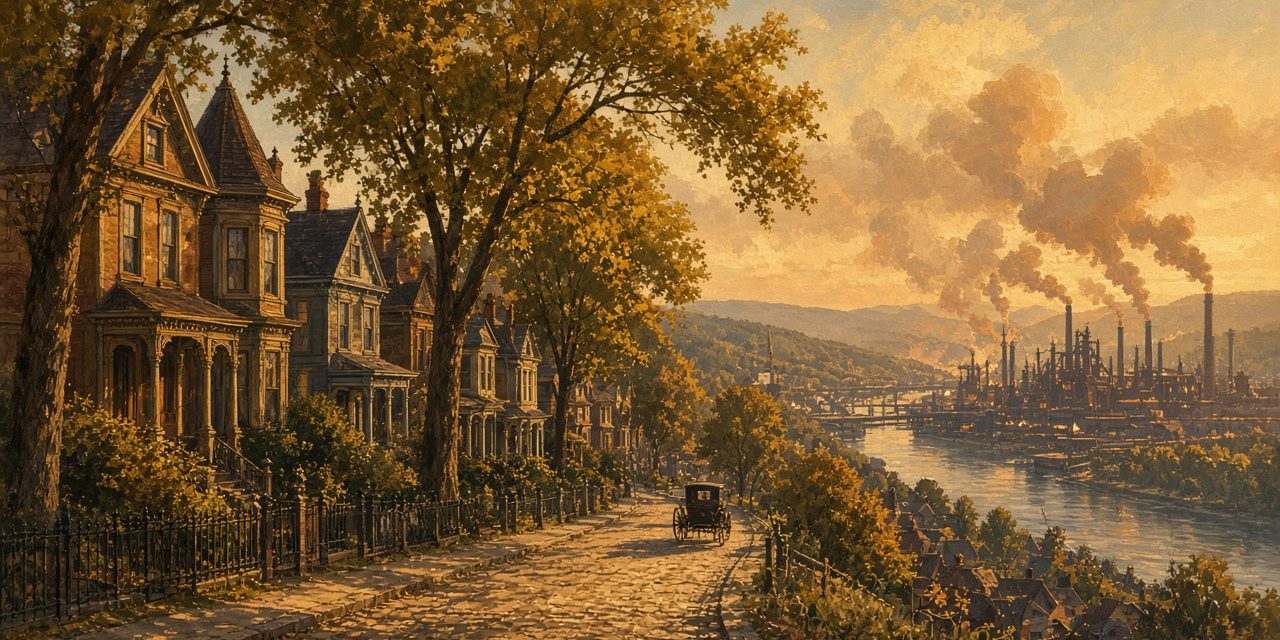
The Vandergrift Historic District was listed on the National Register of Historic Places in 1995, and the borough says the town remains “eighty to ninety percent intact.” The curved streets, the tree-lined blocks of Queen Anne and Victorian houses, and the main business street on Grant Avenue are still there. The town has a Casino Theatre, though I could not confirm it is the same building as the casino on Olmsted’s plan, and the Victorian Vandergrift Museum & Historical Society tells the town’s story locally. St. Gertrude Roman Catholic Church is also on the National Register.
The question the town still raises is a good one. Olmsted’s firm designed a place that was, on paper, a good deal more livable than many mill towns, and the company that paid for it had business reasons for wanting loyal workers. Both things can be true.