
The Spiritual Backbone of Pittsburgh’s History
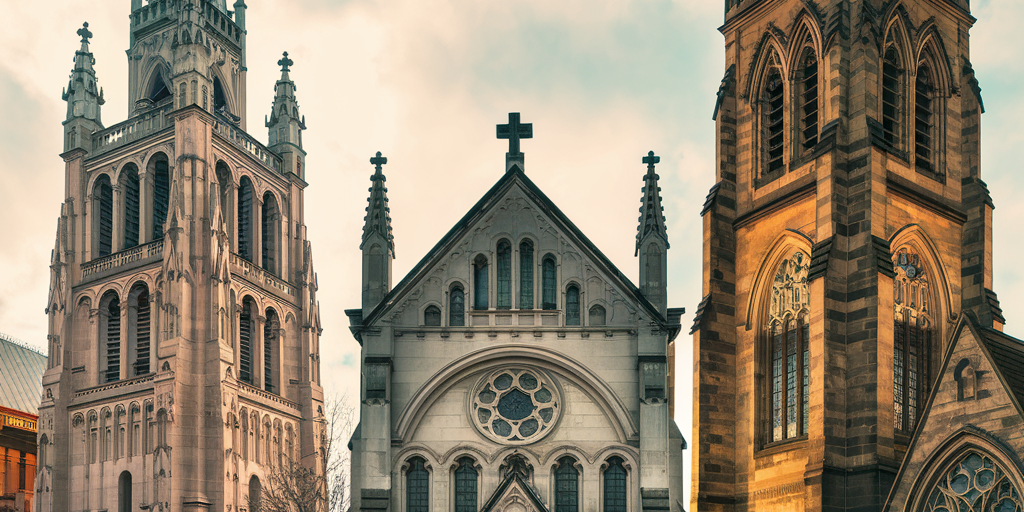
Pittsburgh’s most beautiful churches rise above the city’s steel and glass skyline, their Gothic spires and grand cathedrals telling stories that span centuries. These historic churches in Pittsburgh showcase stunning architectural masterpieces—from soaring stone cathedrals with intricate stained glass to hidden chapels housing sacred relics. Each represents the faith, artistry, and immigrant heritage that shaped this great city.
In this guide, we’ll explore Pittsburgh’s most beautiful churches, from the oldest active church site to Gothic revival cathedrals that rival Europe’s finest.
St. Paul Cathedral – Oakland’s Gothic Masterpiece
The Heart of Pittsburgh’s Catholic Community
Located in Oakland, St. Paul Cathedral is one of Pittsburgh’s most recognizable religious landmarks. Dedicated in 1906, the cathedral was designed in the Gothic Revival style by architects Egan & Prindeville of Chicago, who took Germany’s Cologne Cathedral as their inspiration. The diocese bought the Oakland land after selling its downtown Grant Street property, the site of the second cathedral, to Henry Clay Frick (see our profile of Frick). The cornerstone was laid in 1903, and the church seats roughly 3,000 people.
The cathedral features:
- Soaring spires that rise 247 feet into the air
- Intricate stained glass windows
- Carved stone detailing inspired by Europe’s Gothic cathedrals
St. Paul is the mother church of the Roman Catholic Diocese of Pittsburgh. The parish dates to 1833, and when the diocese was created in 1843 its Grant Street church became the first cathedral. That building was destroyed by fire in 1851 and replaced by a second cathedral in 1855 before the move to Oakland. Its grandeur reflects the importance of faith in a city of immigrants during the industrial boom, and Andrew Carnegie donated the cathedral’s first pipe organ in 1895, for an earlier building. The Oakland location was also part of the neighborhood’s growth, a story told in our article on how Oakland became Pittsburgh’s education and medical hub.
Today, St. Paul continues to host major diocesan events, weddings, and daily mass, making it a vibrant part of Pittsburgh’s religious and architectural heritage.
St. Anthony’s Chapel – Home to One of the Largest Relic Collections Outside the Vatican
A Hidden Gem in Troy Hill
Nestled in the Troy Hill neighborhood, St. Anthony’s Chapel is a true treasure of Pittsburgh. Built by Father Suitbert Mollinger, the Belgian-born pastor of Troy Hill’s Most Holy Name Parish, the chapel was designed to house the religious relics he collected on trips to Europe. Mollinger paid for it himself with an inheritance from his family in Belgium. Work began in 1882 and the first building was dedicated on June 13, 1883. A nave was added and the enlarged chapel was rededicated on June 13, 1892, two days before Mollinger died.
Today, St. Anthony’s boasts:
- Over 5,000 relics, a collection often described as second only to the Vatican’s (though one historian suggests the Spanish crown’s collection at the Escorial may be larger)
- Life-sized Stations of the Cross imported from Munich, Germany
- Stained-glass windows and ornate altars, including a reliquary made in Aachen in 1880 that holds a particle of the True Cross
The chapel became a place of pilgrimage for Catholics and remains one of the most unique historic churches in Pittsburgh. The collection includes relics of saints and a thorn said to be from the Crown of Thorns, connecting visitors to centuries of Christian history. After Mollinger died without a will, his heirs removed valuables such as chandeliers and a black onyx altar, and parishioners bought the chapel and its remaining contents for $30,000. For the neighborhood’s story, see the history of Troy Hill.
St. Anthony’s Chapel is still active, offering regular mass, tours, and a glimpse into Pittsburgh’s deeply spiritual past.
Trinity Cathedral – Pittsburgh’s Oldest Church Site
A Protestant Landmark with Deep Roots
Located downtown, Trinity Cathedral is one of the oldest and most historically significant religious sites in Pittsburgh. The current Gothic Revival building, designed by Gordon W. Lloyd, was completed in 1872. The Penn family’s heirs deeded the hilltop land to the congregation’s founders in 1787, and the churchyard holds the oldest marked graves west of the Atlantic Seaboard. The first Trinity Church, a brick octagon known as the “Round Church,” stood two blocks west and was built between the 1780s and 1805. In 1824 the congregation moved to the hilltop site with what is regarded as the first Gothic structure in western Pennsylvania, and in 1869 it built the present church. That makes this one of the oldest church sites in the city.
Key features include:
- An English Gothic exterior with a single central steeple
- Historic churchyard with 18th-century graves, including those of Native American leaders and French, English and American colonists
- Stained glass windows (most dating to 1872, with some replaced after a 1967 fire) and a carved stone pulpit designed in 1922 by architect Bertram Goodhue
Trinity Cathedral stood through the city’s transformation from a frontier town to an industrial giant, and its exterior was cleaned in 2007 for the first time to remove industrial soot. (The Great Fire of 1845 burned through the city a few blocks away.) Today, Trinity remains a vibrant Episcopal congregation and a vital piece of Pittsburgh’s religious history.
Other Notable Historic Churches in Pittsburgh
Pittsburgh is home to dozens of other historic churches that showcase the city’s rich religious and cultural tapestry:
- St. Stanislaus Kostka Church (Strip District): Built in 1891 and consecrated in 1892, serving Pittsburgh’s Polish Catholic community with Munich-made stained glass that experts rank among the best period “Munich Style” windows in the country. The 1936 St. Patrick’s Day flood put water as high as the wainscoting inside; see the 1936 flood and the Strip District’s transformation.
- First Presbyterian Church (Downtown): Completed in 1905 to a neo-Gothic design by Theophilus P. Chandler, with 13 of its 253 stained-glass windows hand-painted by Tiffany Studios. The congregation traces its roots to the 1780s, and a bill to incorporate it passed on September 29, 1787.
- Calvary Episcopal Church (Shadyside): Designed by Ralph Adams Cram, with its first service held on December 19, 1907. It is built of Indiana limestone in the English Gothic Revival style, with windows by Charles Connick and by English firms such as Heaton, Butler and Bayne.
- Immaculate Heart of Mary (Polish Hill): A grand church serving Pittsburgh’s Polish immigrants, founded in 1897 and completed in 1905 in the Baroque-influenced “Polish Cathedral” style, modeled on St. Peter’s Basilica in Rome, with a massive dome and elaborate interior. Read the story of Polish Hill.
- East Liberty Presbyterian Church (East Liberty): The congregation dates to 1819, and the present building is the fifth on a site that fills an entire city block. The Mellon family, grandsons of the donors of the original land, gave the final plot in 1918; see the Mellon dynasty.
- Heinz Memorial Chapel (Oakland): A gift of the family of H. J. Heinz honoring his mother, Anna Margaretha Heinz. Ground was broken in 1933 and it was dedicated on November 20, 1938, on the University of Pittsburgh campus. See Henry Heinz and the birth of a global brand.
The Cultural and Architectural Legacy of Pittsburgh’s Churches
These historic churches in Pittsburgh do more than serve as places of worship. They are:
- Architectural landmarks reflecting styles from Gothic Revival to Romanesque
- Cultural hubs that preserved languages, traditions, and communities
- Historical records of the immigrants who built Pittsburgh’s industries and neighborhoods
From Polish and German Catholic churches to Protestant cathedrals, these structures symbolize the faith and perseverance of Pittsburgh’s diverse population.
Many of these churches are active congregations, and several, including Immaculate Heart of Mary, are part of the diocese’s Shrines of Pittsburgh, a group of six churches promoted as pilgrimage and visitor destinations. Check each church’s own schedule before visiting.
Keep Reading
- Little Italy Days in Bloomfield
- The Hill District before jazz: immigrant roots and early development
- A timeline of Pittsburgh’s history
Pittsburgh’s Churches as Living History
The historic churches in Pittsburgh are more than stone and stained glass—they are living monuments to the city’s rich cultural past. Whether you’re exploring St. Paul Cathedral’s Gothic beauty, marveling at St. Anthony’s vast relic collection, or walking the historic grounds of Trinity Cathedral, these sacred spaces tell the story of Pittsburgh’s soul.
For history buffs, architecture lovers, or anyone seeking a deeper connection to the city, Pittsburgh’s churches offer a timeless journey through faith, art, and community.
Sources: Wikipedia articles on St. Paul Cathedral, Saint Anthony’s Chapel, Trinity Cathedral, First Presbyterian, Calvary Episcopal, Immaculate Heart of Mary, St. Stanislaus Kostka, East Liberty Presbyterian and Heinz Memorial Chapel (Pittsburgh), and the parish and cathedral websites.