

The Kecksburg UFO story starts with two newspaper headlines. On December 10, 1965, two editions of the Greensburg Tribune-Review told two different stories about the night before. The county edition said, “Unidentified Flying Object Falls Near Kecksburg,” with a second headline reading “Army Ropes Off Area.” The city edition said, “Searchers Fail To Find Object” (Skeptical Inquirer, citing both editions).
More than sixty years later, the story is still caught between those two headlines. Something bright and fast crossed the sky on December 9, 1965. A search happened in the woods of Westmoreland County. After that, almost everything depends on who is telling it and when they first told it.
This is one of the Pittsburgh region’s best-known mysteries from the sky. It is also a good example of how a story grows. I’ll keep it sorted by what the record supports, what rests on memory, and what is still argued about, because in this case those three piles are not the same size.
What was documented on December 9, 1965
Fact: At about 4:43 p.m. Eastern time, a brilliant fireball was seen over the Great Lakes region. NASA’s spacecraft catalog describes it as seen “over southwestern Ontario, Canada and at least eight states from Michigan to New York” (NASA NSSDC, archived copy). The Sky & Telescope report in February 1966 drew on 23 pilot reports collected by the FAA, and a seismograph near Detroit recorded the shock waves, according to summaries of that report.
Fact: In Kecksburg, a village in Mount Pleasant Township southeast of Pittsburgh, people reported that something had come down in the woods. Skeptical Inquirer’s account says a boy playing outdoors saw an object plummet into trees. According to the Blue Book summary, state police and volunteer firefighters responded first, and the Tribune-Review’s county edition said the Army had roped off the area.
Fact: The search found nothing. An AP dispatch on December 10 said state troopers and Air Force personnel tramped through the area for hours with Geiger counters before calling off the search, and that a Department of Defense spokesman said first reports indicated a natural phenomenon and that all aircraft and missiles were accounted for. (I am quoting the AP text as reproduced in the references of Wikipedia’s Kecksburg article; I did not see the original wire copy.)
The Air Force’s own Project Blue Book file survives. According to Stan Gordon, the longtime Kecksburg researcher who is no skeptic, it contains this line from the duty log: “A further call was made to the Oakdale Radar site in Pennsylvania. A three man team has been dispatched to Acme to investigate and pick up an object that started a fire” (Stan Gordon). A summary of the same file says a memo dated December 10 records the search ending around 2 a.m. with “they could not find anything,” and that Blue Book closed the case as “Astro (METEOR)” (UAP Codex, summarizing the file). I have not seen the original pages, so treat the wording as secondhand.
That is a real record of a real search. It is not a record of a find.
The fireball itself was a meteor, and it ended far from Kecksburg
The astronomy is the most settled part of the story. In 1967, Von Del Chamberlain and David J. Krause published “The Fireball of December 9, 1965” in the Journal of the Royal Astronomical Society of Canada (ADS record). Using photographs of the trail taken from two locations near Detroit, they worked out the path and concluded that the object ended its flight over land about 15 miles southeast of Windsor, Ontario, according to summaries of the paper. Sky & Telescope likewise put the end in or near western Lake Erie.
That is more than 300 kilometers, roughly 200 miles, from Kecksburg. How could witnesses in Pennsylvania think it came down in their woods? Geophysicist George Wetherill, quoted in Sky & Telescope, had a simple answer: “Almost everyone who saw the fireball thought it was much closer than it really was,” as the report is quoted by the Anomaly Registry. NASA’s own catalog adds that “estimating the impact point of fireballs from eyewitness accounts is notoriously inaccurate.”
Disputed: A meteor explains the sky, but it does not strictly rule out the possibility that something else came down near Kecksburg that evening. Researchers who believe something did land point to witnesses who described a slow, controlled descent, not the steep path of a meteor. The two ideas are not equally supported, but one does not fully cancel the other.
The Cold War reason people suspected something else
It helps to remember what December 1965 felt like. The space race was at full speed. Gemini 7’s crew was in orbit that same week. Both superpowers were launching probes, and both were tracking each other’s hardware as it fell back to Earth.
The best-known candidate was a Soviet spacecraft. Cosmos 96 was a Venus probe launched on November 23, 1965. It failed to leave Earth orbit and came down on December 9, 1965, the same day as the fireball. NASA’s catalog states that Air Force tracking data show “the spacecraft orbit decayed earlier than 21:43 UT,” that is, before the fireball, and that other analyses “definitively indicate it could not have been the Cosmos 96 spacecraft.” Stan Gordon agrees: he writes that Cosmos 96 reentered over Canada at about 3:18 a.m. and that Russian contacts told him it was not the source.
The suspicion did not die, because military intelligence really was interested in foreign space hardware. Space writer James Oberg once speculated that the Air Force might have kept quiet about recovering Soviet debris, because holding another country’s hardware would have been awkward under international law. He later wrote that checking the orbit showed Cosmos 96’s path “could not possibly be made to coincide with the path of the meteor,” and concluded the two events were coincidence (Oberg’s 2008 statement; I checked the wording against a copy of the statement). In other words, the best-known idea of what the object was has been ruled out by NASA’s own data.
The acorn shows up twenty-five years late
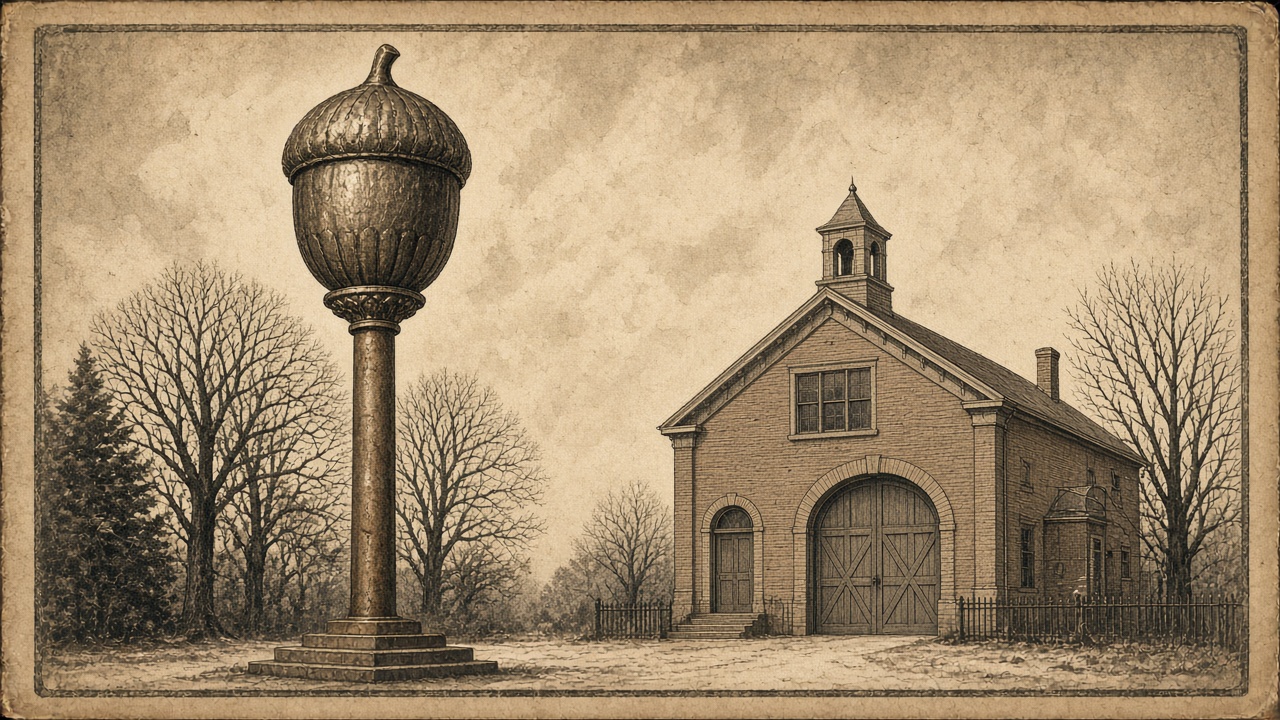
Legend, or at least unproven: The most famous detail of the Kecksburg UFO is that it looked like a large metal acorn, about the size of a Volkswagen Beetle, with markings like Egyptian hieroglyphics around the base, and that soldiers took it away on a flatbed truck. That description is everywhere, including on the roadside sign. But where does it first appear?
According to Joe Nickell and James McGaha, it surfaced “nearly a quarter of a century after the original incident,” when two local men began saying they had entered the woods before the authorities and seen the object. The story reached a national audience on September 19, 1990, when NBC’s Unsolved Mysteries opened its season with Kecksburg (Skeptical Inquirer, May/June 2012). The 1965 newspaper coverage quoted in the sources I found describes a search, not an object.
The witnesses who tell the acorn story are real people with names, and the researcher who collected most of their accounts takes them seriously. According to Stan Gordon, machinist Jim Romansky says he saw a bronze-gold object that looked “as though it had been made from liquid metal and poured into a big mold,” with unusual markings on the back. Gordon also names Pittsburgh jazz musician Jerry Betters, who says soldiers aimed rifles at him and his friends and ordered them off a back road as a flatbed carried away an acorn-shaped object. John Hayes, who was a child living nearby, told the same story on television in 1990 and again in 2003, per Wikipedia’s summary of the broadcasts, and has described watching the activity from his house; the next day, according to a 2025 Latrobe Bulletin account of Gordon’s research, he and his brother walked to the woods and found a cut fence and fallen trees.
Those accounts are what they are: memories, mostly recorded decades later, by people who may be sincere and still wrong. Skeptics point out that the Roswell story contains a similar pairing of an odd object, hieroglyphic-looking symbols, and a trip to Wright-Patterson Air Force Base. Oberg adds a more specific caution. He says the acorn description first appeared some years later, when reporters and UFO researchers showed witnesses photographs of the Soviet Venus probe, which does resemble an acorn, and some answered, “Yeah, THAT’S what I saw” (Oberg’s 2008 statement). That is his claim about how the story developed, not a proven fact, and Gordon would disagree.
One more detail is worth noting about the local reaction. According to Nickell and McGaha, more than fifty Kecksburg residents signed a petition trying to stop the 1990 broadcast, including Ed Myers, who was fire chief in 1965. They also say the show wrongly claimed one couple’s home had been a military command post, and that both the Air Force and state police reported the next day that nothing was found and that all they carried out was search equipment. The town did not speak with one voice then, and it does not now.
The reporter, the radio documentary, and the legend that grew around him
Every version of the Kecksburg story eventually mentions John Murphy, the news director at Greensburg radio station WHJB. In the telling by Stan Gordon, Murphy was probably the first reporter on the scene, and his former wife says he radioed her from the site and said he went into the woods and saw the object.
Legend, and I could not verify it: UFO accounts go on to say that Murphy made a radio documentary called “Object in the Woods,” that two men in dark suits visited the station, that tapes and photographs were confiscated, that the aired version was changed, and that Murphy was killed in an unsolved hit-and-run near Ventura, California, in February 1969. A privately erected roadside marker in Kecksburg repeats the hit-and-run claim (Historical Marker Database). The earliest published version of the full cover-up story I came across is a 2005 article in a UFO journal, International UFO Reporter. I did not find a 1965 newspaper item, a police report, or an archived copy of the original script. Murphy’s death appears in the later accounts, but nothing I found links it to Kecksburg except the later accounts themselves.
The station’s role is easier to document. WHJB was an early local source for the story, and UAP Codex, in its summary of Blue Book material, names Kecksburg resident Frances Kalp as one of the first to alert the station. Pittsburgh radio mattered, too. Gordon, then 16, heard the first news on KDKA’s Contact show that Thursday evening, as he told the Latrobe Bulletin. Our history of KDKA covers how that station became the voice of the region.
The Latrobe Bulletin piece also includes a small human detail. Reporter Maryann Gogniat Eidemiller was working for The Times-Observer and Irwin Standard that day and was about to drive out when a colleague ran out to tell her it was a hoax, so she stayed. She has called it “the best story I never wrote.”
NASA, a lawsuit, and files that can’t be found
The modern chapter began in 2003, when journalist Leslie Kean, with backing from the Sci Fi Channel, sued NASA under the Freedom of Information Act for records related to Kecksburg. In 2007 a court-ordered search was reported by Wired and the AP. According to The Guardian, NASA’s public liaison told the court that two boxes of papers from the time of the incident were missing (Wikipedia’s summary, citing those reports).
Disputed: In December 2005, shortly before the 40th anniversary, a NASA spokesperson was reported by the AP to have said that experts had examined metal fragments from the area and determined they came from a Soviet satellite, though the records were lost. That statement is hard to reconcile with NASA’s own catalog entry, which rules out Cosmos 96. Oberg argued that if anyone examined anything at Kecksburg, they were more likely Air Force personnel posing as NASA staff, and that the lawsuit was a publicity stunt. I could not find a published NASA finding that says what the supposed fragments were.
Theory: In 2015, two MUFON investigators told the Post-Gazette they suspected the object was a General Electric Mark 2 reentry vehicle, launched by the Air Force as a spy satellite that fell out of orbit, but said they needed confirmation from NASA or the Air Force. It has not been confirmed.
So what is the Kecksburg UFO?
If you want the story in four labels:
- Documented: a brilliant meteor crossed the sky; a search with state police and Air Force personnel took place near Kecksburg; it found nothing; the Air Force closed the case as a meteor.
- Legend: the acorn-shaped craft with hieroglyphics, hauled away on a flatbed, and the story of a muzzled reporter. They are told by named people, but they surface decades after the event.
- Theory: a recovered American reentry vehicle or Soviet debris. Each has its supporters, and neither has been confirmed.
- Disputed: whether anything fell in those woods at all, and whether the military’s response was a routine search or something more.
My honest read is that the evidence strongly supports a meteor for the sky and a failed search for the ground. The acorn and the cover-up are the parts that would need new evidence, such as photographs or a military record, to move out of the legend column. Gordon himself has asked for the photographs people say they saw. Nobody has produced them.
Visiting Kecksburg today
You can see what is left, and it is a prop. The acorn on a pole beside the Kecksburg Volunteer Fire Department is a replica built for the 1990 Unsolved Mysteries shoot and left behind afterward. According to Roadside America, the fire department bolted it to the truck barn, then restored it and put it on a hillside around 2005 alongside a UFO gift shop to help pay for a new truck. The department also hosts a UFO festival each July.
The marker nearby is not a Pennsylvania Historical and Museum Commission marker, as far as I can find. It was put up by a private sign company, and it contains several claims, including the hit-and-run story, that I could not verify. The real site, the wooded ravine, is on private property.
If you like this kind of story, read our piece on the Thunderbird legend. For Kecksburg, the safest thing to say is what the two Tribune-Review headlines said between them: something got people to the woods that night, and nobody has shown what, if anything, they found.
Related reading on Steel City History: KDKA Radio History and The Thunderbird Legend.