
The Pittsburgh Agreement is usually dated May 30, 1918, because that is the date on the calligraphic copy. Most accounts say it was signed on May 31. A Slovak historian who examined a copy of the meeting’s minutes says the agreement was entered into the record on the 31st, outside the main session, and that Tomáš Masaryk had by then left the meeting. A Czech historian says it was never an agreement at all, just a resolution. The six short points that Czech and Slovak immigrants approved in a Penn Avenue lodge hall have been quoted, cited, doubted and fought over for more than a century, and the argument starts with what the document was.
Why Pittsburgh
An essay on ExplorePAHistory.com about the state historical marker says more than half of the 500,000 Slovak immigrants to America settled in Pittsburgh and the industrial towns around it. Martin Votruba of the University of Pittsburgh’s Slovak Studies Program told WESA in 2017 that Allegheny County has the highest share of people claiming Slovak heritage of any county in the United States. He added that Pittsburgh had few Czech immigrants, so the crowds were mostly Slovak. Carol Hochman of the University of Pittsburgh, in a 2003 conference paper, notes that the Slovak League of America was organized in Pittsburgh in 1906.
The Czech-Slovak cause was not a settled matter among the Slovaks of Pittsburgh. Hochman writes, drawing on the journalist Milan Getting’s 1933 memoir, that many Slovaks had preferred to bargain with Hungary rather than join the Czechs, and that Pittsburgh’s Slovaks were “particularly resistant” to the idea, saying so in an official memorandum. Getting, who edited a Sokol newspaper, argued for union. By 1918 the Slovak League and Czech organizations had a pact of their own from 1915, the Cleveland Agreement, which the same essay names as the framework the Pittsburgh document built on.
The parade on Memorial Day
Masaryk, the Czech philosopher and politician who led the Czechoslovak National Council from exile, had crossed Siberia and the Pacific that spring and came to Pittsburgh on May 30, 1918, Decoration Day. According to Hochman’s summary of Getting, about 20,000 Slovaks, Czechs and Rusyns turned out in downtown Pittsburgh. Masaryk rode in a horse-drawn carriage through immigrant neighborhoods of what was then Allegheny City, including the Bohemian Hill section (see the SteelCityHistory history of Troy Hill), and then to Exposition Hall at the Point, where a telegram from the U.S. government was read.
Getting remembered the speeches as unprepared. The part in Czech was addressed to the Slovaks present. “There will be a free Bohemia and a free Slovakia,” he quotes Masaryk as saying. “In Slovakia, all political affairs, schools, the courts and everything will be conducted in Slovak; in Bohemia it will be in Czech. … Each branch will be lord in its own home.” That is Getting’s account, in his son’s translation, as quoted by Hochman, and the original Czech or Slovak text was not available for this article.
What was written, and when
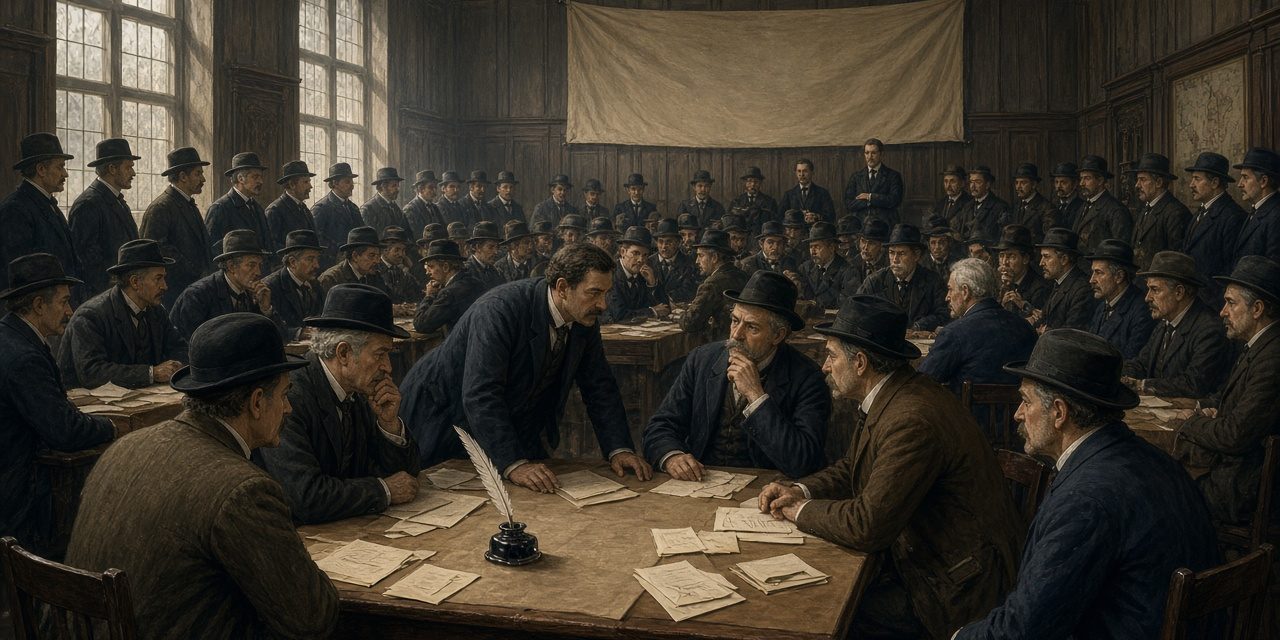
The next day, the American branch of the Czechoslovak National Council met with representatives of the Slovak League, the Czech National Association and the Union of Czech Catholics at the Loyal Order of Moose lodge on Penn Avenue. Getting wrote, per Hochman, that Masaryk was asked how Czech and Slovak unity would be established, and wrote a few phrases in pencil on an ordinary scrap of paper that later went into the agreement. He says there was no discussion of what Masaryk wrote, only of the idea of a Slovak parliament. Hochman adds that it was Getting who moved the closing clause. The Czech National Museum, in a 2018 press release on the loan of the document for an exhibition, says Masaryk drafted the text during his visit.
The Slovak historian Štefan Kucík tells a more complicated story. He describes a protocol of the council’s second meeting, dated May 31, 1918 and headed “Moose Temple, Pittsburgh,” a copy of which is in the Matica slovenská archive in Slovakia and whose original’s location he says is unknown. It records the agreement’s text, which he calls its earliest known version. He says it shows that the agreement was entered into the minutes on May 31, even though the calligraphic copy is dated May 30, and that the agreement was concluded outside the main session. The minutes record only a short consultation among the Slovaks before the agreement was entered, and, by then, without Masaryk, who had left the meeting. Only Kucík’s summary, not the protocol, was available for this article.
So the date has three versions: May 30 on the document and in some Czech scholarship, May 31 in the minutes, in the ExplorePAHistory essay on the marker, and in the Czech National Museum’s account of the signing. And the question of whether Masaryk was in the room when the document took its final form has two answers.
The number of signers also depends on who counts. The Masaryk archive in Prague reproduces a list of 27 names from Edvard Beneš’s 1935 memoir, with Masaryk’s among them. PublicSource, in 2018, said 29 people signed, and the ExplorePAHistory essay says Slovaks had twice as many signatories as Czechs. The Slovak-American historian Victor Mamatey, quoted in a 1969 article by Thaddeus Gromada in Slavic Review, wrote that the calligraphic copy was signed by Masaryk on November 14, 1918, the day he was elected president of Czechoslovakia. If Mamatey is right, Masaryk’s own signature on that copy dates from November, not May. The document itself was not available for this article, and the sources consulted do not say whether the lithograph now in Pittsburgh is the copy he means.
Six points
The text is short. In the available translations, it approves a program to unite Czechs and Slovaks in an independent state of the Czech lands and Slovakia. Slovakia would have its own administration, its own parliament and its own courts, with Slovak the official language of schools and public life. The state would be a republic with a democratic constitution. The last point is the one that mattered most later: “Detailed regulations concerning the establishment of the Czecho-Slovak State are left to the liberated Czechs and Slovaks and their legal representatives.”
Binding, or not?
Czechoslovakia was proclaimed in Prague on October 28, 1918, two days after a meeting in Philadelphia where Masaryk and other leaders of subject nations issued a declaration of common aims, according to Hochman. The question of whether the Pittsburgh text bound the new state began almost at once.
Gromada writes that Slovak autonomists under Andrej Hlinka argued that the new state had assumed an obligation to grant Slovakia autonomy when Prague’s Constituent Assembly, on November 12, 1918, ratified every agreement Masaryk had made during the war. Masaryk, Gromada says, treated it as a local understanding between American Czechs and Slovaks. In March 1919 a Slovak-American delegation carrying photostats of the document left for Slovakia. One of its members, Jozef Hušek, reported that the delegation was received with joy in Hlinka’s Ružomberok but not in Bratislava, where officials favored a central government. Gromada also notes that Hušek and Albert Mamatey, the president of the Slovak League, ended up siding with the Czech-oriented Slovak leaders against an autonomy campaign, on the grounds that it would help the Hungarian side. When Hlinka took a memorandum invoking the agreement to the Paris Peace Conference in September 1919, the American diplomat Stephen Bonsal told him, in Bonsal’s own account, “You have come late,” because the Treaty of Saint-Germain had been signed on the tenth. Gromada says the constitution adopted on February 29, 1920 ignored the Pittsburgh text completely, and he notes that its preamble speaks of a “Czechoslovak nation.”
The Czech historian Eva Broklová, in a 1993 article, argues that the document “lacks the character of a treaty agreement” and was only a resolution of representatives of American organizations, and that its signers were not the “legally binding representatives” of either nation, the kind of representatives its own last clause left the details to. She also cites the Slovak politician Ivan Dérer (1938), who said the title “Czecho-Slovak Agreement” was added afterward by someone unknown, and Masaryk’s own 1925 memoir, which, she says, calls it a resolution or an agreement, not a treaty. Broklová adds that Slovak deputies were still citing the text as late as the spring of 1990, in the dispute over whether Czechoslovakia should be written with a hyphen.
The partisan side is on record too. František Jehlička, who was with Hlinka in Paris, wrote in a 1938 pamphlet published in London by the Slovak Council that Masaryk, in a 1929 letter to Hlinka, “contemptuously dismissed it as a forgery,” and added that this was surprising because Masaryk had written and signed the original draft. The letter itself was not available for this article, and Jehlička was an interested party.
Czechoslovakia ended through a negotiated separation on January 1, 1993, which the ExplorePAHistory essay calls mutually acceptable.
What remains
The lodge was torn down in the 1980s, Hochman writes, to make way for a high-rise. A bronze plaque honoring Masaryk and Woodrow Wilson was dedicated in the tower’s lobby on October 28, 1989 (the paper does not say whether it is still there), and a state historical marker was unveiled at Penn Avenue and Seventh Street on May 31, 2001. The Heinz History Center holds the signed calligraphic lithograph, which, according to the Czech National Museum, was lent for the museums’ 2018 Czech-Slovak exhibition in Bratislava and Prague. WESA reported in 2017 that the museum displayed a copy, so check with the museum before planning a visit around it.