

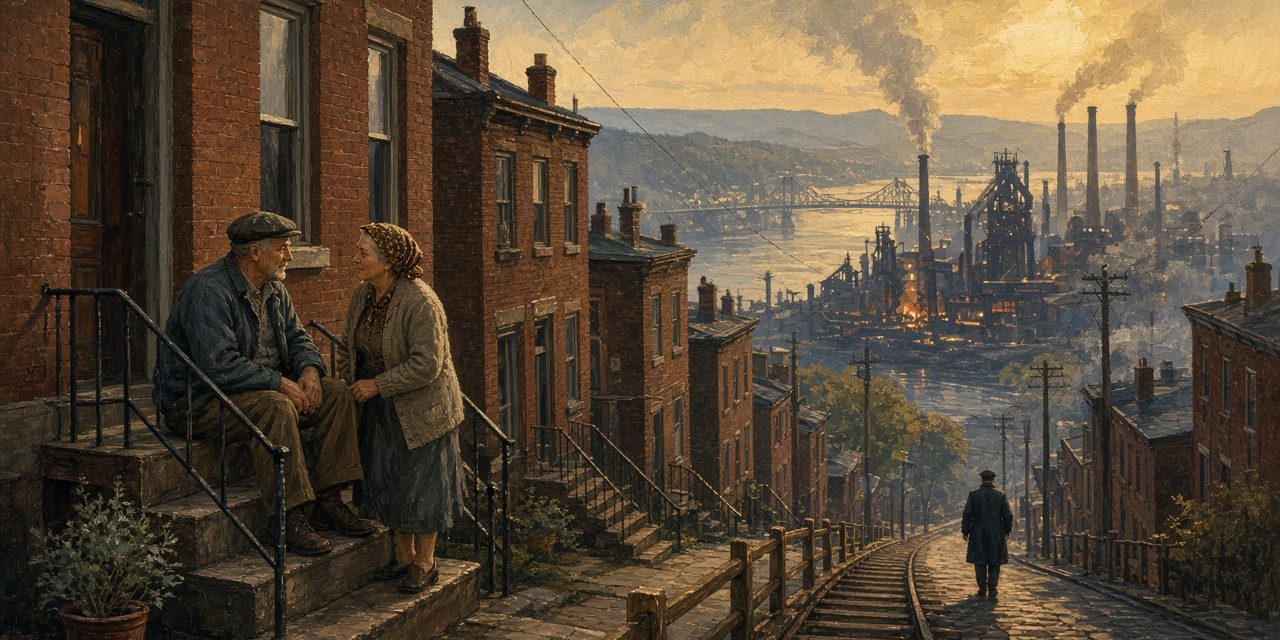
The Pittsburgh accent is usually summed up in one word: “dahntahn.” Parts of the Pittsburgh accent go back to Scots-Irish settlers of the 1700s, but its most famous sound appears to be a twentieth-century development, and the name “Pittsburghese” for the city’s way of talking appears to date only from the 1960s. Here is what the research says about where the accent came from, how its sounds work, and how a way of talking that most speakers once never noticed became a badge of local identity.
What researchers mean by the Pittsburgh accent
Much of what is known comes from two sociolinguists: Barbara Johnstone of Carnegie Mellon University, author of Speaking Pittsburghese: The Story of a Dialect (Oxford University Press, 2013), and Scott Kiesling of the University of Pittsburgh. Their work draws on older surveys, including the Linguistic Atlas of the Middle and South Atlantic States and the Atlas of North American English (2006) by William Labov, Sharon Ash and Charles Boberg.
Two points run through that research. First, in an essay reprinted on PBS’s Do You Speak American site, Johnstone and Kiesling place Pittsburgh speech within a “North Midland” or “Lower Northern” variety, noting that many features thought to be unique to the city are heard across central and southwestern Pennsylvania, the Appalachians and parts of the Midwest. Second, the accent and the popular idea of “Pittsburghese” are not the same thing. Kiesling and Marc Wisnosky, quoting Johnstone, describe Pittsburghese as representations of local speech, often based on folk beliefs, rather than a linguist’s description of how people talk.
Scots-Irish settlers and the Midland foundation
The oldest layer of the accent arrived with the region’s first large wave of English-speaking settlers. Johnstone and Kiesling write that the largest group of early English-speaking immigrants to southwestern Pennsylvania came from Ulster, in what is now Northern Ireland. Most were “Scotch-Irish” (also called Scots-Irish), descendants of Scots who had settled in Ulster at the beginning of the seventeenth century. Many emigrated to North America in the late 1600s and through the 1700s. In a 2002 article in the journal American Speech, Johnstone and her co-authors Neeta Bhasin and Denise Wittkofski note that after the French and Indian War, southwestern Pennsylvania was settled by Scotch-Irish and German newcomers.
Because those settlers also moved west and south along the Ohio River and the Appalachian Mountains, features traced to their speech are found well beyond Pittsburgh. The clearest example is the second-person plural pronoun. In Speaking Pittsburghese, Johnstone writes that the form that became yinz was brought to America by Scotch-Irish immigrants. It is a contracted form of “you ones,” which is still heard as “you’uns” elsewhere in Appalachia. She traces how its pronunciation shifted over time from something like “you’unz” to “yunz” and, for some speakers, to “yinz,” and how its spelling drifted until most people no longer recognized it as a contraction at all.
Grammar carries the same inheritance. Johnstone and Kiesling identify the construction heard in “the car needs washed,” where other dialects would say “needs washing” or “needs to be washed,” as most likely Scotch-Irish in origin. The Atlas of North American English maps the same construction across a wider Midland region. The two linguists also point to pronunciations that follow the same geography as Scotch-Irish words and grammar: an “r” sound in wash, so that it sounds like “worsh,” and a long “i” in words like fire and tile that sounds more like “ah.” They suggest these may be older features that spread with the early settlers, while cautioning that pronunciation is hard to trace in written records.
“Dahntahn”: a twentieth-century sound
The sound most closely tied to Pittsburgh is not part of that colonial inheritance, according to the research. Linguists call it the monophthongization of /aw/. The vowel in out, down and house, which in most American English glides from one position to another, is flattened into a single “ah” sound. That yields “aht,” “dahn” and “hahs,” and the city’s favorite respelling, “dahntahn.” Johnstone and Kiesling describe it as the one Pittsburgh pronunciation that seems much more restricted geographically than the others.
To find out when it appeared, Johnstone, Bhasin and Wittkofski went back to the field notes of the Linguistic Atlas of the Middle and South Atlantic States. Its fieldworker, Guy Lowman, interviewed ten white working-class men born between 1851 and 1896 in Allegheny County and the neighboring counties of Washington, Westmoreland, Beaver and Butler. All but one of the nine who supplied usable examples were farmers. In every case, Lowman transcribed /aw/ as a two-part vowel, with enough detail that the authors doubted he had simply failed to hear a monophthong. They found no evidence of “dahntahn” in speakers born before 1900.
In the study’s twentieth-century recordings, drawn from documentary films and new interviews with working-class men, speakers born between 1900 and 1919 were already using it. The feature peaked in the generation born between 1920 and 1949 and remained in use among young working-class men. As the PBS essay puts it, western Pennsylvanians born before 1900 do not seem to have used the sound, but by the middle of the twentieth century it was quite common.
Where it came from is still an open question. The 2002 authors note that it emerged alongside rapid immigration and urbanization in the late nineteenth century, when city dwellers lived in tight neighborhood and workplace networks. They raise contact with immigrant languages as one possibility, but cite William Labov’s conclusion that “no convincing connection has yet been found” between a Polish substratum and the change. Drawing on the historian Richard Oestreicher, Kiesling and Wisnosky link the sound’s rise to the early twentieth century, when Pittsburgh’s working class came together as a class. Johnstone and Kiesling’s PBS essay is blunter: “Dialectologists do not yet know how this pronunciation originated.”
The cot–caught merger and the rest of the vowel system
“Dahntahn” sits inside a larger set of sound patterns. The most important is the merger of the vowels of cot and caught, so that Don and dawn sound alike, a merger shared by many North Americans. Johnstone and Kiesling point out that Pittsburghers tend to pronounce the merged vowel as a rounded “augh,” as many Canadians do, rather than the unrounded “ah” heard farther west. The Atlas of North American English treats western Pennsylvania as one of three distinct dialects within the merged area, alongside Canada and eastern New England. It notes that the rounded western Pennsylvania vowel already stood out in Hans Kurath and Raven McDavid’s 1961 maps of pronunciation in the Atlantic states, drawn from Linguistic Atlas fieldwork.
The merger may help explain “dahntahn.” Kiesling and Wisnosky suggest that because the merged vowel is pronounced far back and rounded, it leaves open space where a flattened /aw/ can fit, and that the parallel flattening of the long “i” may have provided a model. The Atlas also describes a “Pittsburgh chain shift” involving the vowel of cut, which in Pittsburgh has shifted lower, into the space left as the vowel of cot moved back.
Other features are widely heard elsewhere, according to Johnstone and Kiesling: the same vowel in steel and still, or in pool and pull, and an “l” that sounds more like a “w” or “o,” so that school can come out close to “skoo.” They write that these mergers are becoming more common throughout the United States. In the 2002 study’s collection of local written representations of Pittsburgh speech, from cartoons to souvenirs, respellings of the flattened /aw/ made up 21.0 percent of the examples, almost three times as many as any other feature. The steel/still vowel of “Stillers” accounted for 6.8 percent.
From unnoticed to “Pittsburghese”
For much of the twentieth century, according to Johnstone’s research, most Pittsburghers did not think of themselves as having an accent at all. In a 2006 article in the Journal of English Linguistics, Johnstone, Jennifer Andrus and Andrew Danielson argue that working-class families lived in insular neighborhoods within walking distance of the mills and went to school and church with their neighbors. Before World War II, Pittsburgh was relatively isolated, and its working-class residents had little contact with anyone who spoke English differently. In Speaking Pittsburghese, Johnstone quotes a woman born around 1930 who said that as a child she “never even heard” yinz, although she and everyone around her used it.
The authors call the process by which features come to be recognized and named as a distinct way of speaking “enregisterment.” In Pittsburgh, they argue, it happened in stages: local features went unnoticed, then were heard as markers of class and “incorrect” speech as some Pittsburghers became socially mobile, and later came to stand for being from Pittsburgh.
Newspapers helped drive that shift. In a Carnegie Library of Pittsburgh archive of local press coverage, the 2006 authors found articles about local speech from at least 1910, becoming far more frequent from the 1950s. The early features were largely disparaging. One 1959 Pittsburgh Press piece spoke of “a distinct impression of ignorance.” The authors write that the word “Pittsburghese” first appears in a Pittsburgh Press Sunday Magazine article in 1967. Around the same time, a University of Pittsburgh dialectologist, Robert Parslow, began explaining the history of local forms to reporters and describing them as a dialect.
Commerce followed. A folk dictionary, Sam McCool’s New Pittsburghese: How to Speak Like a Pittsburgher, was first published in 1982 and, the 2006 authors write, became a source for T-shirts, mugs, shot glasses, refrigerator magnets and postcards that recycled its spellings. The best-known Pittsburghese words and what they mean are covered in a separate SteelCityHistory guide.
Mobility, mill closures and a badge of identity
Johnstone’s research links each stage of that awareness to people leaving home. According to the 2006 article, many working-class men traveled in the military during World War II, and postwar union wages paid for vacations at East Coast beaches, where Pittsburghers met people who sounded different. In the 1960s and 1970s, the baby-boom grandchildren of immigrants who had arrived between 1880 and 1920 came of age, mostly no longer speaking their grandparents’ languages and increasingly thinking of themselves as Pittsburghers.
The largest push came with the collapse of the steel industry. The 2006 authors write that the upheaval of the 1970s and 1980s forced longtime Pittsburgh families to relocate for work, with the largest wave of out-migration in the 1980s. Displaced Pittsburghers came back with stories of being told they sounded funny, and nostalgic talk about Pittsburgh speech spread among former residents, later online. In this account, the accent became most visible as a symbol just as fewer people were growing up surrounded by it.
Not every Pittsburgher shares the same features. The linguist Maeve Eberhardt found in a 2008 American Speech article that Pittsburgh-born African Americans share the cot–caught merger, while Johnstone and Kiesling note that casual African American speech in the city preserves more Southern features, which they attribute to long segregation in work, schooling and housing.
Is the Pittsburgh accent dying out?
The research gives a mixed answer. Kiesling and Wisnosky ran a random telephone survey of 50 speakers across the Pittsburgh metropolitan area, asking questions designed to draw out words such as downtown and South Side. They found that the flattened /aw/ was clearly retreating among younger speakers, that men used it more than women in every age group and that people born in the city used it more than people born elsewhere. They argued that the young men who kept it were not rebelling but orienting to what they called “heritage prestige”: pride in the working-class, steel-era image of the city.
Johnstone and Kiesling also found that hearing the sound and using it can be separate things. In a 2008 study in the Journal of Sociolinguistics, they reported that people who heard monophthongal /aw/ as a sign of localness were unlikely to use it themselves. Many people who did use it did not associate it with being local.
In Speaking Pittsburghese, Johnstone suggests that young Pittsburghers whose parents moved up socially probably speak in a more leveled, regional way, keeping features such as the rounded vowel in not and the vocalized “l” in school while dropping the ones that have come to sound distinctly like Pittsburgh. Kiesling, in a University of Pittsburgh linguistics department item, offers a quick test for anyone who wants to hear what remains: say “Knox’s Pierogi House,” and listen for the “aw” in Knox, the “oh” in pierogi and the “ah” in house.
Taken together, the research suggests that the Pittsburgh accent was not imported whole. Its oldest pieces came with Scots-Irish settlers in the 1700s, its signature vowel took hold in the mill neighborhoods of the early twentieth century, and its name arrived with newspaper features in the 1960s. Johnstone and Kiesling summarize the research in their essay on PBS’s Do You Speak American, and the evidence on the vowel’s history is laid out in the open-access copy of the 2002 “Dahntahn” study in Carnegie Mellon’s repository.