
The Frick and Carnegie relationship was one of the most productive and most bitter business partnerships in American history: for nearly two decades, Andrew Carnegie supplied the vision and the capital while Henry Clay Frick ran the coke ovens and steel mills that made both men enormously rich, and then, in December 1899, Carnegie forced Frick out and tried to buy his share of the company for a fraction of its value. Their quarrel shaped Carnegie Steel, the Homestead strike, the founding of U.S. Steel and even Pittsburgh’s skyline. Here is how the partnership began, why it broke, and which of the famous stories about the two men hold up.
Two men from western Pennsylvania’s industrial boom
The Scottish-born Carnegie was already building a steel empire around Pittsburgh by the early 1880s; the SteelCityHistory profile of Andrew Carnegie follows that career. Frick came from the coke region southeast of the city. He was born on December 19, 1849, in West Overton, and his family ties ran through the Overholt distilling family, according to a 2009 Pittsburgh Quarterly profile by William S. Dietrich II.
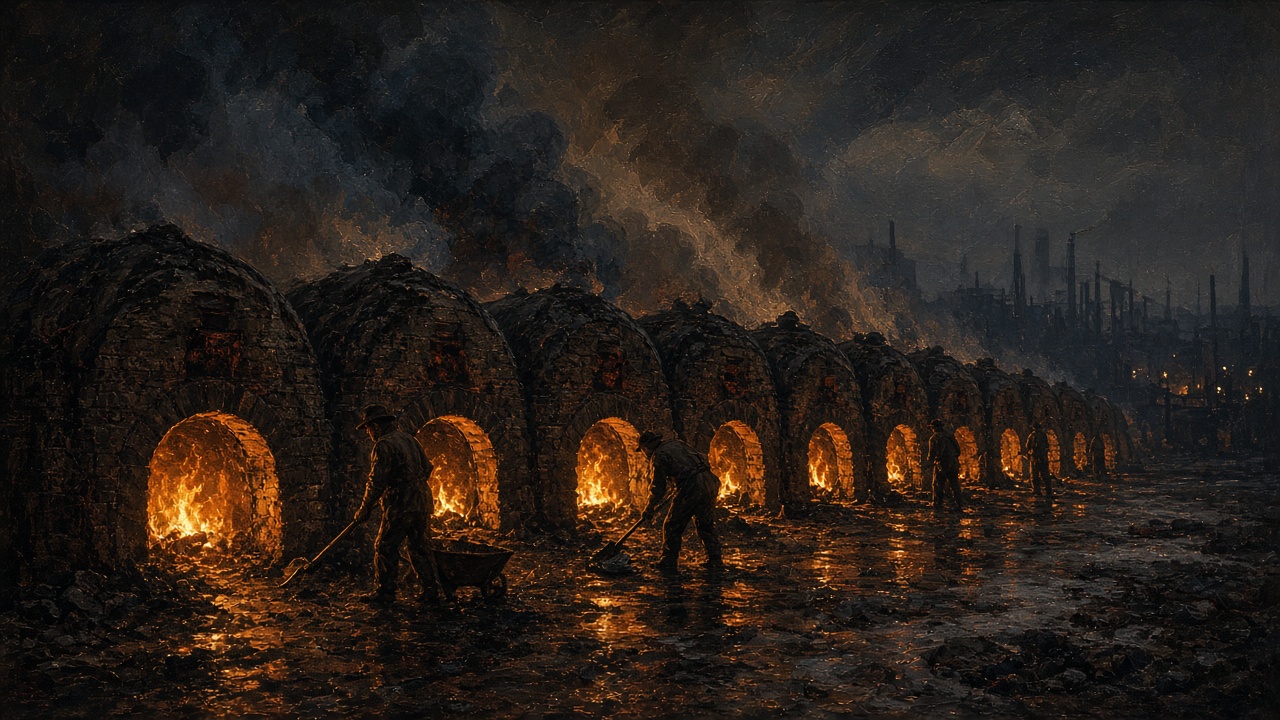
Coke, coal baked in beehive ovens to drive off impurities, was the fuel the furnaces needed, and the Connellsville seam produced some of the best. Frick went into business with relatives in 1871, borrowed from Judge Thomas Mellon, survived the Panic of 1873 by buying up distressed properties, and by 1878, Dietrich wrote, had 1,000 ovens and was a millionaire known as “the coke king.” Britannica dates his first coke ovens to 1870 and Frick and Company to 1871. The SteelCityHistory biography of Henry Clay Frick covers those years in more detail.
How the partnership began
Carnegie’s mills burned huge amounts of coke, and he wanted his own supply. Frick wanted capital. PBS’s American Experience sums up the bargain: “In 1881, Carnegie joined forces with Frick to get the coke he wanted. Frick got the money he needed to expand. But he lost control of his own company. Carnegie quickly became majority stockholder.”
Dietrich places the first deal at a lunch in New York during Frick’s honeymoon in December 1881, hosted by Carnegie and his mother, Margaret. He recounts a story that Margaret Carnegie, suspicious of the hard-driving young man, asked her son in her Scottish brogue what the gain would be “to oos.” The sources disagree on the exact year: PBS says 1881, while an encyclopedia entry on Frick (Encyclopedia.com) says Carnegie took Frick in as a partner in 1882. Dietrich wrote that by 1888 Carnegie’s share of the H.C. Frick Coke Company had grown to 73.5 percent, and that “from 1883 on, Frick was an employee,” in practical terms.
It was contentious from the start. When Carnegie objected to a coal purchase in 1883, Frick wrote back, “I am free to say, I do not like the tone of your letter,” Dietrich reports, and Carnegie backed down.
Frick takes charge of Carnegie’s steel
Despite the friction, Carnegie came to see Frick as the manager he needed. A coke strike in the late 1880s produced an early break: Dietrich writes that Carnegie, who had recently published a book supporting workers’ right to organize, forced Frick to settle with striking miners, and Frick resigned and went to Europe, only to return. (Dietrich’s account gives both 1886 and 1887 for this episode.)
In 1889 Frick became chairman of Carnegie Brothers and Company, according to Britannica. Carnegie was delighted. “Take supreme care of that head of yours. It is wanted,” he wrote, in a letter quoted by PBS. “Again, expressing my thankfulness that I have found THE MAN.” Frick, according to Dietrich, set terms of his own: “I cannot stand fault-finding and I must feel that I have the entire confidence of the power that put me where I am.”
The results were spectacular. Britannica credits Frick with buying out Carnegie’s chief competitor, the Duquesne Steel Works, and with “building Carnegie into the largest manufacturer of steel and coke in the world.” In 1892, under a plan Frick worked out, the firm’s mills were combined into Carnegie Steel Company, Ltd., capitalized at $25 million, according to Encyclopedia.com. Frick’s own stake rose to 11 percent, Dietrich wrote, equal to that of Carnegie’s longtime partner Henry Phipps.
Johnstown, 1889
The two men were linked in another way that year. Both belonged to the South Fork Fishing and Hunting Club, the Pittsburgh retreat whose dam failed on May 31, 1889, and sent a wall of water into Johnstown. The National Park Service’s membership list for the club includes Andrew Carnegie, Henry Clay Frick, Andrew Mellon and Henry Phipps Jr. Dietrich called Frick the club’s largest shareholder and wrote that Frick and Benjamin Ruff bought the reservoir in 1878; the Park Service says Ruff, the club’s first president, bought the property for $2,000 in 1879. See the SteelCityHistory history of the Johnstown Flood of 1889.
Homestead and the first deep crack
The event that most damaged the relationship was the Homestead lockout and strike of 1892. Carnegie had spent years building a reputation as a friend of labor. Frick had a reputation as an executive “who never compromised with his workers,” in PBS’s words. When contract talks with the Amalgamated Association of Iron and Steel Workers reached Homestead, Frick was determined to break the union. On July 6, 1892, barges carrying about 300 Pinkerton guards arrived on the Monongahela, and a battle followed; Encyclopedia.com puts the toll at 10 killed and 60 wounded. Weeks later, on July 23, the anarchist Alexander Berkman shot and stabbed Frick in his office. Frick survived. The full story is in the SteelCityHistory article on the Homestead Strike of 1892.
Carnegie was in Scotland during the lockout, but the sources agree he was not a bystander. “Although Carnegie had supported — and at times directed — Frick’s conduct during the lockout, he tried to foist the blame onto Frick,” PBS says. A 2005 New York Observer review of Les Standiford’s book about the two men quotes Carnegie’s message to Frick during the crisis: “We all approve of anything you do.” Dietrich judged that “any fair weighing of the facts surrounding Homestead leads to the conclusion that Frick acted far more honorably than Carnegie.” Afterward, PBS says, “their relationship grew bitter. Carnegie privately sniped at his partner, which infuriated Frick.”
A partnership on borrowed time
The company kept growing. Encyclopedia.com reports that annual steel production rose from 332,111 tons in 1889 to 2,663,412 tons in 1899, and that profits went from about $2 million to $40 million in 1900. But according to Dietrich, Carnegie meddled more and more in the 1890s: he opposed Frick’s purchase of Mesabi Range iron ore properties, which turned out to be valuable, and he merged a rival coke operator into the Frick company without consulting Frick. Frick resigned in December 1894. Carnegie backpedaled, and Frick agreed to stay on as a non-executive chairman while John G.A. Leishman, and from 1897 Charles Schwab, ran day-to-day operations. Schwab, Dietrich wrote, “mediated between the prickly Frick and the mercurial Carnegie as nobody else could.”
In 1899 Carnegie seemed ready to sell. Dietrich writes that he granted Frick and Phipps an option to arrange a buyout. It did not lead to a sale, and Carnegie kept control of the company until 1901.
The break: coke prices and the “ironclad” agreement
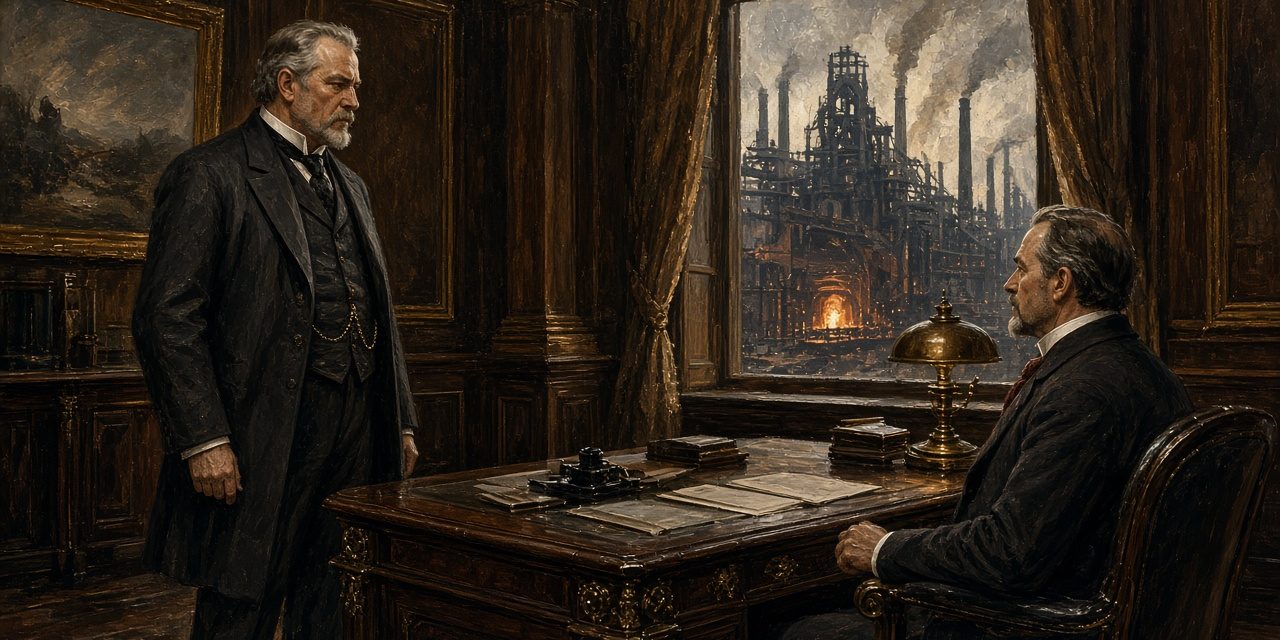
The final fight was over the price Carnegie Steel paid for Frick Coke Company coke. According to Dietrich, Carnegie insisted on $1.35 a ton, while Frick raised the price as the market strengthened, to $1.75. Encyclopedia.com says Carnegie believed he had a binding agreement with Frick on a below-market price, and that Frick stopped deliveries, which threatened to shut the steel company down. “Two reasonable men could have settled on a middle figure,” Dietrich wrote, “but Frick and Carnegie had no desire to be reasonable.”
Frick’s anger at Carnegie’s criticism behind his back spilled into the open. PBS quotes him at a board meeting in this period: “Why was he not manly enough to say to my face what he said behind my back? I have stood a great many insults from Mr. Carnegie in the past, but I will submit to no further insults in the future.” On December 5, 1899, Frick resigned from the board of Carnegie Steel. Carnegie, as majority owner of both the steel and coke companies, pushed him out of both, according to Encyclopedia.com.
Then Carnegie went after Frick’s shares. The weapon was the “ironclad agreement,” a partnership contract that let the company buy out a departing partner’s interest at book value, far below market value. Encyclopedia.com dates it to 1887. Dietrich credited it to Phipps and wrote that it was meant to keep the company from having to liquidate when a partner died, and that a second clause allowed a partner to be forced out by a 75 percent vote. Carnegie got the signatures he needed, Dietrich wrote, and Frick was offered about $5 million, even though, by Encyclopedia.com’s account, the stock was then worth about three times the ironclad valuation.
Frick sues
Frick went to court in equity to have the agreement set aside, and the filings threatened to make public just how profitable Carnegie Steel had become. That threat, the sources agree, pushed Carnegie toward a deal. “After a brief court fight, the men settled,” PBS says. The SteelCityHistory Frick biography dates the settlement to March 1900. Dietrich credits Phipps, who refused to vote with Carnegie, and other mutual friends with brokering it.
How much Frick came away with depends on the source. Encyclopedia.com says the settlement reorganized the company at a valuation that put Frick’s stock at $15 million. Dietrich puts his take at $31 million. The sources read for this article do not explain the difference, so both figures are given here. Either way, as PBS put it, “Frick walked away with pockets bulging.”
After the split
The feud went on in public view. Five months after his ouster, PBS reports, Frick wired Carnegie a list of the company’s “ruinous” decisions, ending: “You are being outgeneralled all along the line, and your management of the Company has already become the subject of jest. Frick.”
In 1901 Carnegie sold to the J.P. Morgan-backed United States Steel Corporation. Britannica says Frick “played a major role” in forming U.S. Steel and later served as a director. Dietrich wrote that Frick’s holdings were valued at $61.4 million in the sale and that he served on its finance committee until his death, though he was never asked to run it.
Frick also built his own monuments in Downtown Pittsburgh. The Frick Building on Grant Street, completed in 1902, went up next to the Carnegie Building. A Bridgeville Area Historical Society article repeats the well-known story that Frick told his architect, Daniel Burnham, to make it the tallest building in the city and to keep the Carnegie Building “perpetually in the shade.” That story is widely told but is not documented in the sources read for this article. Frick also developed the William Penn Hotel, according to Dietrich; see the SteelCityHistory histories of the William Penn Hotel and Pittsburgh’s skyline.
Did Frick really say “I’ll see him in hell”?
The most famous line in the feud is probably not true. In the familiar version, a dying Carnegie sent Frick a message in 1919 asking to meet, and Frick replied, “Tell him I’ll see him in Hell, where we both are going.” Les Standiford used the line for the title of his 2005 book, Meet You in Hell. But reviewing that book in the New York Observer, James McGrath Morris noted that Standiford opens with the words “so the story goes” and called the scene “what’s probably an apocryphal tale.” The verified facts are simpler. PBS says the two men “never met again” after the break; Encyclopedia.com says they “never spoke to each other again.” Carnegie died on August 11, 1919, and Frick died in New York on December 2, 1919, according to Britannica.
Who was the villain?
For more than a century Frick has been cast as the cold enforcer and Carnegie as the philanthropist. Neither source read for this article lets either man off. PBS describes Frick’s “ruthless suppression of strikes” and says the Homestead fight would “brand Frick as cold-hearted, bloodthirsty and mercenary.” Dietrich, who admired Frick as perhaps “the best CEO this town has ever seen,” called Carnegie’s attempt to take his shares at book value “an unconscionable act.” The Observer review argued that Carnegie seemed in the public’s mind “wrongly” to embody a more humane capitalism.
Both left large public legacies. Carnegie’s libraries, museums and institute are covered in the SteelCityHistory Carnegie profile. Britannica says Frick left $15 million and his Fifth Avenue mansion to create the Frick Collection in New York, and gave Pittsburgh a park of about 150 acres with a $2 million endowment. That park is Frick Park, which Dietrich lists at 151 acres. Estimates of Frick’s estate vary widely: Encyclopedia.com gives about $50 million, five-sixths of it for public purposes, while Dietrich gives $145 million, with about $117 million for charity. When the estate was formally appraised in 1923, The New York Times reported a total of $92,953,552.
Common questions
Why did Frick and Carnegie fall out?
The long-term causes were clashing personalities, Carnegie’s meddling, and his attempt to blame Frick for Homestead. The immediate cause, in 1899, was a dispute over the price of coke. Then came Carnegie’s use of the ironclad agreement to try to buy Frick’s shares at book value.
When did Frick leave Carnegie Steel?
Frick resigned from the Carnegie Steel board on December 5, 1899. The legal fight over his shares was settled in 1900.
Were Frick and Carnegie ever friends?
They were close collaborators for years, and Carnegie’s 1889 praise of Frick as “THE MAN” was sincere. But the sources describe tension from the start, and after 1899 they never reconciled.
For the industry the two men built, see the rise and fall of Pittsburgh steel.