
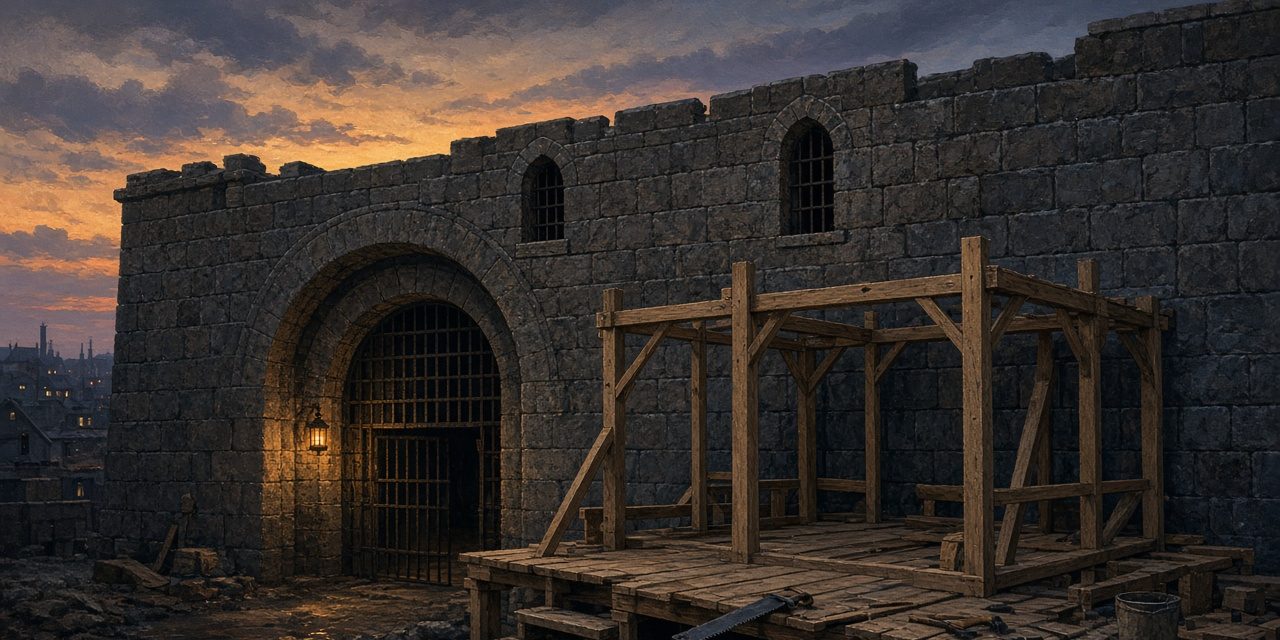
In the fall of 1907, the condemned men on murderers’ row at the old county jail on Ross Street could hear their own gallows being built. A syndicated newspaper feature credited to the New York World said the noise made by carpenters putting up the wooden gallows in the jail yard had rattled their nerves so badly that Warden Edward Lewis had ordered a steel scaffold that could be assembled almost silently, with a few screws and a wrench. That detail says a lot about what Allegheny County jail hangings were like: a crew of carpenters, a stone yard, and men in the cells who knew exactly what the hammering was for. This piece covers the cases that can be documented, how hanging gave way to the electric chair, and what is and isn’t behind the ghost stories.
Where the hangings happened: two jails, one block
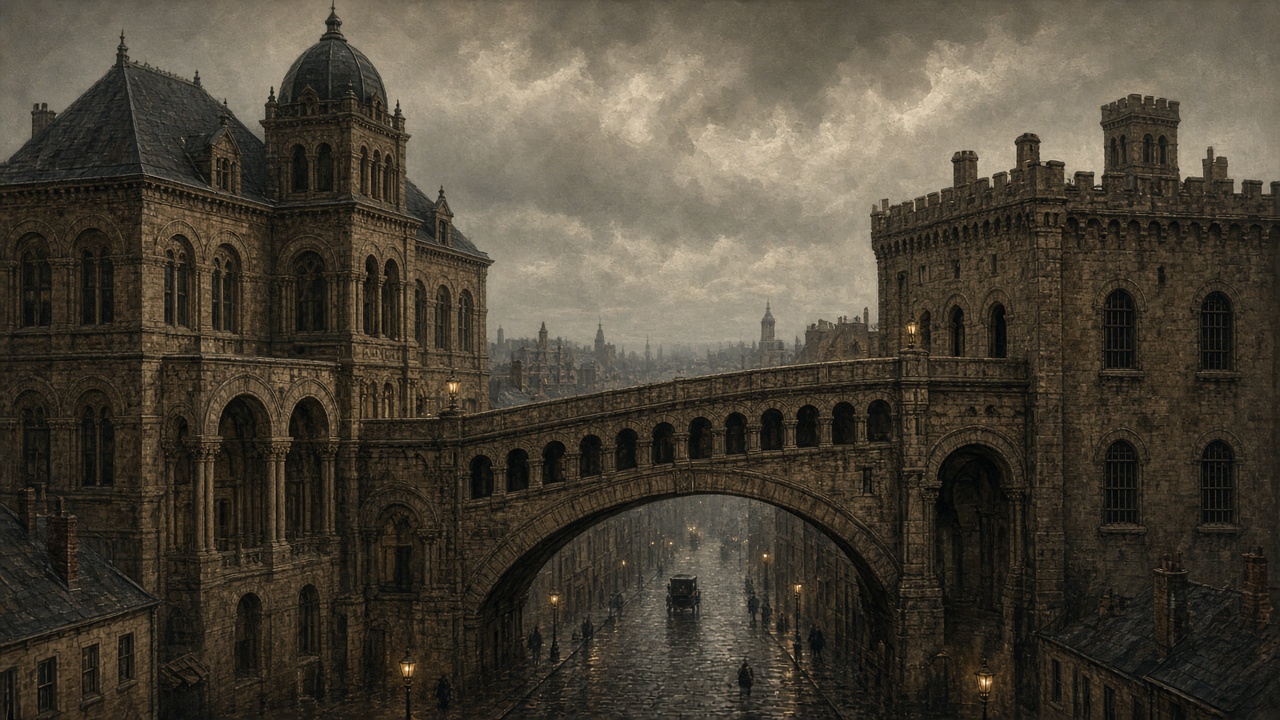
The building most people mean is H. H. Richardson’s granite jail on Ross Street, connected to the courthouse by the Bridge of Sighs. According to the National Register nomination, it was completed in 1886, and the courthouse followed in 1888. It was not the first county jail on that block. A history in Western Pennsylvania History describes an earlier county jail behind the old Grant Street courthouse, on the line of Ross Street, with a walled yard raised well above Diamond Street.
That distinction matters, because the hangings split between the two buildings. Pennsylvania ended public hangings with an act of April 10, 1834, moving them inside the county jail. Researcher Bill Lofquist, whose site State Killings in the Steel City catalogs every Allegheny County execution with newspaper clippings, identifies James Galligo, hanged March 30, 1838, as the first person executed inside the Allegheny County jail. Charlotte Jones and Henry Fife were hanged side by side on February 12, 1858, for the murders of her aunt and uncle, George Wilson and Elizabeth McMasters, near Glassport. A third defendant in that case, Monroe Stewart, was pardoned ten days later, and Lofquist calls it the county’s first wrongful capital conviction. Martha Grinder was hanged on January 19, 1866. Those and the others through 1884 took place in the earlier jail.
The last of them was Martin Weinberger, hanged September 2, 1884, for the murder of Louis Gotfreund, a fellow immigrant peddler. A local-history account from Bell Acres calls Weinberger the last person executed at the Allegheny County Jail. That does not hold up. His hanging came two years before Richardson’s jail was finished, and, as the newspaper reports below show, hangings resumed in the new building and continued until 1911.
Allegheny County jail hangings: the people on the gallows
By Lofquist’s list, the first execution after Weinberger was Patrick Fitzpatrick’s on May 24, 1892, the first in nearly eight years. That has to have been in the new jail, since it was finished in 1886. The last was John Tyrie’s on May 23, 1911. From Fitzpatrick through Tyrie, Lofquist’s list has 38 hangings. A few of them, with the details the record supports:
Patrick Fitzpatrick, 1892. Fitzpatrick, an Irish-born man who had worked in a Dublin brewery, stabbed Samuel Earley on the sidewalk outside Mulvihill’s Saloon in the Phoenix Hotel on September 2, 1891, after a quarrel inside. He was convicted less than four weeks later. The Pittsburgh Press thought the case looked closer to second-degree murder, and the warden said he dreaded the hanging because Fitzpatrick was a “model prisoner.” The Daily Post wrote that “the legal killing of a human being for the illegal killing of another has very little effect as a warning.” The Press also reported that it took 18 minutes before he was pronounced dead.
George Schmous, 1894. On the night of July 26, 1893, Schmous, an iron worker, killed his wife, Catherine, and their daughters, Mary and Maggie, in their South Side home. Their son Johnnie, who survived, testified against him. Schmous was hanged September 20, 1894.
Daniel Werling, 1895. Werling shot his wife, Barbara, at her stand in the Diamond Market on April 7, 1894, after being released from a sentence for assaulting her. His lawyers argued that the Keeley Cure for alcoholism had left him insane. The argument failed, and he was hanged July 9, 1895. Lofquist notes a long history of abuse and that the newspaper coverage of his earlier crimes against her was casual.
The 1900s surge. Lofquist describes an unprecedented burst of death sentences between 1897 and 1907, and the list bears it out: seven hangings in 1904 alone. On March 23, 1905, as reported in a wire story, the noose pulled loose when William Byers dropped through the trap. Sheriff James Dickson caught him as he staggered, and the rope was fitted again. On April 27, 1905, Charles Jackson, Charles Miles and Walter Obey were hanged for the murder of Ivan Kluzor in Leetsdale. The dispatch said it was the first time three men had been hanged in one day in the county, and that more than 200 spectators were present.
Norris B. Holmes, 1908. A newspaper called the 19-year-old the youngest person ever executed in Allegheny County. He was hanged March 12, 1908, for killing Nancy Miller.
Steve Rusic, 1911. A Hungarian immigrant who worked at the Pressed Steel Car Company, Rusic shot Galvarra (Beta) Domboy as she slept next to her husband and baby on January 15, 1910. He was hanged March 21, 1911, after singing a hymn on the way, according to a wire story. Lofquist adds a footnote that mattered at the time: the Socialist editor Frederick Merrick wrote that Judge Marshall Brown had treated Rusic, an immigrant laborer, far more harshly than Brooks Buffington, who was acquitted of a bar shooting on grounds of alcohol-related insanity. Merrick was convicted of criminal libel for saying so.
John Tyrie, 1911. Tyrie beat Mary Emery, 35, to death at their Kirkpatrick Street home in the Hill District on July 12, 1910. He was hanged May 23, 1911, the last hanging in Allegheny County and the last execution inside the county jail. A wire story said a policeman among the witnesses fainted when the trap was sprung.
Lofquist argues that the pattern of who was hanged changed over these years. He sees Fitzpatrick as the end of an era when capital defendants were mostly white men tried with some hesitation, and the later gallows crowded with immigrant laborers and Black defendants. That is his analysis, and it is worth reading in full, but the names and dates above stand on their own.
How a hanging worked, and why people wanted a replacement
Executions were run by the sheriff, in front of a limited list of witnesses. Forty-five officials, journalists and jurors watched Weinberger. Doctors stood by to take the pulse. In the 1907 feature, the gallows was a wooden one that carpenters put up in the yard, which is why Warden Lewis wanted something quieter.
Contemporary reports are blunt about how often it went badly. Lofquist describes Fife’s and Jones’s hangings in 1858 as botched, and the Press account of Fitzpatrick’s in 1892 recorded 18 minutes. (Accounts of Weinberger’s differ: one local history says the drop failed to break his neck, while another summary says the Press called it quick.) Byers’s rope failed in 1905. Lofquist writes that newspaper descriptions show strangulation, sometimes along with other mishaps, occurred routinely into the twentieth century, and that by then a consensus had formed, since New York’s first electrocution in 1890, that the electric chair was more humane, though he calls that debatable.
From the gallows to the electric chair: the 1913 law and Rockview
The Act of June 19, 1913 (P.L. 528) ended the county gallows. It required that a sentence of death be carried out by “a current of electricity of intensity sufficient to cause death,” administered by the warden of the Western Penitentiary, in a building on state land in Centre County. That land became the new Western Penitentiary at Rockview. In Commonwealth v. Tassone (1914), the state Supreme Court rejected a challenge that the act was an improper amendment of an earlier statute.
The first electrocution at Rockview was John Talap’s on February 23, 1915, according to the Pennsylvania Center for the Book, which counts 350 uses of the chair there through 1962. Allegheny County’s first came about a year later. Martin Kristan, a Slovenian coal miner who shot his wife, Mary (Fannie) Kristan, through her window on September 23, 1914, was electrocuted on March 20, 1916. He was the first Allegheny County inmate electrocuted and the first executed outside the county. By then it had been nearly five years since Tyrie. Allegheny County cases continued at Rockview, and Lofquist’s list runs through 1959.
The ghost stories: what’s documented and what isn’t
This is the shortest section on purpose, because most of what you’ll hear on a ghost tour has no source I could find from the time. Here is what I could trace.
The Culp story is a real 1907 newspaper report, with a different ending than modern retellings. A New York Times story dated September 15, 1907, titled “Murderers Saw a Ghost,” is the source a ghost-hunting blog cites. I could not open the Times piece, but I read a syndicated version credited to the New York World in two Oklahoma papers, the Cleo Journal (October 24, 1907) and the Claremore Messenger (October 25, 1907). It says prisoners and guards claimed the ghost of W. A. Culp, who had killed himself in his cell while awaiting trial for murdering his brother, kept returning between midnight and 1 a.m. to act out the killing. Warden Lewis moved the 14 men on murderers’ row to another section. Culp was not executed (some retellings leave that open), and I found no court or coroner record of him. A deputy warden told the first frightened prisoner he’d been dreaming.
The same feature undercuts its own spookiness. It describes an “unearthly shriek,” several years earlier, every night at nine when the jail’s lights were switched between dynamos, and says the warden finally traced it to a prisoner using a paper-covered comb and a rolled-up newspaper. It also says prisoners had claimed to see the ghosts of the Biddle brothers and of Michael Ruminski. His suicide is documented: he strangled himself in his cell on January 17, 1899, awaiting execution for killing his wife, Johanna, and the jail put condemned men on a death watch afterward. The ghost is the newspaper’s claim.
Kate Soffel’s ghost is a modern tour story. A 2016 KDKA piece quotes a Haunted Pittsburgh guide saying she shuffles papers and touches guards. I found no account of it from her era; the 1907 feature mentions the Biddle brothers’ ghosts, not hers. The real events of the 1902 Biddle escape are told in our posts on Kate Soffel and the Biddle brothers, and the broader lore is in our earlier post on the jail’s reputation.
“58 hangings, and a ghost sighting after every one” is the same guide’s line. Counting Lofquist’s list from Galligo in 1838 to Tyrie in 1911 gives about 58 executions in the county’s jails. But by the dates, 38 of them were in Richardson’s building (completed in 1886), and the guide’s “after every hanging” claim has nothing behind it that I could find.
What’s left today
The old jail closed on July 27, 1995. It now houses the Family Division of the county’s Common Pleas Court, and a preserved portion of a cell block is the Old Allegheny County Jail Museum, run by the Pittsburgh History & Landmarks Foundation at 440 Ross Street. Check the foundation for current visiting days. The Bridge of Sighs still crosses Ross Street. I found no evidence that any gallows survives.
Behind every name above are two families. A grandson of Martin Kristan left a comment on one of Lofquist’s pages in 2021, asking for photographs and anything else that could be found about what happened. That may be the most honest reason to keep the record straight.