
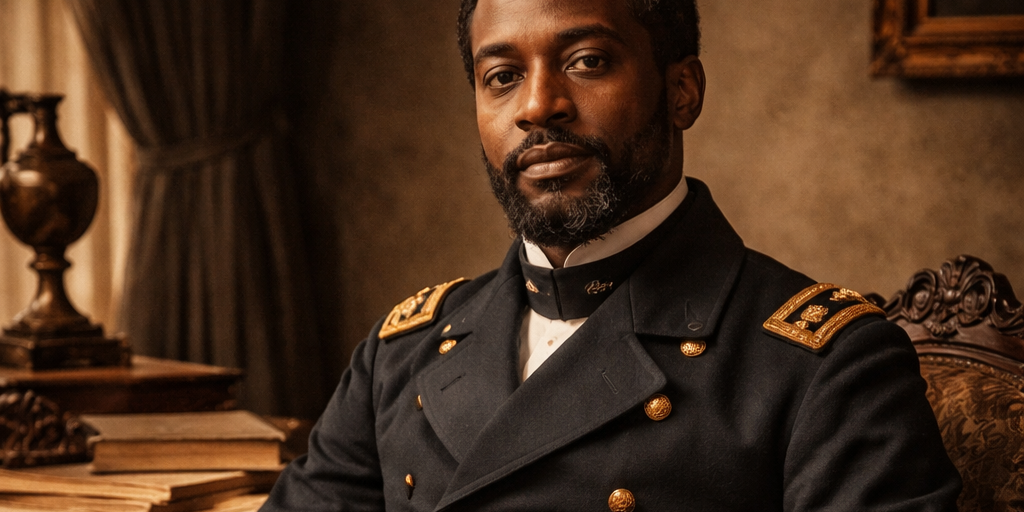
Martin Delany Pittsburgh history begins with a remarkable fact that most people, including most Pittsburghers, have never heard. In February 1865, President Abraham Lincoln personally commissioned Martin Delany as a Major in the Union Army, making him the first Black field officer in the history of the United States. The two men met in early 1865, and Lincoln, who had been impressed enough to describe Delany in a written note to Secretary of War Edwin Stanton as “a most extraordinary and intelligent man,” approved the commission. It was a distinction that had been earned through a lifetime of intellectual labor, political activism, and the specific kind of radical courage that his era demanded of any Black man who refused to accept the terms it tried to impose on him.
That meeting with Lincoln is a fact. It is documented. It belongs in every survey of American history that takes seriously the contributions of Black Americans to the Civil War and to the political thought that preceded and surrounded it. It belongs especially in Pittsburgh’s history, because Pittsburgh is where Delany became the man Lincoln met. He arrived here at nineteen years old, largely self-educated, determined to make something of himself in a country that had decided against allowing people who looked like him to make anything at all. The city shaped him. What he built here shaped the country.
Arriving in Pittsburgh
Martin Robison Delany was born on May 6, 1812, in Charles Town, Virginia, in what is now West Virginia. His mother, Pati, was a free Black woman. His father, Samuel, was enslaved. The specific legal and social circumstances of his birth placed him in the complex middle ground of a society that constructed its racial categories with cruel precision and applied them with equally cruel inconsistency.
When Delany was about ten, Virginia’s ban on educating Black children forced his mother to move the family to Chambersburg in free Pennsylvania, where his father later bought his freedom and joined them. In 1831, at nineteen, Delany went west to Pittsburgh. He came to a city that was already developing a free Black community of unusual depth and organization. Pittsburgh’s geography made it significant: situated at the confluence of the three rivers, at the northern edge of the territory where slavery was legal, it was a natural destination for free Black people seeking the relative safety of a northern city and for freedom seekers crossing the Ohio River in the night. The community that had established itself here was not merely surviving. It was building.
Delany embedded himself in that community immediately and completely. He attended the school run through the African Methodist Episcopal community, studied classics with a local tutor, and, during the 1832 cholera epidemic, apprenticed himself to the physician Andrew N. McDowell, learning the cupping and leeching that were then standard treatments. He kept reading and studying under abolitionist doctors, including F. Julius LeMoyne and Joseph Gazzam, and took part in the city’s temperance, literary, and anti-slavery societies. In 1843 he married Catherine Richards; the couple had eleven children, seven of whom lived to adulthood.
Lewis Woodson and the Education of a Radical
The most important relationship Delany formed in his early Pittsburgh years was with Lewis Woodson, a minister at Bethel African Methodist Episcopal Church who was one of the most intellectually formidable figures in Black Pittsburgh. Woodson, who also ran a barbershop and, with John Vashon, founded the Pittsburgh African Education Society, was a thinker who had arrived at conclusions about the situation of Black Americans that were, for his era, genuinely radical. He believed that Black Americans needed to develop their own separate institutions, their own economic infrastructure, their own communal identity, rather than seeking integration into a white American society that had demonstrated it was not prepared to accept them as equals.
These ideas belong to a tradition of Black nationalist thought that scholars trace through the nineteenth and twentieth centuries. In the 1830s, in Pittsburgh, Lewis Woodson was working them out, and Martin Delany was listening. The intellectual framework that Delany would spend his career developing and articulating was formed in large part in conversation with Woodson in the community organized around Bethel AME in Pittsburgh’s Hill District and surrounding neighborhoods.
John Vashon, another pivotal figure in Black Pittsburgh, ran a barbershop and bathhouse that served as a gathering place for the free Black community, and worked with the city’s anti-slavery Vigilance Committee, which helped freedom seekers moving through Pittsburgh. Delany moved through this world, absorbing its political urgency and contributing to it in return. Pittsburgh’s free Black community was not a passive population waiting for white abolitionists to act on its behalf. It was an active, organized, intellectually serious force, and Delany was becoming one of its most significant voices.
The Mystery and the Pittsburgh Press
In 1843, Delany founded a newspaper called The Mystery, which he published in Pittsburgh until 1847. It is generally described as the first Black newspaper west of the Allegheny Mountains, and Black-owned papers were rare anywhere in the country at that time. His articles were often reprinted elsewhere, including in William Lloyd Garrison’s The Liberator. The Mystery served the function that Black newspapers consistently served in this era: providing news and opinion that the white press either ignored or distorted, advocating for the rights and dignity of Black Americans, and building the sense of collective identity and shared purpose that any political movement requires.
Delany used The Mystery to advocate for abolition, to document the conditions of Black life in Pittsburgh and beyond, and to develop his own evolving political philosophy. The paper gave him a platform and a discipline. The paper also got him into trouble: in 1846 a Black man named Johnson sued him for libel after the paper accused Johnson of being a slave catcher, and Delany was fined $650, which white newspaper supporters reportedly paid for him.
Douglass and Delany met in Pittsburgh in 1847, and when Douglass launched The North Star in Rochester, New York, that year, Delany joined the project. Douglass handled the editing and publishing in Rochester, while Delany traveled to lecture, report and collect subscriptions. The partnership was productive, but it also illuminated a fundamental difference in their thinking about what Black Americans should do about their situation in the United States.
The Great Debate: Douglass and Delany
Frederick Douglass believed that Black Americans should fight for full citizenship and equality within the United States, that the promises of the founding documents should be claimed and enforced rather than abandoned. It was an integrationist position, morally compelling, grounded in a vision of American democracy that insisted on its own fulfillment. It is the position that history has largely celebrated as correct, and Douglass is remembered as one of the great Americans of any era.
Martin Delany disagreed. Not with the moral vision, but with the practical assessment. Delany looked at the evidence of his own lifetime and concluded that the United States was not going to deliver on its founding promises to Black Americans within any timeframe that made waiting for it a viable strategy. His 1852 book, “The Condition, Elevation, Emigration, and Destiny of the Colored People of the United States,” argued this case at length and with systematic rigor. Black Americans, Delany wrote, needed to consider leaving to establish their own nation (he named the West Indies and South America as possibilities in that book), their own territorial base from which to exercise the full range of human and political capability that American society was blocking.
The argument was not a counsel of despair. It was a strategic assessment by a man who had spent his adult life watching what happened to Black people in America and drawing conclusions from that evidence. Delany was not telling Black Americans to give up. He was telling them that the ground they were standing on was not stable and that different ground might be available if they looked for it.
The disagreement with Douglass was real and ongoing and conducted with the respectful intensity of two brilliant people who fundamentally disagreed about the most important question of their era. History has complicated the conventional preference for Douglass’s position. The conditions that Delany was describing in 1852 persisted for another century after he wrote about them. The question of whether patient engagement within American democracy would deliver justice to Black Americans was not settled by Reconstruction, which failed. It was not settled by the Civil Rights Movement, which achieved enormous things and left enormous things unfinished. The debate between the positions Douglass and Delany articulated in the 1840s and 1850s has never been fully resolved.
Harvard and the Rejection
In 1850, Martin Delany applied to Harvard Medical School with letters of support from seventeen physicians, after other schools had rejected him, and was admitted as one of the first three Black men there. The month after he arrived, a group of white students sent the faculty a protest against admitting Black students. Delany and the other two, Daniel Laing Jr. and Isaac Snowden, were forced out after one term when white students protested, even though some students and faculty supported them.
Harvard was not a backwater. Delany returned to Pittsburgh without a degree and went back to practicing medicine on the strength of his apprenticeships. During the 1854 cholera epidemic, when many doctors and residents fled the city, he stayed with a small group of nurses and treated patients.
The Harvard episode confirmed something Delany had been arguing for years. The barriers facing Black Americans were not accidental or peripheral. They were structural and systemic, embedded in the operations of the most respected institutions in the country. A man who had earned his way into Harvard Medical School could be removed from it because of his race, with the full cooperation of the school’s administration. The implications of that fact for any theory of progress through individual merit and patient engagement were not lost on Delany or on anyone paying attention.
The Civil War and Major Delany
By the time the war came, Delany was no longer in Pittsburgh. In 1856 he had moved his family to Chatham, Ontario, where he helped resettle people who had escaped slavery. In 1859–60 he traveled to West Africa to investigate a settlement in what is now Nigeria, signing an agreement with Abeokuta-region chiefs that collapsed amid regional warfare, missionary opposition, and then the U.S. war. He also serialized a novel, Blake; or the Huts of America, in 1859 and 1861–62. When the United States Colored Troops were created in 1863, he gave up the Africa plan and began recruiting Black soldiers, mostly in Rhode Island, Connecticut and Ohio. His son Toussaint Louverture Delany served in the 54th Massachusetts.
His meeting with Lincoln in February 1865 came near the end of the war, as the Union victory was becoming increasingly certain. Delany proposed a corps of Black troops led by Black officers, who could enforce emancipation and recruit newly freed Southerners. The government had turned down a similar proposal from Douglass, but Lincoln was receptive. The commission as Major followed in February 1865. The war ended before Delany’s proposal could be fully implemented, but the commission itself was historic. The first Black field officer in the U.S. Army had spent his formative years in Pittsburgh, had built his intellectual and political foundations in conversation with Lewis Woodson and John Vashon, and had published his first newspaper there. Note the limits of the title: Dr. Alexander T. Augusta, a surgeon, reached a higher rank (lieutenant colonel by brevet), so Delany is best described as the first Black field officer rather than the highest-ranking Black officer of the war.
Reconstruction and the Long Aftermath
After the war, Delany stayed in South Carolina, serving at Hilton Head with the Freedmen’s Bureau before resigning from the Army later in 1865. He pushed for land for freedpeople and got into the complicated politics of the state. His later record is mixed: he ran unsuccessfully for lieutenant governor in 1874 as an Independent Republican, was appointed a trial justice in Charleston and then forced out after a conviction in 1875 for defrauding a church (he was pardoned), and in 1876 backed Democrat Wade Hampton for governor, a controversial choice in an election marked by violence against Black voters. Historians still argue about how to read those choices.
He continued writing and speaking until near the end of his life. He died on January 24, 1885, in Wilberforce, Ohio, having outlived the Reconstruction era and witnessed the beginning of the reversal of its gains. He was seventy-two years old.
Delany at a Glance
| Date | Event |
|---|---|
| May 6, 1812 | Born free in Charles Town, Virginia (now West Virginia) |
| 1831 | Arrives in Pittsburgh at 19 |
| 1843 | Starts The Mystery; marries Catherine Richards |
| 1847 | Joins Frederick Douglass’s North Star effort |
| 1850 | Admitted to, then dismissed from, Harvard Medical School |
| 1852 | Publishes The Condition, Elevation, Emigration, and Destiny of the Colored People |
| 1854 | Treats cholera patients in Pittsburgh; leads National Emigration Convention in Cleveland |
| 1856 | Moves family to Chatham, Ontario |
| 1859–60 | Travels to West Africa and England |
| Feb. 1865 | Commissioned a major |
| Jan. 24, 1885 | Dies in Wilberforce, Ohio |
Where to See Delany’s Pittsburgh
A Pennsylvania state historical marker at 5 PPG Place, at Third Avenue and Market Street Downtown, notes that he published The Mystery at an office nearby. Bethel AME, where Lewis Woodson ministered, and the neighborhood around it are covered in our Hill District history and in The Hill District Before Jazz.
Why Pittsburgh Should Know This Name
Martin Delany’s contributions to American history are substantial enough that they require no inflation. The first Black field officer in the United States Army. An early and influential voice for Black nationalism. A traveling reporter and organizer for Douglass’s North Star. A practicing physician who stayed to treat cholera patients in 1854 after being dismissed from Harvard because of his race. A man who persuaded Abraham Lincoln to approve a commission.
All of that was built on the foundation he laid during the years he spent in Pittsburgh, in the barbershop and the church meetings and the newspaper office, in conversation with Lewis Woodson and John Vashon and the community of free Black Pittsburghers (see also early Black entrepreneurs in Pittsburgh) who were doing something extraordinary in a city that the historical record has not always adequately credited. They were building an intellectual and political tradition under conditions designed to prevent exactly that, and Martin Delany was one of their most gifted products.
He is not as famous as Frederick Douglass. He may never be. But the history of Black Pittsburgh, and of Pittsburgh broadly, is incomplete without him.
Frequently Asked Questions
Was Martin Delany born in Pittsburgh? No. He was born in Charles Town, Virginia, raised in Chambersburg, Pennsylvania, and came to Pittsburgh in 1831. He left for Canada in 1856.
Did Delany graduate from Harvard Medical School? No. He was admitted in late 1850 and forced out after one term when white students protested.
Was Delany the highest-ranking Black officer of the Civil War? No. He was the first Black field officer (major). Surgeon Alexander T. Augusta reached a higher rank by brevet.
Where was The Mystery published? In Pittsburgh, beginning in 1843. A state marker at 5 PPG Place notes its office was nearby.
Sources
Wikipedia, “Martin Delany”; African American Registry and Wikipedia on Lewis Woodson; Axios Pittsburgh, Feb. 25, 2026, on Pittsburgh’s Underground Railroad history; Explore PA History (PHMC marker listing); Visit Pittsburgh historical markers page.