
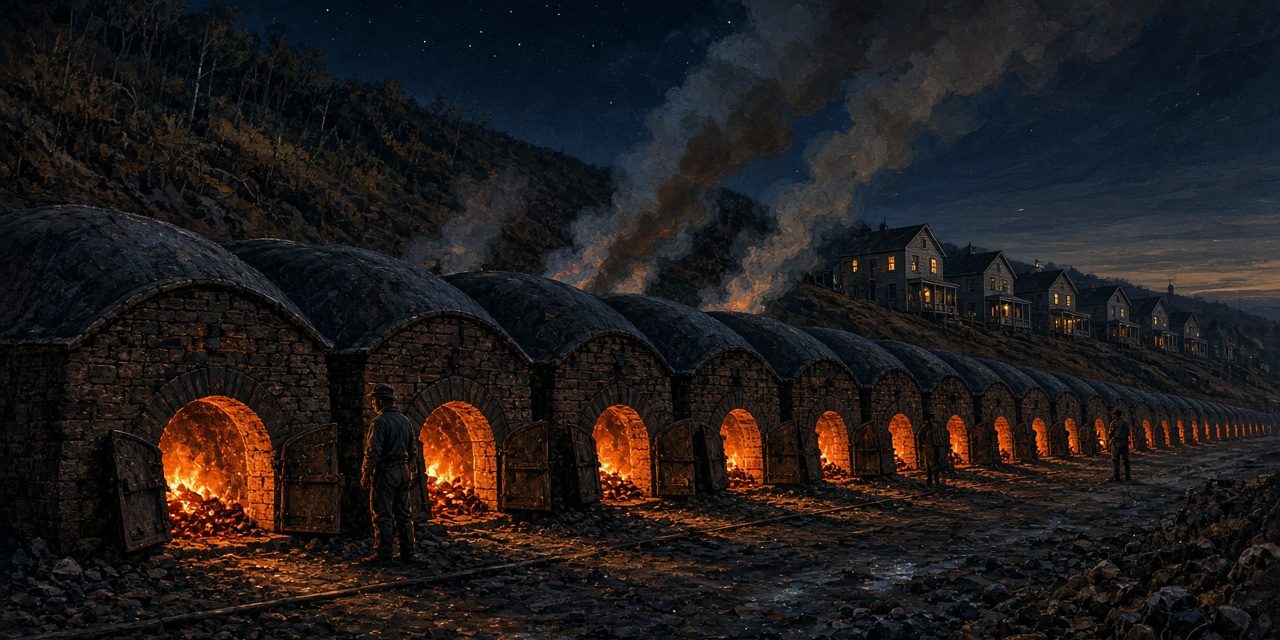
In December 1880, Harper’s New Monthly Magazine told readers about a fuel it called Connellsville coke, baked in ovens southeast of Pittsburgh, and about what those ovens looked like at night. “The nocturnal appearance of a range of coke ovens in full blast,” the magazine wrote, “so nearly embodies the orthodox idea of Satanic scenery that unregenerate Pittsburghers have comparatively few surprises in store after this life.” Pittsburgh’s own reputation for smoke was already well established. The line is quoted in a 2014 preservation assessment of the coke ovens at Dunbar, and it points to a part of the story that Pittsburgh’s steel history tends to skip: the furnaces in the city ate fuel that came from somewhere else, and the somewhere else was worse to look at.
A narrow strip of very good coal
Connellsville coke came from a seam that ran through two counties, not one. The state’s historical marker commentary describes “a skinny strip of land, scarcely two or three miles wide, running some fifty miles through Westmoreland and Fayette counties,” from Latrobe in the north through Mount Pleasant, Dawson and Connellsville to just south of Uniontown. The Library of Congress’s Historic American Engineering Record (HAER) survey puts the Pittsburgh seam under the region at nearly 147 square miles and says that, together with the adjacent Klondike fields, it held “the world’s largest complex of beehive coking ovens.”
The coal mattered because of what it was not. According to a 1992 National Park Service analysis, Connellsville coal came out of the mine already broken up, saving the cost of crushing it, and it was low in ash, phosphorus and sulfur, leaving nearly pure carbon after coking. A blast furnace needs a fuel that will not crush under a tall load of iron ore, and the same study, quoting an earlier one, says the coal “was comparatively free from impurities and possessed a strong structure capable of bearing the heavy burden of the blast furnace charge.” When the lower part of the district opened up after 1900, farms there, in the words of a local historian quoted by the state, suddenly “blossomed into gold.”
How a beehive oven worked
The ovens took their name from their shape: masonry domes roughly twelve feet across and five to seven feet tall by the state marker’s measure, built in long banks along hillsides or in back-to-back blocks on flat ground. The park service study gives slightly different ranges for the height and diameter, and notes that Frick standardized his own ovens while the industry as a whole did not.
The work was divided into jobs with their own names. A charger dumped six or seven tons of coal through the opening at the top, the trunnel, for a 48-hour burn, or eight tons for a 72-hour weekend burn. A leveler spread it with an eighteen-foot bar. The oven’s door was bricked up, leaving a gap for air, and the coal burned from the top down. When it was done, a water boy tore out the door and sprayed the coke to cool it, and a puller raked the coke out onto the yard to be loaded into railroad cars. The 2014 Dunbar assessment says the burning gases lit the sky at night and gave off, in its words, “the pungent smell of rotten eggs.”
The beehive was cheap and wasteful. The state says it turned as much as seventy percent of each ton of coal into coke, against about fifty percent for the older method of burning coal in covered mounds, and everything else went into the air as smoke. According to the park service study, a beehive cost about $300 to build, while the by-product ovens that later replaced them cost $1,600 to $2,200 each.
From a few hundred ovens to tens of thousands
The state says the first proper beehive ovens in the district were built in 1841 near Sedgwick Station, though another state marker places the first beehive production in the 1830s. There were twenty-six ovens by 1855, when the railroad arrived. By 1870 the whole Connellsville region had only around twenty coke works and about 550 ovens, according to the Dunbar assessment. Then the steel industry took off. The park service study says 3,578 ovens were built in the region in the two years 1876 and 1877, and that by 1900 there were more than 20,000.
The peak is harder to pin down than it sounds, because sources count different areas and different years. The state marker says that at its peak in 1913 the Connellsville district’s 38,000 ovens supplied half of the nation’s metallurgical coke. A marker at Adelaide says 44,252 of Pennsylvania’s 55,166 coke ovens were in the region in 1910. The state’s second marker has the whole Pittsburgh seam peaking at almost 48,000 ovens in 1910 and about 46,000 in 1916. The park service study says only that peak production came between 1906 and 1910. All of them agree on the point that matters: for a few decades one narrow stretch of two counties produced a large share of the fuel behind American iron and steel.
The Coke King
The man who came to stand for the region began as a bookkeeper. Henry Clay Frick was twenty-one or twenty-two, depending on the account, when he bought coal land with his Overholt cousins and started building beehive ovens. The state marker says he got a $10,000 loan from the Pittsburgh banker Thomas Mellon. A New York Times obituary in 1919 says Mellon sent an agent, J. B. Corey, to look the young man over, and that Corey spent a day and a night in the two-room cabin that served as home and office. When Frick asked the Mellon bank for a second loan, the state says, its report read: “lands good, ovens well built; manager on job all day, keeps books evenings . . . knows his business down to the ground.”
Frick bought hard during the Panic of 1873, when others sold. By 1873 the state counts 200 ovens, and by 1879 he had 853. A Western Pennsylvania History article on his career says he controlled 1,022 ovens in 1882, almost one in every eight in the district, and that his company held well over half of the industry by 1900. (The SteelCityHistory profile of Frick covers the rest of his career.) Andrew Carnegie’s company took a controlling share of the H. C. Frick Coke Company, and Frick’s coke went to steelmakers well beyond Pittsburgh. The state says he was shipping to Salt Lake City and Syracuse within a decade, and that Chicago-area steel companies held a dominant share in the South West Coal and Coke Company, which owned the Morewood property.
The people in the patches
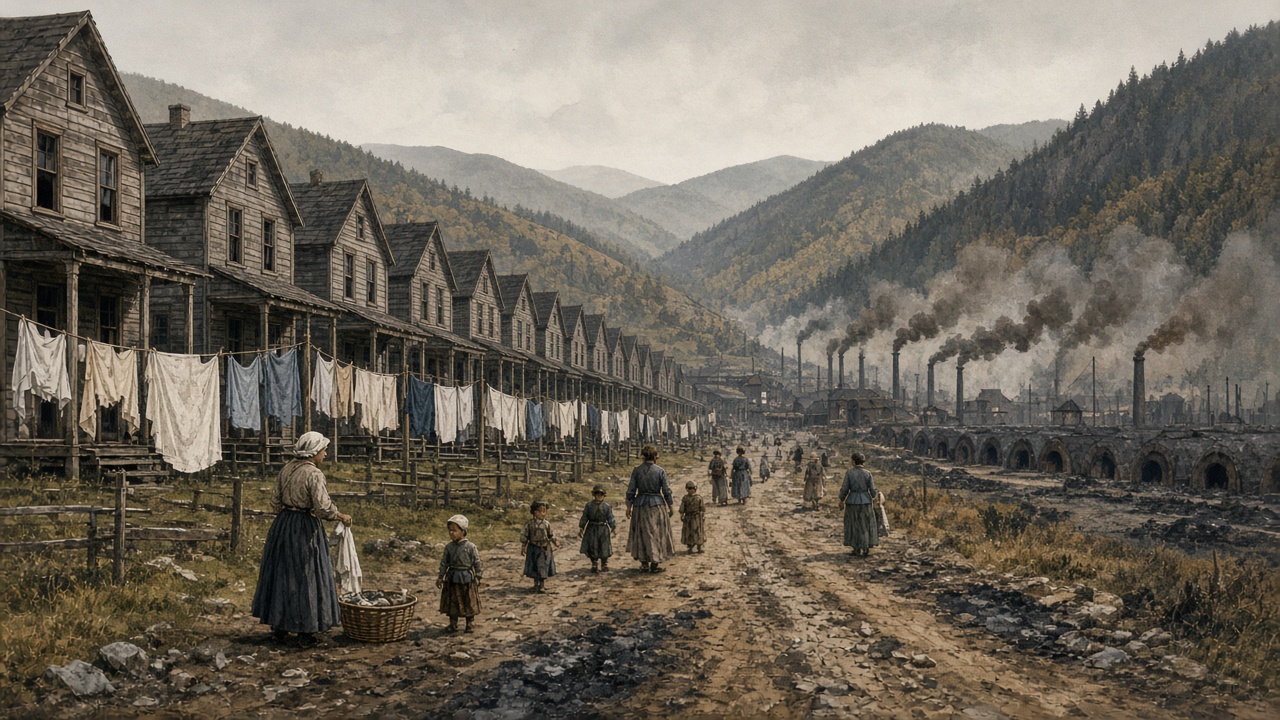
Early coke workers were local farmers and townsmen of English, Welsh, Irish, Scots-Irish and German descent, according to the park service study. The industry outgrew that labor supply fast. In 1879, the state says, Frick brought the first immigrant workers from eastern and southern Europe to Morewood. A visiting Pittsburgh Dispatch reporter, in the hostile language of the day, called them “a convenient lever to the operator’s hand, wherewith he regulates the more demanding spirit of his other laborers,” and was astonished that their wives helped fork coke into railcars. The state says they came from mining districts in Italy, Bohemia, Hungary and Poland, and the park service study says the census category “Hungarian” lumped together Hungarians, Slovenes, Germans, Croatians and Slovaks. Before 1900 most of them were single men between nineteen and thirty-five who meant to go home. The same study says about two-thirds ended up staying.
They lived in company housing known as patches, close enough to the ovens that smoke and cinders left, in the study’s words, “a thin film on rugs and wallpaper, inside bureau drawers, and in people’s hair and food.” Companies controlled daily life through rent contracts, company stores and scrip. The study credits Frick with introducing company scrip, the “Frick Dollar,” in western Pennsylvania during the panic of 1873. The Pittsburgh Labor History Trail says the men who tended the ovens worked eighty-four hours a week. A worker named Matthew J. Welsh wrote to the Pittsburgh Times in April 1894 that “ignorant as we are, we know that it is time to quit work and die of starvation rather than be trying to work and starving at the same time.”
1891
The year 1891 was the worst in the region’s history. On January 27, an explosion at Mammoth No. 1 Mine, which the Frick company had bought in 1889, killed 109 men and boys. The state marker says it was the worst bituminous mine disaster in Pennsylvania up to that time, and that seventy-nine of the dead were buried in a mass grave at St. John’s Cemetery in Scottdale. A state commission found that mine gas had been ignited by open flames and called the mine safety law “very defective and ambiguous.”
Within weeks the coke workers struck. Ten thousand men and 95 percent of the region’s 16,000 ovens were idle by early February, according to the state. The companies wanted a sliding scale that pegged wages to the price of coke, and Frick wrote to a Carnegie manager that if the companies won, “union organization in the Coke region is killed.” On April 2, around a thousand strikers marched on Frick’s Morewood works near Mount Pleasant. Seven were shot dead and two more died later.
Accounts disagree about who fired. The Pennsylvania Historical and Museum Commission’s Morewood marker says sheriff’s deputies killed the strikers. The state’s longer account says guardsmen under Captain Loar, a local dentist, opened fire “on whose orders it is not clear.” A list of the dead posted with the marker at the Historical Marker Database identifies them as Hungarian, Polish and Italian. About 10,000 people attended the funeral, by the state’s count. The strike collapsed in late May, and Frick cabled Carnegie, “Coke victory complete.” A month later he asked a lieutenant what had become of the Winchester rifles and pistols bought for the strike. The next year came Homestead.
The ovens go dark
Two things ended the beehive’s dominance. One was pollution. The state quotes a 1911 federal report on the region that said “the smoke and gas from some ovens destroy all vegetation around the small mining communities,” and the University of Wisconsin president Charles Van Hise, who saw the ovens from a train, wrote that “by night the scene is rendered indescribably vivid by these numerous burning pits.”
The other was a better oven. By-product ovens captured the gas, tar and ammonia that beehives let go. The first in the region, fifty of them, were built at Dunbar in 1894, according to the park service study, though cheap beehives and plentiful Connellsville coal delayed the switch for years. A by-product plant with 640 ovens was running at Clairton by 1918, and the same study says by-product production passed beehives in 1924, by which time a third of the region’s beehive ovens had closed. Because by-product ovens could use lower-grade coal and sat near the mills rather than the mines, the coking left the mining region, and the new centers were places like Clairton (see the SteelCityHistory piece on the Mon Valley). In 1910 beehive ovens made more than 80 percent of America’s coke, the state says, and two decades later less than 6 percent.
Sources differ on when the fires went out. The state says the last beehive ovens stopped operating in 1972. The park service study says limited beehive production continued in the Connellsville region until the late 1950s, with idle ovens fired up again during World War II and the Korean War. It also says Fayette County lost close to a quarter of its population between 1940 and 1970.
What remains
The ovens did not disappear. The 2014 assessment counts seventy-six surviving beehive ovens at the old Uniondale works in Dunbar, which the borough owned at the time, and the state’s marker commentary says a mile of abandoned ovens can be seen from the Yough River Trail near Dawson and Connellsville. Trail conditions and access change, so check before going. The Coal and Coke Heritage Center at Penn State Fayette, near Uniontown, reopened in 2025 with exhibits on coal, coke and community, and the Library of Congress holds the HAER documentation of the Connellsville coal and coke region, with its drawings and photographs, for anyone who wants to see how the ovens were laid out.
When people say Frick and Carnegie built Pittsburgh steel, the ovens, the patches and the men who drew the coke are mostly left out. They were in Fayette and Westmoreland counties, outside the city, and the furnaces depended on them.