
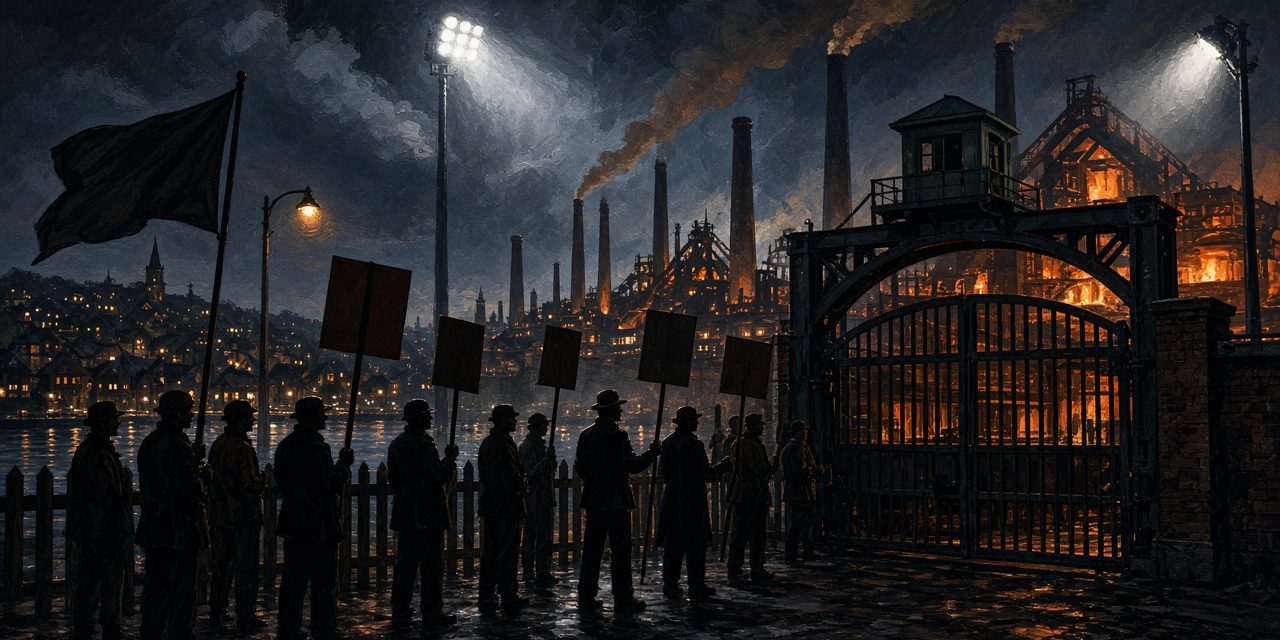
At about 9:30 on the night of May 12, 1937, roughly 500 men walked up to the tunnel that served as the main gate of the Jones & Laughlin steel mill in Aliquippa, Pennsylvania, and began draping it with American flags. When the second shift came out at 11:00, almost nobody went in to replace them. According to a Penn State research profile that draws on the papers of the local union, the mill employed about 11,000 men and stretched along the Ohio River for more than four miles. By midnight it stood nearly empty. Meyer Bernstein, a young union organizer on the scene, wrote that “for the first time in years the valley is not brilliant red at night.”
The strike lasted about 40 hours, by the Penn State count; Casebeer says 48. What made it remarkable was where it happened. For decades, Aliquippa had been the kind of town where a union organizer could be turned back at the train station. This is the story of how that town came to be, how ten of its steelworkers became the men whose firing led to a U.S. Supreme Court case, and what the records do and do not show about the people behind the case. The accounts I rely on are union testimony, scholarship, oral history, and the Court’s own opinion. The company’s side is thinner, partly because J&L chose not to put on a defense at the hearing, and I flag that where it matters.
A town the company built
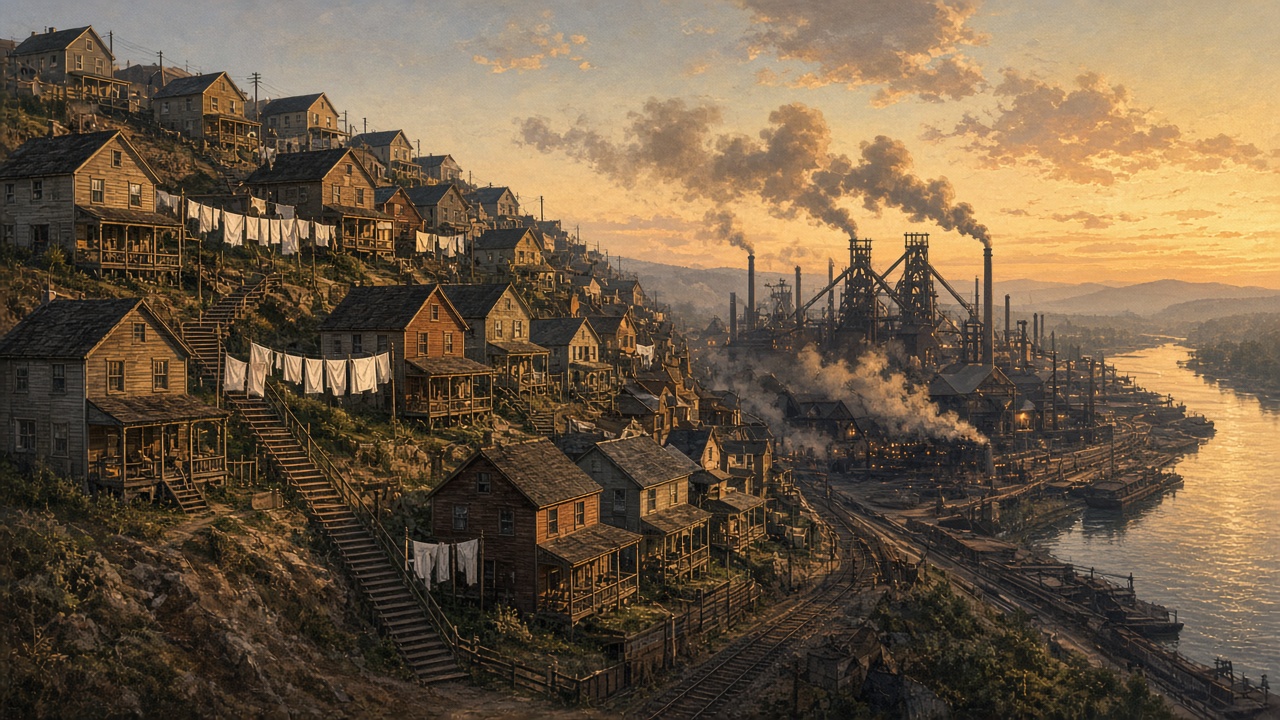
Jones & Laughlin was a Pittsburgh steelmaker that ran out of room on the South Side. In the early 1900s it bought land along the Ohio River, 20-some miles northwest of the city, at a place called Woodlawn, where an amusement park had stood. Sources differ on the date: a Penn State profile says 1907, and a law-review study of the town says the company began buying farmland and swampland in 1898 and broke ground on its first blast furnace in November 1906. The mill came first, then the town to house its workers. In 1928 Woodlawn was renamed Aliquippa, after the Seneca leader known as Queen Aliquippa, whom George Washington mentioned in his 1753 journal.
By the 1930s the town held about 27,000 people. The Supreme Court’s own opinion says the plant had about 10,000 employees in a community of about 30,000. The company’s subsidiary, the Woodlawn Land Company, owned much of the land. According to Kenneth Casebeer’s study, J&L owned about 700 houses occupied entirely by employees, and about 40 percent of Aliquippa families had mortgages it controlled. The company also owned the water company, the railroad, and the bus and trolley lines. The newspaper, the Aliquippa Gazette, was owned by a man who was also an officer of the land company, and it ran editorials against union organizers.
The town was divided on purpose. J&L built twelve numbered housing “plans,” one on each hill, and placed workers by nationality: Italians in one, Serbians in another, Anglo-Saxons across the valley, management on the highest ground. A resident, Donald Thompson, put it in an interview quoted by Casebeer: “You can call it ruthless segregation or common sense.” A Penn State account says the company recruited immigrants from many countries and saw the mix of languages as an advantage, because workers who could not talk to one another were less likely to organize. Black workers, who made up about 8 percent of the workforce in the 1930s according to Casebeer, were pushed into the worst jobs, such as unloading coke ovens, and into one section of town.
The company’s own pitch was different. William Larimer Jones, quoted in Tom Girdler’s memoir, said J&L wanted “the best steel town in the world,” a place where a steelworker could raise a family. Girdler, who ran the Aliquippa works in the 1920s before leaving for Republic Steel, later testified that he did not recall steps taken to discourage union activity beyond advising men to mind their own business. The workers’ name for the town was “Little Siberia.”
How the control worked
Several of these details come from union members’ own testimony and decades-later interviews, and they can’t all be checked independently. They are consistent across many speakers, though.
Police were one tool. The borough police chief was a former J&L employee, according to Casebeer, and anti-union work ran through the office of the company police chief. Workers handing out union cards were followed, arrested on “suspicious person” charges and fined, and the fines came out of their pay along with rent and company-store debts. Organizers who got off the train were questioned and sent back. In the 1919 national steel strike, Girdler himself bragged that organizers had never set foot in town, according to the Penn State profile. Casebeer writes that not one man walked out of the Aliquippa mills.
The ballot was another. Penn State’s profile says workers were driven to the polls in company vehicles and timed in the booth, and that voting Democratic could cost a man his job and his house. An undated Republican committee form letter in the Penn State collection, probably from the 1936 election, told a worker the records showed he had failed to vote and urged him to vote the straight Republican ticket.
A 1926 case shows how far it went. Pete Muselin and four other Croatian men were arrested after a fraternal lodge meeting and charged under Pennsylvania’s 1919 sedition law, according to Muselin’s later account as summarized by Casebeer. The district attorney would not take the case, and J&L’s own solicitor was appointed special prosecutor. They were convicted in 1927 and sentenced to five years in the county workhouse. That account rests on one prisoner’s recollection, and I did not find the court records.
The union drive, 1933 to 1936
The New Deal changed the odds. Organizers from the old Amalgamated Association of Iron, Steel and Tin Workers worked from Ambridge, across the river, because they could not stay in Aliquippa. In August 1934 they got a charter for Beaver Valley Lodge No. 200. Harry Phillips was its first president. He told the National Steel Labor Board in November 1934 that on August 30 he was followed by company police, then struck with a blackjack near the mill tunnel. He said that when he asked the borough police for help he was told, “Get the hell out of here. You don’t deserve protection.”
One case, reported in several accounts, has become shorthand for the period. A laid-off worker named George Isoski, whose name is also spelled Isosky, was stopped by police in 1933 with about fifty union cards under his shirt, according to his own statement. In Casebeer’s account, he was committed to the state hospital for the insane at Torrance the next morning on the word of a panel that included the company doctor, and his family was not told where he was. He was held for about two months, until Governor Gifford Pinchot intervened. Pinchot also sent state police to Aliquippa, and his wife, Cornelia Bryce Pinchot, spoke to a large crowd of workers. “I am against Jones and Laughlin first, last, and all the time,” she said, as quoted in the Penn State profile. Several men who attended were later fired.
The momentum did not last. The Penn State profile says that about 6,000 men eventually risked being identified as union members. Then J&L fired the lodge officers, set up a company-run union, and watched the Supreme Court strike down the National Industrial Recovery Act in May 1935. By spring 1936, according to that account, Lodge 200 was down to fewer than 100 members. The case that went to the Supreme Court came out of a union that had nearly collapsed.
Ten men, and a case
The charges began with discharges. According to Casebeer, who names them from the record, J&L let go 13 men in and after June 1935, among them Harry Phillips, Domenic Brandy, Angelo Volpe, Martin Gerstner, and Royal Boyer, who he says was a leader of the Black workers in the plant. The reasons the company gave, he says, included leaving machine keys unattended, using a head signal rather than a hand signal, failing to close a door that was usually left open, and “making bad nails.” The Supreme Court’s opinion describes the ten men whose reinstatement was ordered as union officers and leaders: two motor inspectors, a tractor driver, three crane operators, a washer in the coke plant, and three laborers.
The facts below come from the Court’s opinion, which you can read in the official U.S. Reports volume at the Library of Congress. The National Labor Relations Board found that J&L had discharged the men “because of their union activity and for the purpose of discouraging membership in the union,” and ordered them reinstated with back pay. J&L admitted the discharges, said they were for inefficiency or broken rules, and argued that the Wagner Act itself was unconstitutional. It appeared only to object to the Board’s jurisdiction and then withdrew from the hearing, so it never put on evidence to rebut the union’s case. The Court noted that. The appeals court refused to enforce the order, and the Supreme Court took the case. Argued in February 1937, it was decided on April 12, 1937. Chief Justice Charles Evans Hughes wrote the opinion for a 5–4 Court.
The ruling held that Congress could protect workers’ right to organize in a steel company with J&L’s reach. Hughes wrote that a stoppage “would have a most serious effect upon interstate commerce” and that “it is obvious that it would be immediate and might be catastrophic.” He also said the Act “does not compel any agreement whatever” and left employers free to discharge workers for reasons other than union activity. It is often called a turning point in how the Court read the Commerce Clause. Casebeer points out something else: the opinion never mentions the town. Nothing about the plans, the police, the polls or Torrance appears in it. Scholars he cites, Peter Irons and Richard Cortner, say the Labor Board chose this case as a strong test of the law. That is one reading, and I have not seen the Board’s internal records.
The 40 hours of May 1937
The decision came a month before the strike. U.S. Steel had recognized the new Steel Workers Organizing Committee in March. J&L’s chairman then offered an election in a week or two, with no contract, and the union feared a trap and called the men out, the Penn State profile says. On the morning of May 14, according to that account, Governor George Earle came to town and was met by J&L police with raised rifles. He reportedly gave them a tongue-lashing, and, as observers noted, said nothing to the strikers. That afternoon the local organizer, Joe Timko, came back from Pittsburgh with a preliminary agreement.
Bernstein called it capitulation by “the toughest corporation in America.” Casebeer calls it a “less favorable version” of the pattern contract U.S. Steel had signed. Both can be true in different senses, and I did not compare the contract texts. A woman who had been in the tunnel recalled, in a public-television interview quoted by Penn State, that the day of the recognition election was “the best day of our lives.”
What changed, and what did not
The Penn State account says the SWOC slate won nearly every office in November 1937, a pro-union burgess was elected, and by early 1938 the local union minutes record a move to replace the police force. By 1940, Democrats controlled the borough council. The union’s grievance process, which the profile says filled 13 large boxes in its archive, gave immigrant and Black workers a way to challenge foremen. The local’s president reported that “the very first man the union negotiated for was a colored man.” That statement is the union’s own account of itself, and the record on how the union treated Black members over the long term is more mixed than a single quote can show.
In 1943 United Steelworkers Local 1211 bought the former First National Bank building at 501 Franklin Avenue as its hall, according to a Western Pennsylvania History article, and put its name on the front. The records of the local are now held at Penn State. Historians have long argued about whether steel’s unionization was imposed from the top, by John L. Lewis and the CIO, or built from below. The researcher whose work the Penn State profile describes, Lynn Vacca, argues the Aliquippa workers had been trying for years and “needed help” but “were ready for it.” Scholars still disagree about how much came from each direction.
The mill did not last. Casebeer wrote in 1995 that the works, once more than 10,000 workers, were “largely rusted, scavenged hulks” worked by a few hundred. For the wider arc, see our pieces on why the steel industry collapsed and the Homestead strike of 1892, the best-known earlier steel labor fight in the region. For a different model of a company-built town, see Vandergrift.
The case is still taught as a landmark of labor law. The people in it were a coke-plant washer, three crane operators, three laborers, and the men who inspected motors and drove tractors, in a town where the company owned the ground they lived on. They lost their jobs, the Board found and the Court accepted, because of their union activity, and the ruling helped clear the way for other workers to organize.