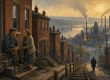

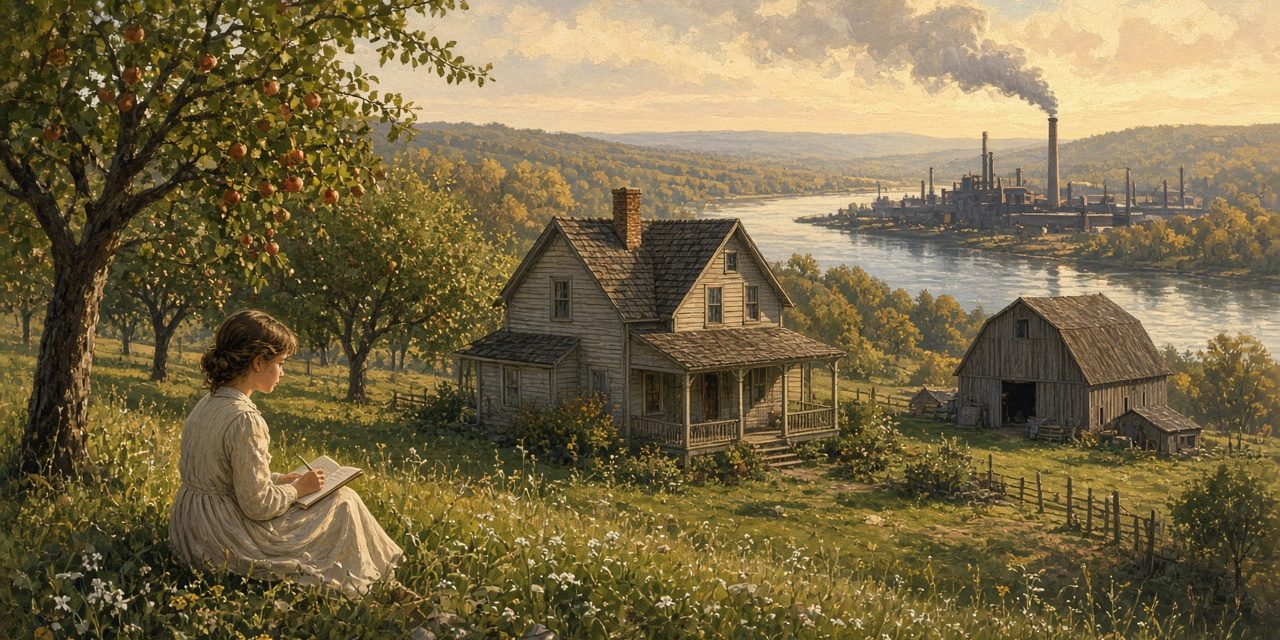
Her biographer Linda Lear put it this way: “In the end, Rachel Carson remembered only how embarrassed she was by the foul smell of the glue factory that greeted disembarking passengers at the train station; how dreary and dirty the working-class town became when the West Penn Power Company and Duquesne Light Company squeezed it between their huge power stations at both ends, and how endlessly ugly Springdale was.” Stories about Rachel Carson Springdale usually begin with a girl in the fields above the Allegheny River learning the names of birds and plants. Lear’s version is harder to picture, and it gets less attention. Both are in the record.
A temporary farmhouse
Rachel Carson was born on May 27, 1907, in Springdale, an Allegheny County town on the river north and east of Pittsburgh. Her parents, Robert and Maria Carson, had bought an old farmhouse and 64 acres there in 1901, according to the Rachel Carson Homestead’s history. They planned to sell off lots and build a modern house. They sold some lots, but a series of economic downturns kept them from raising the money, and the Carsons paid a mortgage for more than thirty years on a house that was meant to be temporary. By the Homestead’s account it had no indoor plumbing or central heat, and electric lines reached it only in the parents’ last years there.
The Science History Institute describes her mother, Maria, a former schoolteacher and follower of the nature study movement, taking Rachel on outings through the fields, orchards and woods to identify plants and wildlife. Lear writes that Carson “could hear the horns of the riverboats and paddle-wheelers coming and going” on the Allegheny, though she could not see the river’s bend from the porch (see also the SteelCityHistory history of the river’s boats).
The town around the farm
Lear’s 1993 essay on Silent Spring calls Springdale “a dreary town north and east of Pittsburgh which never became much more than a bedroom community for the West Penn Power Company.” A CounterPunch essay on Carson’s education fills in more detail, and should be read as an opinion piece rather than a source of record. It says the Franklin Glue Works boiled animal parts into glue on the riverbank, that West Penn Power built a large generating plant during the First World War, and that a Duquesne Light plant followed, its red-and-white stack rising into the view from the Carson hilltop. It also quotes a state report from around 1909 on the Allegheny’s pollution. The sources consulted do not confirm these specifics against a primary document.
One correction is useful to anyone who has read about Springdale lately. The Cheswick Generating Station, the plant most often named in modern accounts, “wasn’t built until after she moved away,” according to E&E News, which, citing Lear, also reported that by the end of her life she was appalled at the pollution that choked her hometown. The power stations of her childhood were earlier ones.
A girl from Springdale at the Pennsylvania College for Women
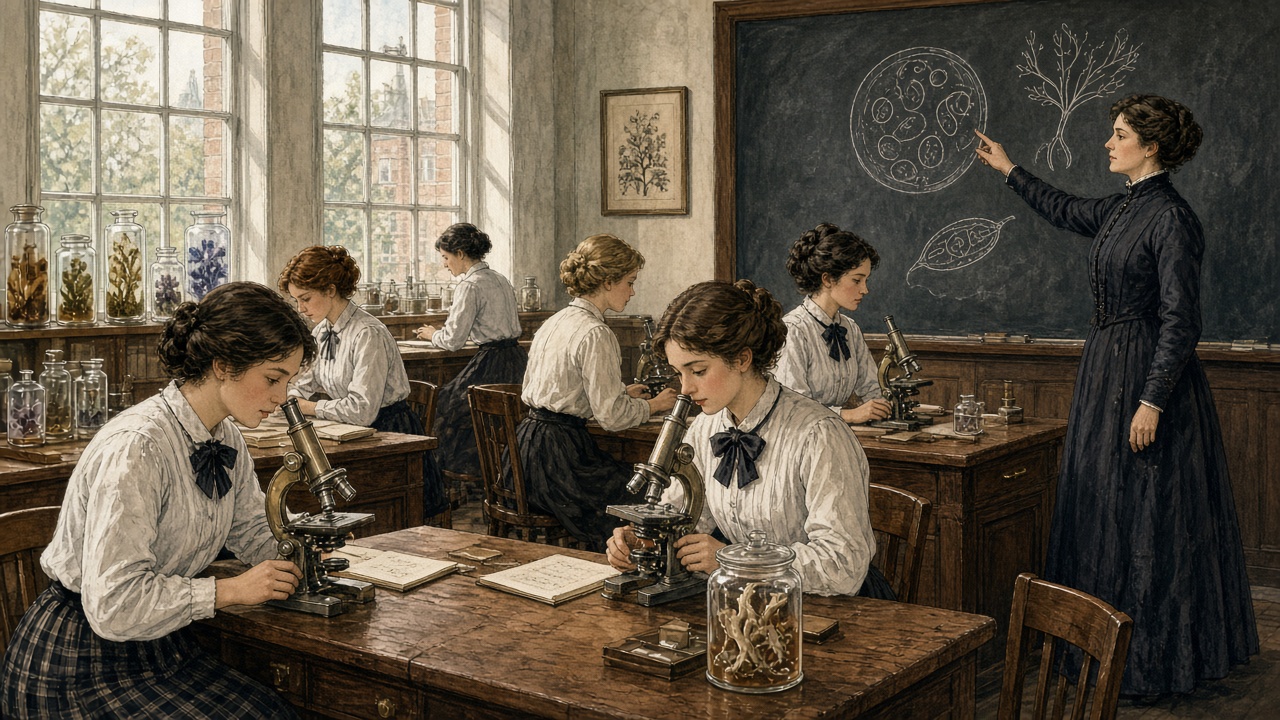
Carson entered the Pennsylvania College for Women in Pittsburgh, today’s Chatham University, in the fall of 1925 by Chatham’s account, though one archive description puts her start in 1926. The Science History Institute says the Carsons were not well off and that her mother “sold family valuables and taught piano lessons” to cover room and board. A Chatham archives description says her attendance was achieved through loans and help from anonymous donors, along with a tuition scholarship and a state scholarship. Lear adds that her mother chose her roommate, from a Presbyterian farm family in Washington County, and notes that the two women lived frugally and were unlikely to join in the social life of the daughters of Pittsburgh’s wealthy industrialists.
She began as an English major, intending to be a writer. A required biology course changed that, and the teacher was Mary Scott Skinker. According to the Rachel Carson Council’s biography of Skinker, Skinker had grown up near St. Louis, taught school, earned a Columbia degree and a master’s in zoology, joined the college’s faculty in 1923, and became acting head of biology the following year. Accounts disagree on when Carson switched: Lear says at the end of her sophomore year, the Science History Institute and the Chatham archives say during her junior year, and the Council’s page gives January 1928. She founded the college’s Science Club, and graduated magna cum laude in 1929 with a scholarship to Johns Hopkins.
The Council says Skinker took leave in 1929 to start her own doctorate at Johns Hopkins, that Carson tried to follow her there at once, and that student loans and lack of money forced her to graduate with her class first. That summer, Lear says, Carson went to the Marine Biological Laboratory at Woods Hole as a “beginning investigator,” and saw the sea for the first time. She completed a master’s in zoology at Johns Hopkins in 1932. When her father died in 1935 she became the family’s breadwinner and took a part-time job with the federal Bureau of Fisheries, writing radio scripts about marine life.
Is Silent Spring a Springdale book?
It would make a neat story if it were. The record does not say so. Lear’s account shows that Carson’s concern about poisons can be documented as early as 1938. She had read reports on DDT residues in fish while writing for the Fish and Wildlife Service during the war. The immediate trigger came in January 1958, when her friend Olga Owens Huckins sent her a letter she had written to the Boston Herald about birds killed after aerial spraying of DDT near Huckins’s bird sanctuary in Duxbury, Massachusetts. Carson was also following a federal fire ant eradication campaign in the South and a lawsuit on Long Island over aerial spraying. Houghton Mifflin published Silent Spring on September 27, 1962.
None of the sources consulted says that the air or river of Springdale led her to write it. What they do show is Lear’s own account of the town as something Carson remembered with embarrassment, a scientific training that began at a college in Pittsburgh, and a woman who left the region at twenty-two. That is as far as the evidence goes. Whether childhood in a mill-river town prepared her to take industrial pollution seriously is a reasonable question, but it is one her biographers pose and do not answer.
What remains
The Rachel Carson Homestead at 613 Marion Avenue in Springdale is the farmhouse itself. Its history says that after the Carsons left, the house was sold to a teacher at Springdale High School, Angeline Sober, who later recruited a small group to preserve it, and that the borough of Springdale bought it. The National Park Service says the homestead was listed on the National Register of Historic Places in 1976. The Homestead’s website says it gives docent-led tours by appointment, so contact them before visiting.
In downtown Pittsburgh the Ninth Street Bridge was renamed the Rachel Carson Bridge on Earth Day, April 22, 2006; it is one of the “Three Sisters” bridges described in the SteelCityHistory piece on Pittsburgh’s bridges. Chatham says her influence guided it to the creation of its Eden Hall Farm campus. And Chatham’s archives say that on May 26, 1952, the college she had struggled to pay for gave her an honorary doctor of literature.