
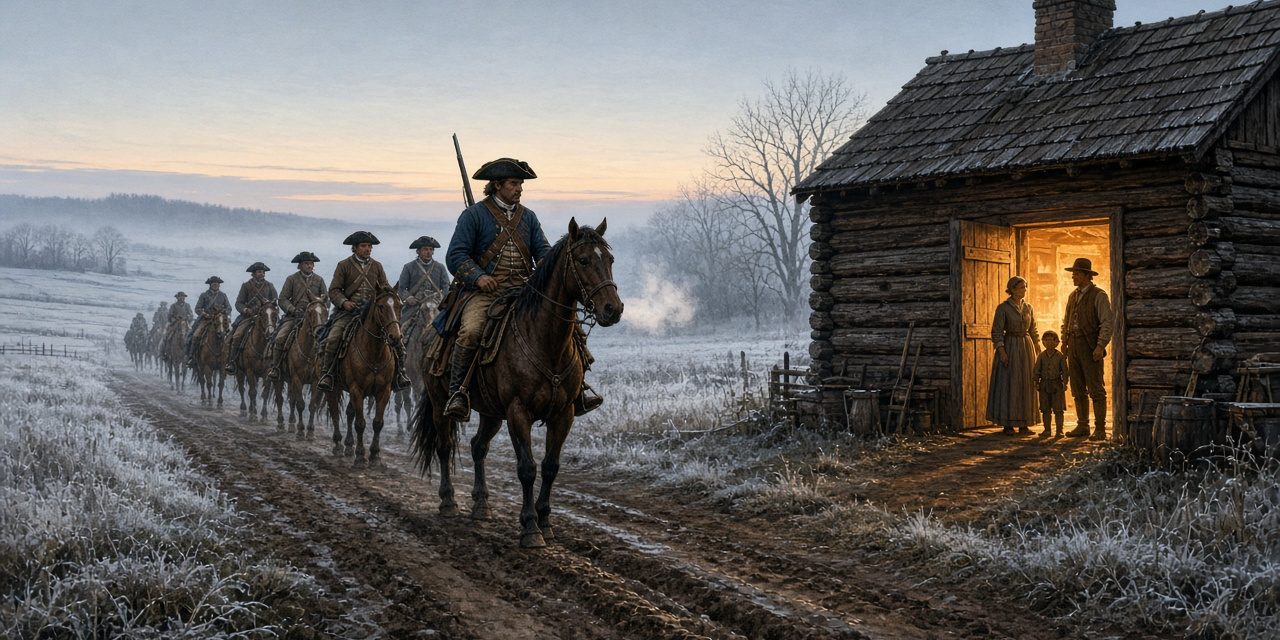
The Whiskey Rebellion Pittsburgh lived through ended not with a battle but with arrests that began in the dark in November 1794, with horsemen at the door. In the account of the Rev. James Carnahan, then a student at the academy in Canonsburg, a company of Virginia cavalry surrounded the house where he lodged about two in the morning and ordered his landlord, an old man, to guide them to a neighbor’s. Two boys boarded in the attic. One of them, who had talked loudly in favor of the insurgents, lay trembling in bed, sure the horsemen had come for him. The other, who had always condemned the insurgents, jumped up and ran downstairs half-dressed to see what was happening. The horsemen slapped him with their scabbards, called him a “young insurgent,” and made him run a quarter of a mile without shoes on frosty ground to find a horse. He was one of the innocent ones.
That night, or one near it, became known as the Dreadful Night. Nearly everything about it is disputed: the date, the number of men taken, who was guilty, and how badly the prisoners were treated. What follows separates what the documents show from what later tellers added.
An army with no one to fight
By the autumn of 1794 the uprising that had burned General John Neville’s Bower Hill house in July, and put thousands of armed men on Braddock’s Field that summer, was mostly over. President Washington had called up about 13,000 militiamen from four states, according to the history on the federal Alcohol and Tobacco Tax and Trade Bureau’s website, and had led them as far as Bedford before turning back in late October. He left General Henry “Light-Horse Harry” Lee, the governor of Virginia, in command. Treasury Secretary Alexander Hamilton stayed with the troops, and a federal judge, Judge Peters, went along to examine prisoners.
The army arrived to find little resistance. Carnahan wrote that “between one and two thousand men, with rifles in their hands, had withdrawn, and remained absent until the army left the country,” and, in the words of William Findley, a western congressman who wrote a history of the uprising, men like Bradford and Parkinson had “either secured an amnesty by submitting in due time or fled out of the country.” Lee told a committee of local residents, in a letter printed in an 1882 county history, that he meant to hold the army in the country “until daily practice shall convince all that the sovereignty of the Constitution and laws is unalterably established.”
The orders
Lee’s plan for arrests is in his own orders, which the 1882 History of Washington County prints. On November 9, writing from his headquarters near Parkinson’s Ferry on the Monongahela, he told General William Irvine, who was advancing into “that part of Allegheny County” that Lee assigned him, that “from the delays and danger of escape which attend the present situation of judiciary investigations,” it was “advisable to proceed in a summary manner in the most disaffected scenes,” using the military to apprehend those who had “notoriously committed treasonable acts” and bring them before the district judge. The men taken, he wrote, “ought to be leading or influential characters or particularly violent.” A separate list covered witnesses, who were to be brought in and “treated as such.” To keep word from running ahead of the horsemen, the parties were to strike “at the same moment,” at “day-break on Thursday morning.” Thursday was November 13.
The county history also prints a letter said to be from Lee to General Morgan on November 11, suggesting that making farmers thresh their wheat for the army was “an excellent pretext” for sending horsemen around to “accomplish the other business.” The historians who printed it say it was in the possession of a judge in Wheeling, that it “does not have the appearance of a letter of instructions from a commanding general,” and that it is “given for what it is worth.” It should be treated the same way here.
The night
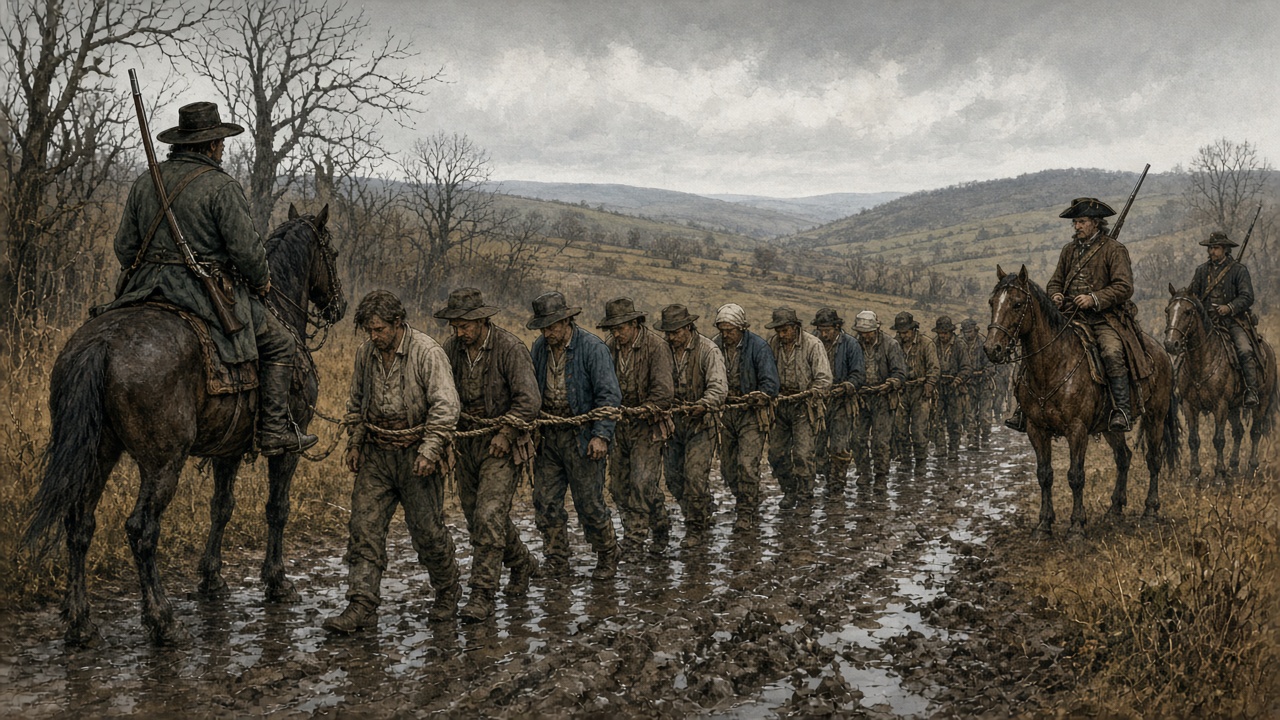
The horsemen came in the early hours of the 13th. Carnahan wrote that the horsemen “before daylight arrested in their beds about two hundred men.” He added that “in justice to the Virginia, Maryland, and Philadelphia horsemen, it must be said they made arrests and treated their prisoners with as much gentleness and humanity as practicable.” The worst reported abuse comes from Findley, who had urged peaceful protest, and whose history says that about forty men were brought to Parkinson’s farm that Thursday on General Anthony White’s orders, tied back to back in a wet, muddy cellar and denied food and drink until Saturday. The county historians who quote Findley caution that “his statements may have been a good deal exaggerated,” since his narrative shows a clear wish to put every act of the army “in the worst possible light.”
Even the weather is contested. Carnahan remembered “a frosty night.” Historian William Hogeland, as Pittsburgh Magazine quotes him, has the prisoners prodded “out of cabins into new-fallen snow.” Neither account can be checked against a weather record.
The numbers are slippery too. The usual figure is about 150 arrested, which both the Mount Vernon timeline and the Papers of George Washington use. Carnahan says about two hundred. The county historians add that “all the prisoners taken by the army, excepting three, were taken in that county and Allegheny.”
Thirteenth or fourteenth?
The date puzzled the people who wrote the first histories. The county history says the arrests were made on the morning of the 13th, “most of them between three o’clock and sunrise,” as the orders directed, and that Carnahan was “evidently mistaken” in placing them on the night of the 13th and the morning of the 14th. Some modern accounts differ: Smithsonian magazine puts the Dreadful Night on November 14, while Mount Vernon, Pittsburgh Magazine and a Pennsylvania Magazine of History and Biography article say November 13.
Even the name is not fixed. The county historians say Hugh Henry Brackenridge and others called it “the terrible night,” and wonder why that label went to the night of the 13th, “as the condition of the prisoners was fully as bad on the latter as on the former night.” The Pennsylvania Magazine of History and Biography calls it “the dismal night.” What is documented is that the order was for the morning of Thursday the 13th. Whether the name belongs to the night of the arrests or to the nights the prisoners spent in cold cellars and barns is not settled by the sources.
From the Monongahela to Pittsburgh
Many of the prisoners were taken to Pittsburgh. Carnahan watched a large number from Washington County led through Canonsburg, where they spent a night in an upper room of the academy. The Philadelphia and New Jersey cavalry rode in front in fine blue uniforms, and the prisoners followed on horses of every shape and color, some in great-coats, some in blankets, some “downcast, melancholy, dejected,” others “stern, indignant.” They were then taken on to Pittsburgh “under guard,” he wrote, so that a district judge could decide which of them should go to Philadelphia for trial. Most were let go. Hamilton interrogated some of the leading men himself. Brackenridge, Pittsburgh’s first lawyer, who had urged calm all summer, was among those questioned. He wrote that Hamilton received him with the look “a man will have when he sees a person with regard to whom his humanity and his sense of justice struggle,” as if he “would have him saved, but is afraid he must be hanged.” Hamilton concluded he was no traitor, and he was never charged, according to a University of Pittsburgh Law Review article on early Pittsburgh lawyers. Pittsburgh Magazine, citing biographer Ron Chernow, says the hostility toward Hamilton was strong enough that he needed an escort of six mounted soldiers when he left Pittsburgh in late November.
Twenty to Philadelphia, two convicted
Twenty prisoners were marched east, and the army and prisoners reached Philadelphia by Christmas Day, according to the Encyclopedia of Greater Philadelphia. In May 1795 the attorney general charged thirty-five prisoners with treason, the editors of the Washington Papers note, and ten stood trial. The Mount Vernon timeline, by contrast, says twenty-four were arrested for high treason. Two men, John Mitchell and Philip Vigol (the name is also spelled Weigle or Weigel), were convicted. They were, according to the Encyclopedia, the first Americans convicted of federal treason.
The pardons came in layers, which is why the story of “the pardons” is often told wrong. On November 29, 1794, Lee issued a general pardon for the participants, with thirty-three named exceptions, the Treasury’s account says. On July 10, 1795, Washington proclaimed a broader pardon for treasons committed in western Pennsylvania before August 22, 1794. That proclamation excluded anyone then under indictment or convicted, which left Mitchell and Vigol out. Washington stayed their executions in June, and on November 2, 1795, he pardoned both. The Encyclopedia says he found one a “simpleton” and the other “insane.”
What is left
The Whiskey Rebellion shaped Washington County and Pittsburgh long after. The Treasury’s tax bureau says markers across southwestern Pennsylvania identify the Braddock’s Field meeting site, Bonnet Tavern and Mingo Creek Church, and that the David Bradford and Miller family homes are museums. Those details may have changed since it was written in 2020, so check before going. In Pittsburgh itself, one physical witness is the Old Stone Tavern on Greentree Road, where a Whiskey Rebellion ledger was found. The pardon that ended the story is short, and its text of July 10, 1795, is online at Yale’s Avalon Project, with the exclusions that left two men outside it.
The army never fought a battle. What it did in the western counties was mostly the roundup, carried out in the dark. In Carnahan’s judgment, the men who were chiefly guilty “had signed the amnesty, or had left the country before the army approached.”