

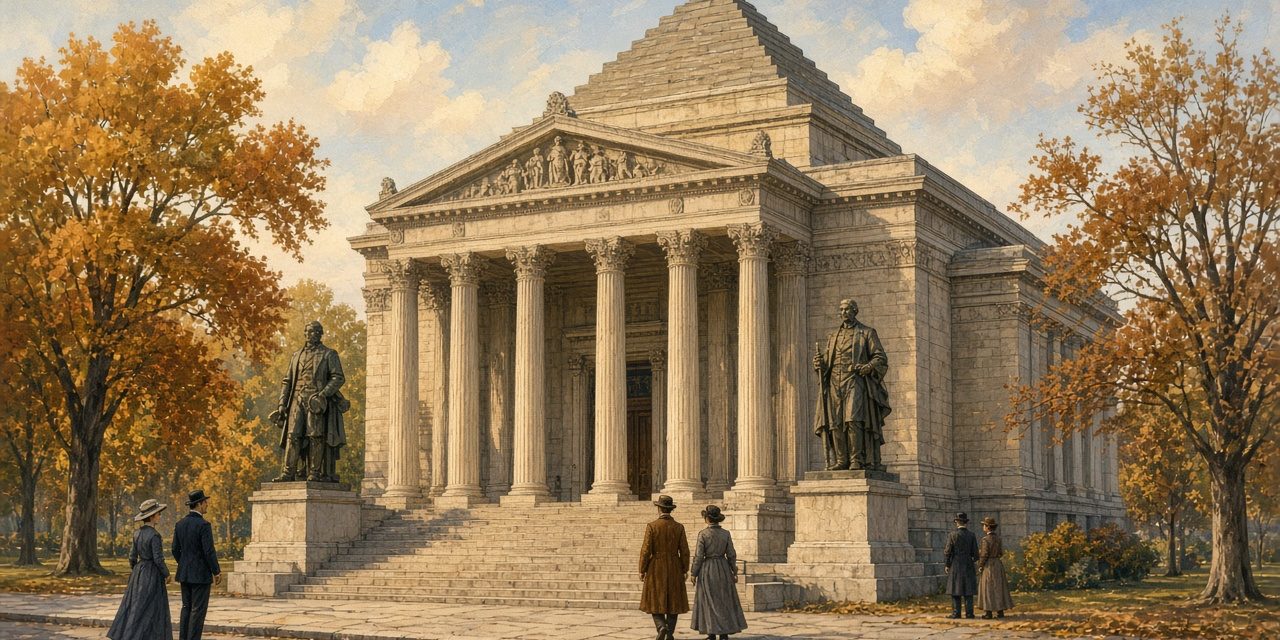
Soldiers and Sailors Memorial Hall in Oakland exists partly because a court told a committee of Civil War veterans that a monument would not do. In the years after 1895 the committee petitioned Allegheny County’s Quarter Sessions Court for permission to build a memorial shaft. The court turned down the petition, the veterans’ own printed history says, because it lacked a cost estimate. The judges added that they “would not be inclined to approve the erection of a mere monument or shaft,” and suggested a memorial hall “more in keeping with the dignity and greatness of this county.” The veterans took the advice. What they got took until 1910 to build, a special act of the legislature, a tax on the county’s own voters and a court fight to survive.
The account of those years comes mainly from the committee itself, in a booklet printed for the October 1910 dedication, so it is the veterans’ version. Where other sources add to it or differ, they are noted below.
Fifteen years of asking
The idea began in 1891 at meetings of the Allegheny County Grand Army Association, made up of delegates from the county’s twenty-eight posts of the Grand Army of the Republic, the Civil War veterans’ organization. A committee was appointed to find a way to pay for a memorial. It reported, in the booklet’s words, “a deep and unanimous sentiment” for one “of a character so imposing and impressive as to represent the wealth, intelligence and patriotic sentiment of our great industrial center, which the immortal Lincoln had referred to as the ‘State of Allegheny.'” The Lincoln remark is the committee’s claim, and the booklet gives no source for it.
Getting the money took legislation. An 1895 act, introduced by State Senator C. L. Magee and signed by Governor Pattison on May 22, let counties erect Civil War monuments. After the court’s advice, the committee obtained a 1903 amendment authorizing memorial halls, and then a special act for Allegheny County alone, approved April 12, 1905. It required approval by two grand juries, the court and a majority of the county’s voters. It also capped the cost of building and grounds at $1,250,000, a figure later raised by additional legislation to $1,562,500. Historian Carol Reardon, writing in 2019, calls the 1905 vote unprecedented, because county residents imposed a special tax on themselves, and puts the cost of construction at $1.7 million, a figure that differs from the booklet’s and may include other costs.
The special act itself was challenged in 1906 as unconstitutional. Judge John D. Shafer of the Common Pleas Court dismissed the challenge, and the state Supreme Court affirmed his decision on the first Monday of January 1908, according to the booklet. By then several of the veterans who had started the movement were dead. The booklet names Denniston, Sample, Duvall, Stulen, Davis and Burchfield among those who “did not survive to witness the fruition of their hopes and labor.”
Hornbostel’s temple
The county asked for competitive designs, with Warren P. Laird of the University of Pennsylvania as consulting architect, and on February 15, 1907, the award went to Palmer and Hornbostel. The contract was let on November 25, 1907, and the cornerstone laid on October 2, 1908, with an oration by General Horace Porter and remarks by Vice President Charles W. Fairbanks. The hall’s historical marker says Henry Hornbostel’s neoclassical design was inspired by the Mausoleum of Halicarnassus, and Reardon says the building reminded many of that ancient monument, one of the Seven Wonders of the ancient world.
It sits on Fifth Avenue in Oakland, facing Schenley Park and the Carnegie Institute. By the booklet’s description, a bronze figure of “America” by Charles Keck stood over the main entrance. Reardon adds two bronze figures by Frederick C. Hibbard, Parade Rest, an infantryman, and Lookout, a sailor. Inside, the auditorium was built to seat 2,550, according to the booklet. The hall’s own marker today gives 2,364 and Reardon about 2,300, so the number has changed since 1910. The two wings of the front entrance each held a meeting room for Grand Army posts and the Union Veteran Legion.
Dedication, October 1910
The dedication ran for five days. On Sunday, October 9, 1910, there were religious services. The next day, Monday, the public was admitted to inspect the building, which is why the hall’s marker says it “opened to the public on October 10.” Tuesday, October 11, was the dedication proper. A parade of surviving veterans, which Reardon says included more than 2,000 Civil War veterans, two National Guard regiments and Spanish-American War veterans, preceded the ceremony, and the main-floor seats in the auditorium were reserved for veterans only. John Dalzell turned the building over to the county commissioners. Thomas J. Stewart gave the oration. That evening there was an old-time camp fire where Major General Daniel E. Sickles and other survivors told war stories. Wednesday was “Woman’s Day,” run by the Woman’s Relief Corps and the Ladies of the Grand Army, and on Friday the Sons of Veterans presented a bronze bust of Abraham Lincoln.
What is on the walls
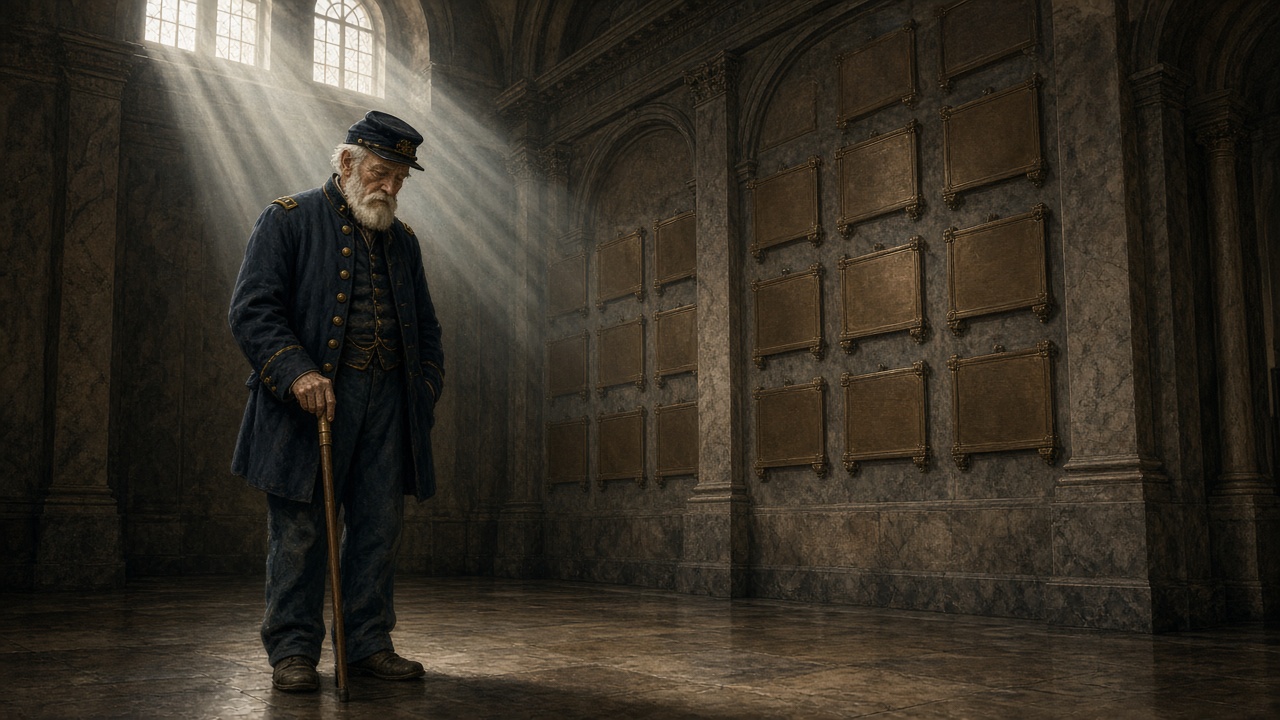
The names are the point of the building. The hall’s marker says 25,930 Allegheny County Civil War veterans are cast in bronze on plaques along the corridors. Reardon, who counted sixty-one plaques, each for a Pennsylvania regiment with Allegheny County soldiers in its ranks, found a rule that confuses visitors: the plaques list only men who enlisted in Allegheny County. When she looked for a great-great-grandfather, she found a name that seemed wrong, “Private John Garver,” not her ancestor, Corporal Joseph Garver. She later learned that he had enlisted in Armstrong County, and that the plaque contained no error. The sources consulted do not say how Allegheny County’s Black soldiers, some of whom enlisted in Massachusetts regiments, are recorded there.
Reardon notes one more oddity. The corridors are called the West, North, East and Main Halls, because, by tradition, the Union veterans who first ran the building refused to apply “South” to any part of a hall dedicated to Northern valor. And the stage in the auditorium was once meant to have an immense battle mural behind it. When it proved too costly, she writes, the planners put up the text of Lincoln’s Gettysburg Address, which is still there. The hall’s marker describes it as a 70-by-18-foot painting of the address, said to be the largest in the world.
From one war to all of them
Soldiers and Sailors was built for the Union veterans of one county in one war. Its marker says that as that generation died, “veterans of subsequent wars took their place using Soldiers and Sailors for meetings and gatherings.” One of the marker’s captioned photographs is of doughboys of Company B, in July 1918. In 1963 the Hall of Valor was dedicated to honor Medal of Honor recipients and others decorated for valor, from the Civil War to today’s conflicts, and it now lists more than 700 honorees, according to the Soldiers and Sailors Memorial Hall and Museum Trust. The building was listed on the National Register of Historic Places in 1974, and the Trust, a nonprofit, began running it around 2000.
It has also been a public hall in a wider sense. In June 1941, and again on December 7, 1941, the America First Committee held rallies there against American entry into the war, the first over the protests of some veterans, according to historian David Goodman. That afternoon in December, when the news from Pearl Harbor reached the audience, is a story of its own. Years later the hall’s upstairs ballroom appeared in a film: the SteelCityHistory guide to movies filmed in Pittsburgh says it stood in for a Tennessee courthouse in The Silence of the Lambs.
What remains
The hall at 4141 Fifth Avenue is both a memorial and a military museum. Its website lists regular hours Monday through Saturday and free admission for veterans and military, though both may change, so check before going. The 1910 booklet that gives the veterans’ account of their fifteen years of work is posted online by the Sons of Union Veterans of the Civil War, and it is short enough to read in one sitting.
The booklet’s cover states the original purpose: “In Honor and Memory of those who served from this County in defense of the Union, 1861-1865.” That is still what the bronze in the corridors says. The rest of the building has since taken on every war after it, a long way from the shaft the committee first asked for.