

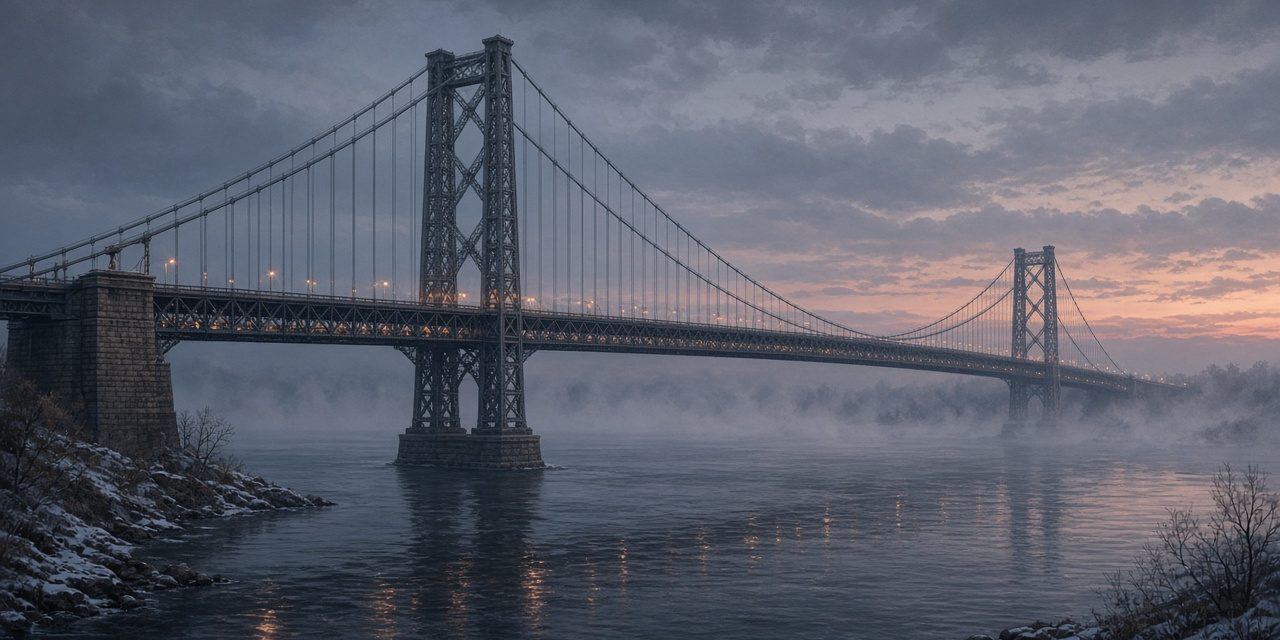
At about 5 p.m. on Friday, December 15, 1967, the U.S. 35 bridge between Point Pleasant, West Virginia, and Kanauga, Ohio, was full of Christmas traffic. According to the National Transportation Safety Board, 37 vehicles were on it. Then a single steel link in the suspension chain on the Ohio side let go. Within about a minute, the 700-foot main span, both 380-foot side spans and the towers had collapsed. Forty-six people died. Nine were hurt. Two of the dead were never found.
That is the history, and it is solemn. Folklore has grown up around it, though, and the folklore has a name: Mothman. A winged, red-eyed creature was reported near Point Pleasant in the thirteen months before the collapse, and a famous book later connected the two. This piece keeps them apart. It also answers a question Pittsburgh readers tend to ask when the subject comes up, which is why a story from the Ohio River, some 250 river miles downstream, belongs on a Pittsburgh history site. The answer is steel, and it is a good one.
To be clear from the start: the sightings are reports from Point Pleasant, centered on a wildlife area about five miles north of town. This is not a Pittsburgh-area ghost story. The Pittsburgh connection is the bridge.
How to read the labels
We use the same five labels as in our Western Pennsylvania Bigfoot piece. FACT means something that can be checked in a record: a government report, a published article, a date. REPORT means a person said they saw or heard something, and someone wrote it down. A report is evidence that the person said it, not proof of what they saw. LEGEND means a story that has grown in the retelling. DISPUTED means the sources conflict or serious people disagree. HOAX means someone has been shown or has admitted to faking it.
The bridge
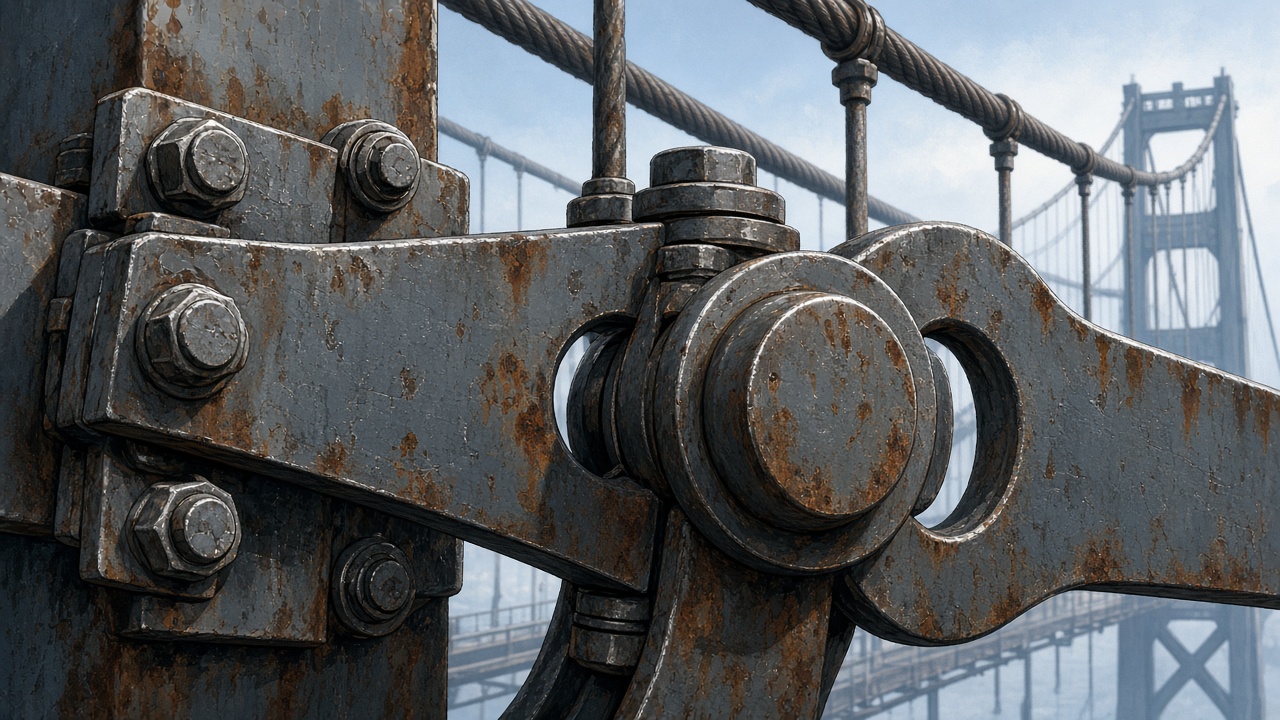
FACT: The Silver Bridge opened on May 30, 1928, named for its aluminum-colored paint. It was designed by the J. E. Greiner Company of Baltimore and built by U.S. Steel’s American Bridge Company. The original plan called for a conventional bridge hung from wire cables. Bidders were allowed to offer an alternative: chains made of high-strength, heat-treated steel eyebars, flat bars about 2 inches thick and 12 inches wide with a hole forged into each end, linked by large steel pins. The eyebar version was cheaper. According to a West Virginia Department of Transportation history, Engineering News-Record called it “the first of its type in the United States” in 1929.
FACT: The key design detail is the number of bars. The Silver Bridge’s chains had two eyebars in each link. Older eyebar bridges, as engineer and historian Frank Griggs notes in Structure magazine, typically used rows of four to six or more bars, so that if one failed, the others could carry the load. A twin of the Silver Bridge was built 75 miles upstream at St. Marys, West Virginia, by the same engineer and contractor.
The state bought the bridge in 1941 and removed the tolls in 1951. State records list repeated inspections, the last by an area maintenance engineer on December 6, 1967. All of them, as Griggs points out, were visual. A bar’s outer surface could be checked. The inside surface of the hole at the end of a bar could not.
What happened, and what the investigators found
FACT: The NTSB’s final report, number NTSB-HAR-71-1 and dated December 1970, identified the first failure: a cleavage fracture in the lower part of the eye of eyebar 330, in the north chain on the Ohio side, at the joint nearest the Ohio tower. The upper part of the eye then tore, the paired bar slipped off its pin, and the chain separated. With the chain severed and the towers resting on rocker seats, the interim report said, total collapse was a certainty. You can read the NTSB’s summary of the investigation on its own site.
FACT: The flaw that started it was tiny. A National Bureau of Standards account describes a clamshell-shaped crack about 0.12 inch deep and 0.28 inch long, starting 0.1 inch from the face of the eye. The NTSB found that the crack grew over the bridge’s 40-year life through a combination of stress corrosion and corrosion fatigue. Its location on the inside of the pin hole put it out of sight, and the NTSB concluded it could not have been found without taking the joint apart. In 1927, the board added, engineers did not know these mechanisms could attack the kind of steel used under ordinary rural conditions. It also found the two-bar design had made total collapse “inevitable” once one bar failed, as the WVDOT summary quotes the report.
FACT, with variations: Counts differ slightly by source. The NTSB says 31 of 37 vehicles on the bridge fell; the West Virginia and Structure accounts say 32. The West Virginia history says the collapse took less than 20 seconds; the NTSB says about a minute. Everyone agrees on the death toll of 46.
The NTSB did not assign blame to the designer or the builder. Lawsuits against the federal government and West Virginia failed. According to Griggs, the builder and the engineer settled suits against them in August 1973 for $950,000. The point of the investigation was what came next.
The Pittsburgh connection
Here is where the story reaches Western Pennsylvania. The American Bridge Company was the steelmaker’s bridge-building arm, and its enormous fabricating plant, completed in 1903, gave the Beaver County town of Ambridge its name. The plant closed in 1983, according to a Beaver County historical marker. Between 1924 and 1928, the same company built the superstructures of Pittsburgh’s Three Sisters, the Sixth, Seventh and Ninth Street bridges over the Allegheny River, the Roberto Clemente, Andy Warhol and Rachel Carson bridges today. The Library of Congress holds the Historic American Engineering Record documentation, which lists the builder as American Bridge Company of Ambridge.
FACT: The Three Sisters are also eyebar chain suspension bridges, the first self-anchored suspension spans in the United States. Griggs writes that their chains used nests of eight and nine eyebars, against the Silver Bridge’s two. Griggs also argues that American Bridge, having used eyebars in Pittsburgh, persuaded the designer and bridge company that a similar design would be safe and cheaper at Point Pleasant. That is his interpretation, though the engineer’s own letter, as he quotes it, shows that the alternatives to wire cable were invited in the bidding. HAER calls the Three Sisters “among the only surviving examples of large eyebar chain suspension bridges in America.”
The bar count is the difference engineers point to. After the collapse, the twin bridge at St. Marys was closed and later taken down, in 1971. I did not find a record of the Three Sisters being closed, and I did not find a 1967 or 1968 document saying what Allegheny County did about them, so I cannot tell you whether they were re-inspected then. What can be said is that engineers’ comparisons of the two designs come down to the bar count, and what stands today is the result: three bridges of the same family as the one that fell, still carrying traffic over the Allegheny. If you have walked across the Clemente Bridge on a Pirates game day, you have been on one. (Our piece on Pittsburgh’s bridges covers the rest of the city’s crossings, and our look at the rise and fall of the steel industry covers the company that built so many of them.)
The reports from Point Pleasant
REPORT: About midnight on November 15, 1966, thirteen months before the collapse, two young married couples, Roger and Linda Scarberry and Steve and Mary Mallette, were driving in the “TNT area” north of Point Pleasant, a former World War II munitions plant that is now a wildlife management area. The Point Pleasant Register carried their account the next morning under the headline “Couples See Man-Sized Bird…Creature…Something.” They described something six or seven feet tall with a wingspan of about 10 feet and red eyes that glowed only when their headlights hit them. “It was like a man with wings,” Steve Mallette told the paper. Linda Scarberry wrote her own account for police days later. Deputies and city police who went to the scene around 2 a.m. did not spot anything. The Associated Press picked up the story, crowds went out to the TNT area, and more reports followed.
FACT: The local newspaper took the witnesses seriously while also printing mundane explanations. The Register called the thing “the bird.” Outside papers called it the “Mason County Monster” and a “monster moth.” The name “Mothman” came later and its origin is unclear. Some people point to the Batman craze of the period; I could not trace it to a first use.
DISPUTED: What the witnesses saw is a matter of opinion. Within days the Register quoted a West Virginia University professor who thought it might be a sandhill crane, a bird he described as six or seven feet tall with patches of red around the eyes. Its wingspan is about five feet, about half of what the couples reported. Skeptical investigator Joe Nickell, after visiting the area in 2002, argued for owls: the TNT area is a wildlife refuge, owls’ eyes can shine red in headlights, and the Register reported a “giant owl,” probably a snowy owl, killed on a nearby farm in late December 1966. Witnesses and some researchers answer that the size, the man-like shape and the speed are hard to square with any bird. Both sides can point to the original reports.
HOAX: Some of the flap was pranks. A local story says a man in a Halloween costume scared couples at the TNT area, though a local innkeeper told Nickell that at least half a dozen people now claim to have been that man, and Nickell did not find the story credible. The same innkeeper described construction workers who floated plastic balloons with red flashlights tied to them. Nickell also notes that spring 1967 UFO reports in the area included deliberate pranks, such as a pilot who flew back and forth across the river at night. These do not explain the first reports, but they muddy the record.
DISPUTED (the numbers): Over the next year, the story got bigger. A study of the legend by folklorist Eleanor Hasken of Indiana University, published in Contemporary Legend (vol. 4, April 2026), says more than a hundred people reported seeing the creature over thirteen months, and describes a layer of other strange stories: UFOs, “men in black” visitors, reports of interference with phones and televisions. She also notes that Keel claimed “hundreds of sightings” but that no record has been kept that would corroborate it. Keel’s own published timeline, as she summarizes it, listed 21 sightings in 1966 and five in 1967.
Where the two stories meet
DISPUTED: The claim that Mothman is tied to the bridge collapse comes from John A. Keel, a New York writer who visited Point Pleasant several times in 1966 and 1967 and wrote about it in the magazine True and in books, most famously The Mothman Prophecies in 1975. The book is the main source of the idea that the creature, along with the other strange events, was somehow connected to the disaster. It is a first-person account, and Keel himself, according to Hasken, leaned toward stranger explanations for the whole phenomenon, which he described in extradimensional terms. The 2002 film adaptation is a dramatization.
FACT: The calendar is neat. The Scarberry-Mallette sighting was November 15, 1966, and the collapse was December 15, 1967, thirteen months later. But the neatness is partly built in the retelling. Sightings did not start and stop on those dates. Mary Hyre, who covered the story for the Athens Messenger, wrote on November 16, 1967, a month before the collapse, that reports had continued throughout the year, including one two weeks earlier. After the collapse, Hasken found, mentions of the creature vanished from the local record, because the bridge filled the pages.
FACT: The NTSB investigation found a physical, documented cause with no role for anything else. A crack, corrosion and a design without redundancy brought the bridge down, and the report says nothing about omens.
LEGEND: The idea that the creature warned of the disaster, or caused it, is a legend. A second, older legend is sometimes added: that a curse placed by the Shawnee leader Cornstalk, who was killed at Fort Randolph, on the site of Point Pleasant, in 1777, hangs over the town. The killing is documented. The curse is folklore.
It is worth hearing what people in Point Pleasant say about it. One resident told Hasken, in a 2017 interview, that the sightings stopped being something to write about once the bridge fell: “The bridge was too real. The bridge fell. A lot of prominent people went down on that bridge. The mayor’s parents went down on that bridge. A little girl in my class went down on that bridge, with her parents.” For many in the town, the two stories do not belong together.
What changed
FACT: The collapse led to the National Bridge Inspection Standards. Congress required national inspection standards in the Federal-Aid Highway Act of 1968, and the Federal Highway Administration adopted them on April 27, 1971, according to Griggs. They require most public bridges longer than 20 feet to be inspected at least every two years, and more often when they are at higher risk. A replacement bridge, the Silver Memorial Bridge, opened about a mile downstream in 1969.
Pittsburgh and the standards, 2022
Those standards were tested in Pittsburgh on January 28, 2022, at 6:37 a.m., when the Fern Hollow Bridge, which carried Forbes Avenue over Frick Park, fell about 100 feet into the park. A Port Authority bus and several cars were on or near it. At least four people were injured, two of them seriously, according to the NTSB. It was not an eyebar bridge and has no connection to the Silver Bridge. But the NTSB’s 2024 findings make a sharp contrast. At Point Pleasant, the investigators said the flaw could not be seen. At Fern Hollow, they found that corrosion had been written down in inspection reports from 2005 to 2021 and that the city had not acted on repeated maintenance and repair recommendations. They also found poor inspection quality, incorrect load ratings and insufficient oversight by the Pennsylvania Department of Transportation. The system created in the wake of 1967 is only as good as what is done with what it finds.
What remains
In Pittsburgh, the Three Sisters still carry traffic. In Point Pleasant, according to roadside guides, a memorial and historical marker near the old bridge approach remember the 46 who died. The town also has a Mothman statue, unveiled in 2003, and an annual festival. They are separate things, a legend celebrated and a loss remembered, and a visitor should treat them that way.
The sightings may always be argued over. The bridge is not in dispute. The people on it were neighbors and shoppers and commuters, and the standards that came after them are why a very small crack in a very large bridge is now something inspectors are trained to find.