

In April 1942, a Pittsburgh Courier columnist named George Schuyler spent 900 miles on airplanes and trains getting to a one-story house at 1239 Indiana Avenue in Wichita, Kansas, to meet a man whose only claim to fame was a letter. “I knew that he was young and endowed with unusual gifts of expression,” Schuyler wrote in the story that followed. He pressed the buzzer. Inside lived James G. Thompson, 26, who had worked in the cafeteria at the Cessna aircraft plant until he quit in March, after the company refused him a five-cent-an-hour raise.
The Courier had good reason to send one of its best-known columnists. Thompson’s letter, printed in the issue dated January 31, 1942, had given the paper the most successful campaign in its history. It was called Double V, and within months it had pins, parades, a song, a hairstyle and a membership the paper put at 200,000. It had also put the Courier’s offices in the sights of the FBI.
The letter from the cafeteria
Wichita was an aircraft town, and in 1942 it was hiring. But according to the National Park Service’s biography of Thompson, the four aircraft plants there employed only about 150 Black workers as of April 1942, and Cessna at first would not hire African Americans for anything above janitorial or similarly unskilled work. Thompson, who had taken business and journalism extension classes and passed the civil service exam for a junior typist’s job, served food.
The United States had been at war for less than two months. The armed forces were nearly closed to Black Americans. In his study of the campaign, journalism historian Patrick Washburn described the situation this way: Black men could not join the Marines, Coast Guard or Air Corps, the Navy would accept them only as messboys, and the Army confined them to four units in which openings seldom came.
Thompson’s letter put the question plainly. “Should I sacrifice my life to live half American?” he asked. “Would it be demanding too much to demand full citizenship rights in exchange for the sacrificing of my life?” Then he borrowed the most famous gesture of the war. The “V for Victory” sign was being flashed in every democracy fighting tyranny. “Let we colored Americans adopt the double VV for a double victory. The first V for victory over our enemies from without, the second V for victory over our enemies from within.” You can read the full letter, with its context, at the U.S. Holocaust Memorial Museum’s educational site.
A note on dates, because sources disagree slightly. Several sources say Thompson wrote the letter on January 31. The Courier’s own issue carrying it is dated January 31, a Saturday, so he must have written it earlier. Washburn says the letter ran in that issue and the first Double V drawings followed in the issue of February 7.

How a letter became a campaign
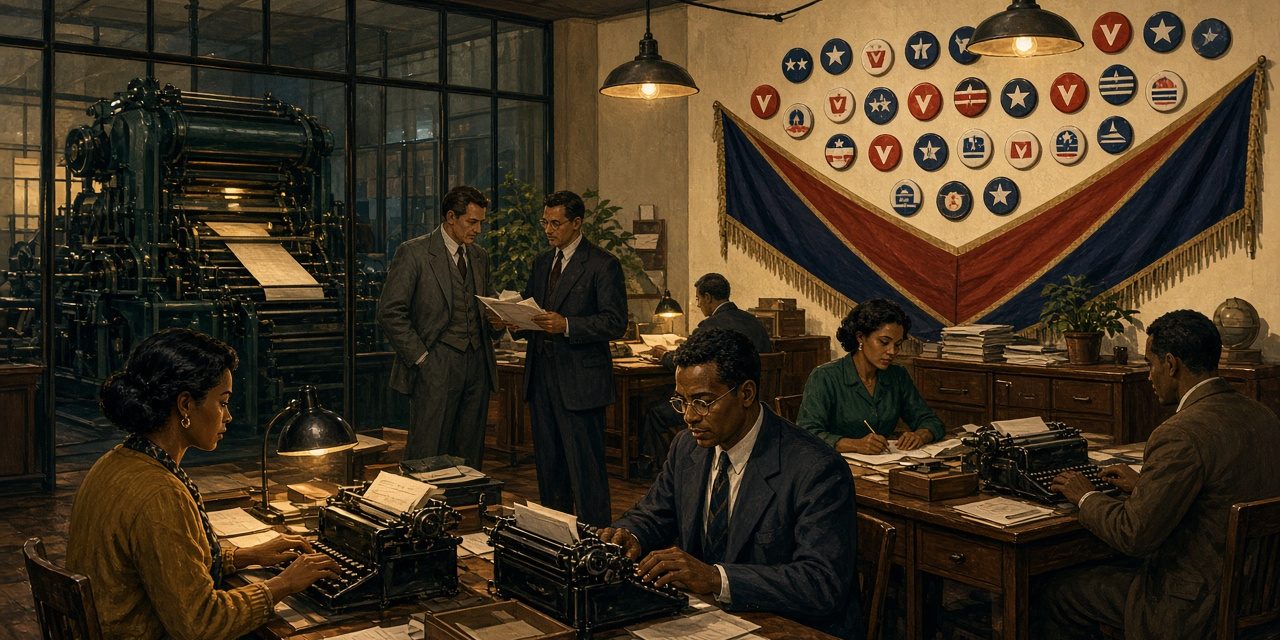
The Courier moved with unusual speed. On February 7, four Double V drawings appeared, and the eagle-topped logo, with the words “Democracy. Double VV Victory. At Home – Abroad,” took over the upper left corner of the front page. A week later, according to Washburn’s week-by-week count, the paper devoted more than five times as much space to the campaign as in the issue before, and a box on the front page declared: “WE HAVE A STAKE IN THIS FIGHT. . . . WE ARE AMERICANS, TOO!”
Washburn counted 970 Double V items in the Courier between February and the end of 1942, made up of 469 articles, editorials and letters, 380 photographs and 121 drawings. The peak came on April 11, with 50 items filling 569 column inches, a bit over 13 percent of the paper’s news space.
The campaign was also a marketing machine, and a clever one. A reader could buy a Double V pin for five cents. A group that wanted to form a Double V club needed only to buy a dollar’s worth of pens or stickers, with stickers a penny apiece. Washburn found the number of clubs grew from 38 on May 2 to 206 three months later, in 34 states, the District of Columbia and the Canal Zone. The paper’s pages carried a “Double V Girl of the Week.” In March it replaced the plain rules between stories with rules that had a VV in the middle, so that a reminder appeared wherever a reader’s eye landed. By mid-July the Courier claimed 200,000 members. That figure is the paper’s own, and Washburn treats it as a claim.
Beyond the page, the V appeared on dances, flag-raisings and baseball games. At a Double V game in St. Louis between the New York Black Yankees and the Birmingham Black Barons, drum and bugle corps formed a giant V on the field. Andy Razaf and L. C. Johnson wrote a song, “A Yankee Doodle Tan,” inspired by the campaign, and Lionel Hampton, billing his band as the “Double V Band,” played it on a national NBC radio broadcast in May. The Courier said two million people heard it. There were Double V hats and dresses, and, as Washburn put it, a Double V hairstyle that was sometimes called a “doubler.” The national Negro Baptist Council designated Easter Sunday 1942 as National Negro Double Victory Day, though Washburn notes the paper never mentioned the day afterward, which suggests it did not take off nationally.
Famous people were photographed with the sign or the pin. Washburn lists Marian Anderson, Lionel Hampton, Adam Clayton Powell Jr., Roy Wilkins and Joe Louis’s wife, Marva, among Black supporters, and Wendell Willkie, Thomas Dewey, Sinclair Lewis, Humphrey Bogart and Ingrid Bergman among white ones. The NAACP endorsed the campaign, and so did the United Auto Workers.
The Hill District behind the slogan
Behind all this was a newspaper rooted in the Hill District. According to an Associated Press history of the paper, the Courier worked from a brick building at 2628 Centre Avenue and had bought its own printing press in 1929. (Our piece on the history of the Hill District describes the neighborhood it grew up in.) Its founding editor and publisher in its great years, Robert L. Vann, had died in 1940. Accounts differ on who held which title afterward. The paper’s own history says his associate Ira Lewis became president and executive editor, while Washburn describes Vann’s widow, Jessie, as the publisher who took over with little newspaper experience. Veteran newsroom hands like managing editor P. L. Prattis helped steer the paper. Frank Bolden, who would later cover the war overseas, was on staff and wrote columns.
The Courier’s circulation depends on whose figure you take. Washburn cites an audited average of 190,684 in the first half of 1942, up from 141,525 a year earlier. The paper’s later histories give larger numbers: a circulation above 250,000 by the war, a high of 357,000 in 1947. A reader should treat any single number from this era with some caution, but all agree that the campaign coincided with a jump in readership.
The editors knew how the campaign could be read. The same issue that put the logo on the front page tried to calm nervous white readers, insisting that Black Americans were determined to “protect our country, our form of government.” In April, two days after the fall of Bataan, the Courier ran a “Double V Creed” across the front page. “We pledge allegiance to the United States of America,” it began, and continued with a pledge to “full participation in the fruits of this victory.” But the paper did not soften everything. Bolden wrote that “those who do not want colored people to fully participate in the war effort should be classed as traitors to the cause of democracy.” A March 28 editorial added, “If we are to have no democracy at home, it does not make a great deal of difference what happens abroad.”
The government takes notice
Not everyone liked it. The columnist Westbrook Pegler, who wrote for millions of readers, called the Courier and the Chicago Defender “dangerous,” in the Andscape account of this episode excerpted from Dan Goldberg’s book on the Navy’s first Black officers. According to that account and to Washburn, the War Department asked the Justice Department to consider sedition charges against Black editors and publishers, and FBI agents visited the Courier’s offices. Bolden later recalled seeing agents at the paper twice, once in 1940 and once in the first half-year after the U.S. entered the war. He told Washburn they were “scared white men, Hoover’s flunkies,” that they told the staff to “shut our mouths,” and that “we just ignored them.” The Courier also welcomed the attention, he said, because stories about government pressure sold papers.
The most dramatic scene came in June 1942, though the Courier was not in the room. Attorney General Francis Biddle summoned John Sengstacke, publisher of the Chicago Defender and head of the national Black publishers’ association, and laid out copies of Black newspapers, including the Courier, on a table. According to the Goldberg account, he told Sengstacke the papers came “very close to sedition” and that if they did not change their tone, he was “going to shut them all up.” Sengstacke is said to have answered, “You have the power to close us down, so if you want to close us, go ahead and attempt it.” Biddle backed off, promising not to indict publishers in exchange for a more cooperative tone and better press access to officials. Accounts differ on the role of J. Edgar Hoover and President Roosevelt. Washburn writes that the president would not allow court action. Other writers describe Roosevelt as pushing his officials to warn editors off, and the PBS series on the Black press says Hoover sought indictments with the president’s approval. Historians have not settled how close the government came. The historian’s fullest treatment is Washburn’s book A Question of Sedition, published in 1986.
Why it faded
By the late summer of 1942, the V was disappearing from the Courier. Washburn found the campaign’s share of the paper’s news space had dropped to under two percent by the last three months of the year, and that it appeared on the front page in only seven of the remaining 31 weeks. He tested the obvious explanations and could not make them fit: circulation was rising, advertising was not falling, other major Black papers had not criticized the Courier, and Bolden insisted government pressure had not caused the retreat.
Bolden’s own explanation was more practical. The campaign had won attention, and things had started to change: Washburn lists commissions for Black men in services that had excluded them, Black women admitted to the new Women’s Army Auxiliary Corps, the Red Cross collecting blood from Black donors, and defense plants hiring Black workers in large numbers, partly because of government pressure on employers. “The Double V was like a Roman candle,” he said. “It flared up, it did its work and then it died down.” The Courier replaced Double V material with pages of pictures and stories about those gains.
Washburn offers other possible explanations, and labels them as possible. One is the caution of a newspaper whose publisher had no newspaper training and depended on it financially. Another is money. In 1942, excess-profits taxes pushed American companies to advertise in the Black press for the first time in numbers, and by the end of the year Philip Morris, Esso, Pepsi-Cola and Pabst were buying space in the Courier. He concludes that the surviving records do not explain the decline, and that no one involved left a clear answer in writing.
What the campaign achieved is also a question of interpretation. Washburn concludes that some of the 1942 gains would probably have come anyway, given the urgency of the war, but that the campaign “unquestionably hastened” their size and speed. Other historians have treated it as one thread in a larger movement against military segregation that ended on paper when President Truman signed Executive Order 9981 in 1948.
What happened to Thompson
Thompson left Wichita for the Courier, which made him director of its national Double V campaign (Washburn dates this to June 1942; the Park Service suggests he left Wichita earlier). He stayed until February 1943, when he enlisted in the Army. According to the Park Service, he served as a corporal in a segregated quartermaster truck company in the India-Burma theater and was honorably discharged in 1946, with a Soldier’s Medal, the Army’s top award for heroism outside combat. The Courier reported the medal in November 1945 under the headline “Soldier’s Medal for Ex-Courierite.”
Not much is known of his later life. The Park Service says historical records indicate his Army pension was refused because he had not lived in Pennsylvania long enough before he enlisted. He lived for a time in California and eventually came home to Wichita, where he died in October 1999. His obituary in the Wichita Eagle called him a journalist. It did not mention Double V.
What remains
The Courier of 1942 is gone. The paper went bankrupt in 1966 and was bought by Sengstacke, who relaunched it as the New Pittsburgh Courier, which still publishes weekly. The neighborhood the paper called home was reshaped by urban renewal within a generation; see our story of the Lower Hill demolition. A Double V handkerchief made in red, white and blue linen is in the collection of the Smithsonian’s National Museum of African American History and Culture. In 2022, the National Park Service named both Pittsburgh and Wichita American World War II Heritage Cities.
For the wider picture of the home front, see our look at Pittsburgh’s role in World War II, which mentions the campaign in a paragraph, and the early Black entrepreneurs who built institutions like the Courier.
Thompson wrote his letter as a cafeteria worker who had no reason to expect anyone would print it. A paper in the Hill District did, put an eagle over it, and for a few loud months turned one man’s question into a national slogan. Whether the slogan changed the war is still argued. The question it asked was serious enough that the people in power spent 1942 worrying about it.