
When Richard King Mellon and his wife, Constance, came back to Pittsburgh after the war, they arrived on a night when the smog was so thick that, from a window of the William Penn Hotel, they could not see the lights of the Mellon National Bank half a block away. That is how Time told it in its October 3, 1949 cover story on Mellon. Constance Mellon’s reaction, as the magazine reported it, was: “I had almost forgotten how bad it is. Now I understand why a lot of people leave it and why a lot of people will never come back to it.” This is the story of what the city was like before Pittsburgh smoke control, how long it took to get there, and what the people who lived through it said about it afterward.
Hell with the lid taken off, and the people who defended it
The famous line comes from James Parton, writing in the Atlantic Monthly in January 1868. He had been taken to a street along a bluff, he wrote, from which you could look down on the part of the city by the rivers, “filled with blackest smoke, from out of which the hidden chimneys sent forth tongues of flame.” Anyone who wanted a spectacle as striking as Niagara, he said, could walk up to Cliff Street and look over into “hell with the lid taken off.” (The Pennsylvania Historical and Museum Commission’s “Behind the Marker” essay on Mayor Lawrence credits a similar “lid lifted” line to Charles Dickens. The earliest source I could find for the phrase is Parton’s, so I’d give it to him.)
The part people skip is what Parton wrote next. Pittsburghers, he reported, did not just put up with the smoke. A “son of Pittsburg,” when pressed, would admit it had its inconveniences, but he “insists, however, that the smoke of bituminous coal kills malaria, and saves the eyesight.” The smoke, Parton was told, was “a perpetual public sun-shade and color-subduer.”
That attitude lasted a very long time. In 1913, a University of Pittsburgh study put it bluntly: because coal had been so important to the city’s growth, “Pittsburghers have come to regard smoke as a sign of prosperity.” The study called that “a false conclusion.” The state’s marker for Mayor David L. Lawrence, written decades later, makes the same point from the other direction: there had been smoke laws on the books since the 1860s, it says, and they were never enforced, because smoke meant wealth.
What the smoke cost: the 1913 numbers
The study behind that 1913 quote was the Smoke Investigation, which ran from 1911 to 1914 through the University of Pittsburgh’s Department of Industrial Research. The university’s finding aid for the records calls it the first comprehensive study of dust fall and air pollution in the United States, drawing on 25 specialists. Its bulletins carried the Mellon Institute name. The investigation counted what the smoke cost in dollars, because dollars were a language the business community spoke.
Bulletin No. 4, “The Economic Cost of the Smoke Nuisance to Pittsburgh,” added up the measurable costs for the city at about $9.9 million a year. That included $1.5 million in laundry bills, $750,000 in dry cleaning, and money for repainting, replacing curtains, extra lighting, and ruined merchandise. It also counted $1.5 million lost by the smoke makers themselves, in fuel that burned badly. The authors noted that the total left out injury to health and property values. (I read these figures as quoted in a 1951 report to the Pennsylvania General Assembly, not in the bulletin itself.) The same city’s dust-fall gauges for 1912 and 1913 recorded 1,031 tons of soot, ash and other solids per square mile over the year, or roughly 85 tons a month.
The study had a political arm, too. In December 1912, the Smoke and Dust Abatement League formed through the Chamber of Commerce to push the findings into law. (It is sometimes shortened to the “Smoke Abatement League.”) Its secretary for several years, John J. O’Connor Jr., spent them lecturing and lobbying. An article in Western Pennsylvania History says the League favored persuasion and education over confrontation, and describes one of its first projects as the first smoke abatement exhibition in North America.
Court rulings were a bigger problem than lack of will. The 1951 report lists two Pittsburgh ordinances that Pennsylvania courts threw out as unreasonable. A 1902 ordinance failed because it banned the emission of any “smoke” at all. A second one, in a 1910 case, banned dense black or gray smoke except for eight minutes in any hour while a fire was being cleaned or built. The court held that this would in practice force owners to install mechanical stokers and give up hand firing. Writing a rule that would survive in court, and that people could actually follow, took decades.
Streetlights at noon: what the record shows
“Streetlights burned at noon” is one of the best-known Pittsburgh smoke stories, and the documentary record supports a careful version of it. The Pennsylvania Historical and Museum Commission’s Lawrence marker says the smoke got so bad early in the war that the city turned its streetlights on during the day. The same text says Pittsburgh got only about a third as much winter sunshine as the Allegheny County Airport, seven miles away, and that the city had the nation’s highest rate of pneumonia. (I have not been able to confirm either figure in the underlying study.)
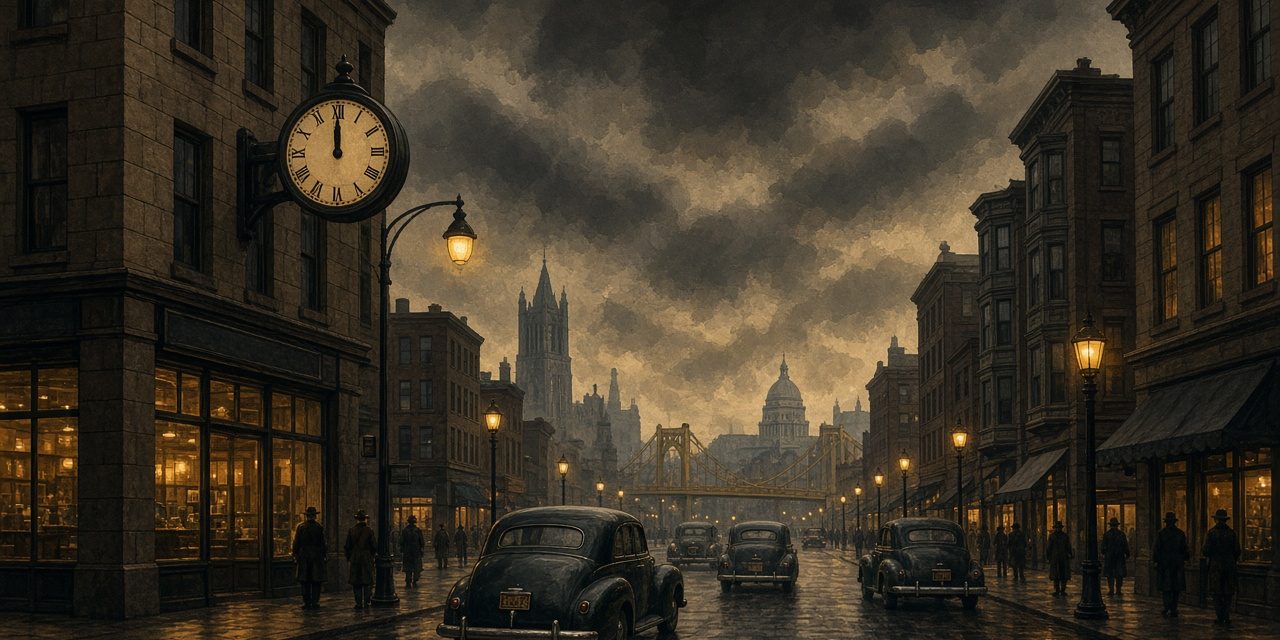
The University of Pittsburgh Archives holds a collection of 119 lantern slides, dated about 1940 to 1950, showing the city before and after smoke control. According to the collection’s finding aid, several of the views include clocks that read late morning or early afternoon, while the smoke makes the scene look like dusk or night. They are the closest thing I found to a photographic record of what people meant by noon looking like night.
The record also keeps this from becoming a simple “every day was like this” story. A Homestead oral history held at the Rauh Jewish Archives at the Heinz History Center has Ann Sheckter Powell, who lived in West Homestead from 1939 to 1948, describing a house that got “really dirty” from the dust and dirt in the air. She added: “that darkness at noon that I seen in pictures is something that I never experienced myself.” The worst days were bad enough to photograph. They were not every day, in every neighborhood. Even The New York Times, in a dispatch from the day the household smoke ban took effect (more on that below), described the smog season as running from the first chilly weather in September into spring, with “several wintry days” when the smog kept the sun from shining until as late as 11 a.m.
The long road to Pittsburgh smoke control
The turning point on paper was July 1941. At the request of Mayor Cornelius D. Scully, a commission drafted an ordinance modeled on the one St. Louis had adopted in 1937, and City Council passed it. The City Archives’ index to the 1943 ordinances refers to it as the ordinance “approved July 8, 1941.” It required smokeless fuel or smokeless-burning equipment: high-volatile bituminous coal, the soft coal mined around Pittsburgh, could be burned legally only if it was burned without smoke. Domestic users, meaning the owners of ordinary houses, were to be covered last. According to a scholarly article in Pennsylvania History, one councilman cast the only vote against it.
The Walker Foundation’s history credits three people for getting there: Dr. I. Hope Alexander, who took the health case to the public; Edward Leech, the editor of the Pittsburgh Press; and Councilman Abraham L. Wolk. It also says City Council had abolished the smoke regulation bureau in 1939, which would mean the city had gone backward before it went forward. I have only that one source for the 1939 abolition.
Then the war arrived and delayed putting the ordinance into effect. (For the wider story of those years, see our piece on Pittsburgh’s role in World War II.) By the marker’s account, the air was so foul that U.S. Steel, Alcoa, Westinghouse and other companies were threatening to pull their headquarters out of town because they could not recruit and keep office workers. The Walker Foundation repeats the claim and cites the marker. Treat it as the way the story was told afterward, not as something I found in a company document.
David L. Lawrence made the difference. He had campaigned in 1945 on a pledge to put the 1941 rules into force, according to the Pennsylvania History article. In April 1946, as mayor, he got City Council to make the ordinance effective October 1, 1946 for commercial users, with households following a year later. In his inaugural address, the marker records, he said: “I am convinced that our people want clean air. There is no other single thing which will so dramatically improve the appearance, the health, the pride, the spirit of the city.”
He could not do it alone. The marker text and the Walker Foundation both describe the partnership between Lawrence, a Democrat from a working-class Irish neighborhood, and Republican banker Richard King Mellon, who used his influence with business leaders and coal suppliers. Time reported in 1949 that after Mellon and his associates formed the Allegheny Conference on Community Development and enlisted Lawrence, they pushed a package of bills through the state legislature that included countywide smoke control. Lawrence’s anti-smoke effort was part of what became known as the Pittsburgh Renaissance, alongside flood control and the Point redevelopment.
The last piece, the one that reached into people’s basements, came at midnight on September 30, 1947. A New York Times dispatch from Pittsburgh (reproduced in a University of California, Irvine course reading, with no year printed; I dated it from the contents) said the city “after 107 years of campaigns for smoke control” had begun “a full-scale ban.” About 150,000 one- and two-family houses came under the law that night. Only smokeless fuel could be used, unless a home had a smoke-burning stoker for high-volatile coal. Thirteen inspectors were assigned to a 57-square-mile city, and the paper noted the staff would have to be larger. The ban started “without fanfare,” the paper said, and Lawrence warned residents not to expect miracles overnight.
Pennsylvania’s 1951 report describes how the rules worked in practice. Pittsburgh banned the sale or use of solid fuel with more than 20 percent volatile matter, with an exception for mechanically fed furnaces that met the Bureau of Smoke Prevention’s approval. In effect, that meant hand-fired furnaces had to use oil, gas, or a low-volatile coal. Enforcement ran through the coal dealers.
What residents remembered
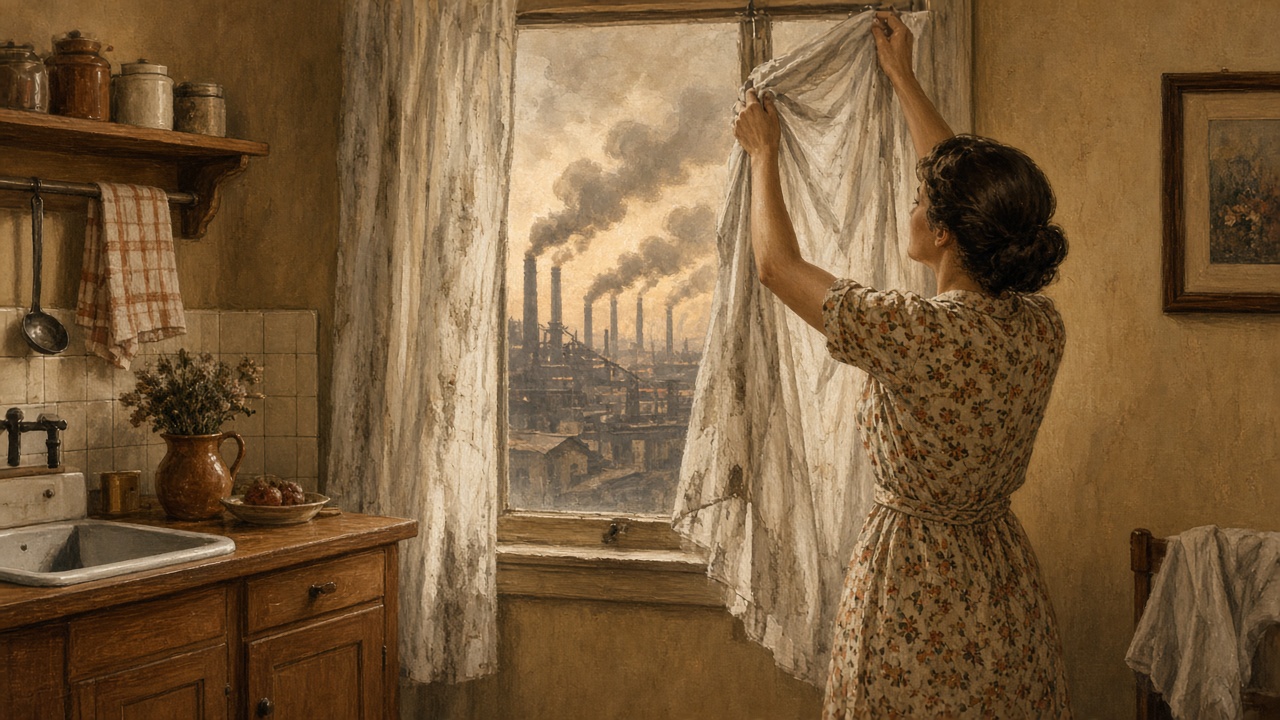
Most of what we have from ordinary people is recollection recorded decades later, which is worth keeping in mind. A set of eighth-grade interviews on the Pittsburgh History & Landmarks Foundation’s “Spotlight on Main Street” site gives a feel for it. A woman born in 1920 told her young interviewer that her family changed the white curtains at least once a week, that a blown nose came out black on a handkerchief, and that white laundry had to be boiled until it was white again. Another woman, born in 1922, who lived on the South Side, said the soot from the mills was everywhere: “You had to keep your windows shut to keep the dirt out. You had to sweep your sidewalk a couple of times a day and clean the outside windowsills of your house.” A third, born in 1926, put it more simply: “You seldom saw the sun.”
Longtime resident and former U.S. Steel employee Art Thomas told 90.5 WESA in 2024 that you would run out and pull wet laundry off the line when you saw soot coming. “If you didn’t get them off the lines, you had to wash your clothes again.”
The white shirt is the best-known detail, and there is some documentary support for it. When Time described the result of smoke control in 1949, one of the things it said was that there was 39 percent more sunlight, so “a white shirt could be worn decently a whole day.” The stories of men changing shirts at lunchtime are family recollection, and I haven’t found one tied to a named person in a solid source. But the 1949 line suggests why the stories got told.
What changed, and what the numbers can’t prove
The headline figures come from the state marker: in the winter of 1947-48 Pittsburgh got 39 percent more sunshine than the winter before, and by 1954, the marker says, smoke was 90 percent below its 1946 level. Time had the same 39 percent figure in 1949 and added that when fog settled over Pittsburgh, “it was no longer smog; it was fog.”
Other measures are less dramatic. The 1951 state report says Pittsburgh’s dust fall averaged 65 tons per square mile per month in October and November 1937 and 55 tons in the same months of 1947. That is a drop, but not a collapse. The same report quotes city officials, via a 1950 Philadelphia Inquirer story, claiming that after eight years of smoke control the air held 65 percent less dirt than in 1945. Dust-fall gauges, the report cautions, measure settled particles, not everything in the air, and not all of it is from smoke. The honest summary is that the sky visibly cleared, the officials’ figures were large, and some of the measured numbers moved more slowly than the sunshine did.
It is also worth being careful about credit. Smoke control was not the only change. The Walker Foundation says natural gas arrived as a cleaner fuel, and the Pitt lantern slide collection pairs its “before” photographs with steam locomotives and the diesels that replaced them. The 1948 Donora smog and the county-wide rules that followed the city ordinance are separate stories, and they came after the city had already acted.
One more detail from the Walker Foundation’s history: the city sandblasted decades of soot off its buildings, which gave the public fast, visible proof that its leaders meant it. Downtown looked different well before the statistics settled. The clean-up began quietly, at midnight in 1947, and then showed itself building by building in daylight.
Related reading on Steel City History: Steel City Saga: How the Steel Industry Shaped Pittsburgh and The Pittsburgh Neighborhood Demolished to Build the Civic Arena.