
The Pittsburgh Crawfords of the early 1930s were, by most informed assessments, one of the greatest baseball teams ever assembled. Their roster in the mid-1930s included five players who would eventually be inducted into the Baseball Hall of Fame. Their pitcher was Satchel Paige, among the most dominant and theatrical hurlers of his era. Their catcher was Josh Gibson (see our Josh Gibson article), the great power hitter of the Negro Leagues. Their outfield included Cool Papa Bell, whose speed generated stories that bordered on myth. And holding the whole enterprise together was a Hill District entrepreneur named Gus Greenlee, who funded his baseball empire with profits from an illegal numbers operation.
The Pittsburgh Crawfords never played in the World Series. They were never eligible to play in the World Series. The color barrier that kept Black players out of Organized Baseball until 1947 ensured that the greatest collection of talent the Crawfords assembled would never get to test itself against the best white players in an official championship context. That is part of the story, along with the achievement.
Gus Greenlee and the Foundation
The Pittsburgh Crawfords took their name from the Crawford Bath House, a recreation center in the Crawford neighborhood of the Hill District. They began as an interracial sandlot team of local youths; as the teams became more competitive, lines of color were drawn, and Bill Harris and Teenie Harris helped form a predominantly Black team. Greenlee bought the club in 1931, at a moment when the major Black leagues of the 1920s had collapsed in the Depression, and signed many top stars, most notably Satchel Paige. Greenlee was one of the most influential figures in the Hill District during its peak years, a man whose business interests ranged from the Crawford Grill jazz club to a boxing stable to the numbers racket that generated the capital underlying everything else.
The numbers game, an illegal lottery common to urban Black communities throughout the early twentieth century, made Greenlee wealthy in a context where legitimate routes to wealth were systematically closed to Black entrepreneurs. He took that wealth and invested it in institutions that gave the Hill District cultural prestige and civic pride: the Crawford Grill, which became one of the premier jazz venues in the country, and the Pittsburgh Crawfords, which he turned from a neighborhood baseball team into a professional powerhouse.
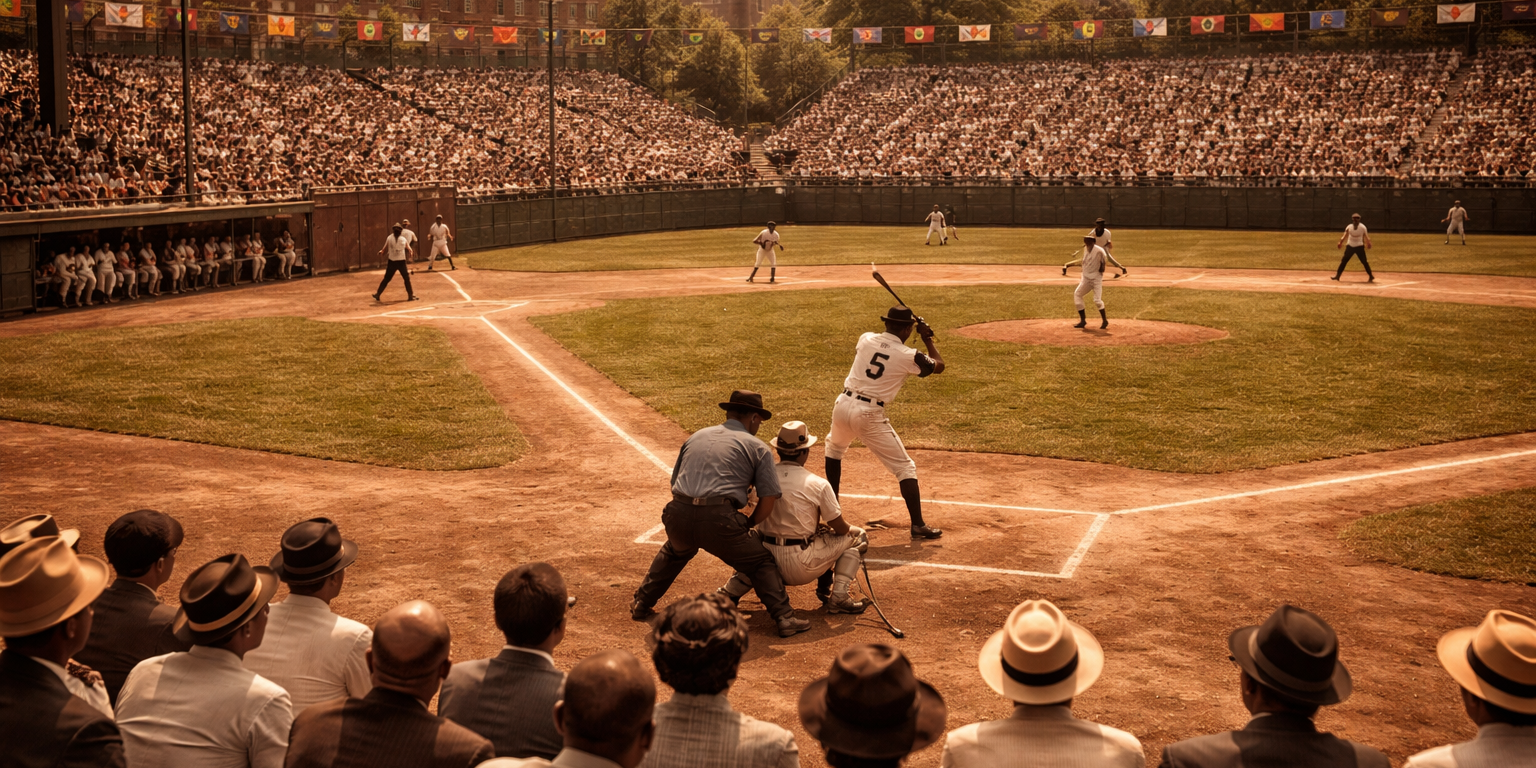
In 1932, Greenlee did something that had no precedent in Black professional baseball. He built Greenlee Field on Bedford Avenue between Chauncey and Duff in the Hill District. It was dedicated on April 29, 1932, reportedly cost $100,000, and held about 7,500 spectators. It was one of only a few ballparks in the country built and owned by a Negro League team (it is often called the first Black-owned stadium, but “one of the few” is the safer claim). The first game was played the next day, April 30, 1932, with Paige pitching and Gibson catching, against the New York Black Yankees, as the mayor and county commissioners watched.
The Homestead Grays also played there for a time, and the Pittsburgh Steelers used it for in-season practices in the 1930s. In 1933 Greenlee founded a new Negro National League and served as its president, with the Crawfords as charter members.
Building the Roster
The team Greenlee assembled has been called the greatest in Negro League history, a claim that needs qualification: there are several contenders and the records are incomplete. Many historians do consider the 1935 edition the best ever, and five of its players, Charleston, Gibson, Johnson, Bell and Paige, are in the Hall of Fame. In 1932 Greenlee hired Charleston as playing manager and added Gibson, Johnson and Bell.
Oscar Charleston, who played first base and the outfield, was a player whose all-around game, power, defense and baserunning, led contemporaries to compare him to both Ty Cobb and Babe Ruth. Many historians of the Negro Leagues rate him among the greatest all-around players the leagues produced. Judy Johnson at third base was known for steady defense and contact hitting. Cool Papa Bell in the outfield was a switch-hitter whose speed produced stories that have never been fully separated from the legends they became.
The battery of Satchel Paige and Josh Gibson was the centerpiece. Both are in the Hall of Fame and both are routinely ranked among the best ever at their positions; that they were teammates in a stadium Greenlee built in the Hill District is remarkable. Paige and Gibson also often unwound at the Crawford Grill, where performers such as Lena Horne and Bill “Bojangles” Robinson played.
Satchel Paige
Leroy Robert Paige was born in Mobile, Alabama, and according to the usual story got the nickname Satchel carrying luggage at a train station as a child. He was a right-handed pitcher whose fastball hitters called among the hardest they ever faced, with command precise enough for the showmanship that would have been suicidal for a lesser pitcher.
Stories say Paige would call in his outfielders, sometimes sending them off the field, and then strike out the side, or announce a pitch to the batter and throw it past him. These are among baseball’s most-told tales; details vary and I have not found a contemporary account of any specific game, so read them as legend.
His relationship with Gus Greenlee was one of mutual appreciation and recurring friction. Paige knew his market value and several times left for better-paying jobs; in 1935 he skipped most of the Negro National League season to pitch for a semipro team in North Dakota, and he was back in 1936.
The philosophical wit that Paige displayed in interviews and public statements made him one of the most quoted figures in baseball history. He is famously credited with the line “Don’t look back, something might be gaining on you,” and with “Age is a question of mind over matter. If you don’t mind, it doesn’t matter.” Both are attributed to him in popular collections; I have not traced either to a first printing.
The Gibson-Paige Battery
When Josh Gibson caught Satchel Paige at Greenlee Field, Pittsburgh was watching a formidable pitcher-catcher pair at a ballpark about two miles from downtown.
In 1934 Gibson led the league with 16 home runs and Paige won 20 games.
The 1935 Championship and the Peak Years
The Crawfords were mighty before 1935 but their results in the new league were unsettled. In 1933 they narrowly lost the first-half title to the Chicago American Giants; both teams claimed the second half, and Greenlee, as league president, awarded it to the Crawfords, so the overall pennant was never settled. In 1934 they had the best record counting all games but won neither half. In 1935, with Paige away, they took the first half at 26–6 and then beat the New York Cubans in a close seven-game series for their only undisputed Negro National League pennant. Lefty Leroy Matlock reportedly won 18 games without a loss that year. In 1936 they rallied to win the second half, but the playoff against the first-half winner lasted one game and the pennant was awarded to Pittsburgh over protests.
Offseason barnstorming games against white major leaguers were the only direct comparison available, and Black stars often held their own. I have not cited particular box scores here; for specific results consult the Negro Leagues databases at Seamheads and Baseball-Reference.
Trujillo and the Diaspora
In 1937 Paige led several Crawfords players, including Gibson, Bell and Sam Bankhead, to the Dominican Republic to play for a team backed by the dictator Rafael Trujillo. The Crawfords fell to fifth of six teams at 12–16.
The heart of the old team, Paige, Gibson and Bell, soon moved on to other teams; only the 41-year-old Charleston was left. The salary motive is commonly cited, but I have not found a source for Greenlee’s reaction.
They finished third in 1938 at 24–16. Attendance fell after the white members of the board reportedly forced Greenlee to bar Black workers from jobs such as ushers and ticket-takers at Greenlee Field, angering fans. After the 1938 season Greenlee sold the club, the field was torn down, and the team became the Toledo Crawfords, then the Toledo-Indianapolis Crawfords, before folding in 1940. In 1945 Greenlee formed a new, unrelated Crawfords in Branch Rickey’s United States League, which lasted two seasons.
What It All Meant
The Crawfords were at full strength for only a few years, but in that time they were arguably the best team in Black baseball.
Oscar Charleston, Judy Johnson, Cool Papa Bell, Josh Gibson and Satchel Paige all earned Hall of Fame plaques on their whole careers. Their careers overlapped in Pittsburgh.
The color barrier kept these players out of the major leagues. The games were real, though the record is incomplete.
The field is gone; the Bedford Dwellings housing project was later built on the site. A historical marker at Bedford Avenue and Junilla Street commemorates Greenlee Field and the Crawfords. Greenlee’s other legacy, the Crawford Grill, is covered in our Hill District history; the Grill No. 2 building on Wylie Avenue has stood vacant, with restoration efforts reported but no confirmed reopening in the sources I found.
Timeline
| Date | Event |
|---|---|
| 1931 | Greenlee buys the Crawfords; signs Satchel Paige |
| 1932 | Charleston hired as player-manager; Gibson, Johnson, Bell join; Greenlee Field opens April 29 |
| 1933 | Greenlee founds the second Negro National League |
| 1935 | Crawfords win the NNL pennant over the New York Cubans |
| 1937 | Paige, Gibson, Bell and others go to the Dominican Republic |
| 1938 | Season ends; Greenlee Field demolished |
| 1939–40 | Franchise moves to Toledo, then Toledo–Indianapolis, then folds |
Frequently Asked Questions
Who were the Hall of Famers on the Crawfords? Oscar Charleston, Josh Gibson, Judy Johnson, Cool Papa Bell and Satchel Paige played together in the mid-1930s; other Hall of Famers, such as Bill Foster, Biz Mackey and Jud Wilson, are also linked to the franchise by Wikipedia.
Where was Greenlee Field? On Bedford Avenue in the Hill District; the Bedford Dwellings housing project now occupies the site.
Did the Crawfords win championships? Their only undisputed Negro National League pennant came in 1935.
Sources
Wikipedia, “Pittsburgh Crawfords” and “Greenlee Field”; Society for American Baseball Research, “Greenlee Field (Pittsburgh)”; Historical Marker Database, Greenlee Field marker; Wikipedia, “Crawford Grill”; Rob Ruck, “Kings on the Hill,” Carnegie Museum of Art Storyboard (2014).