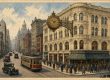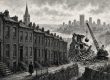

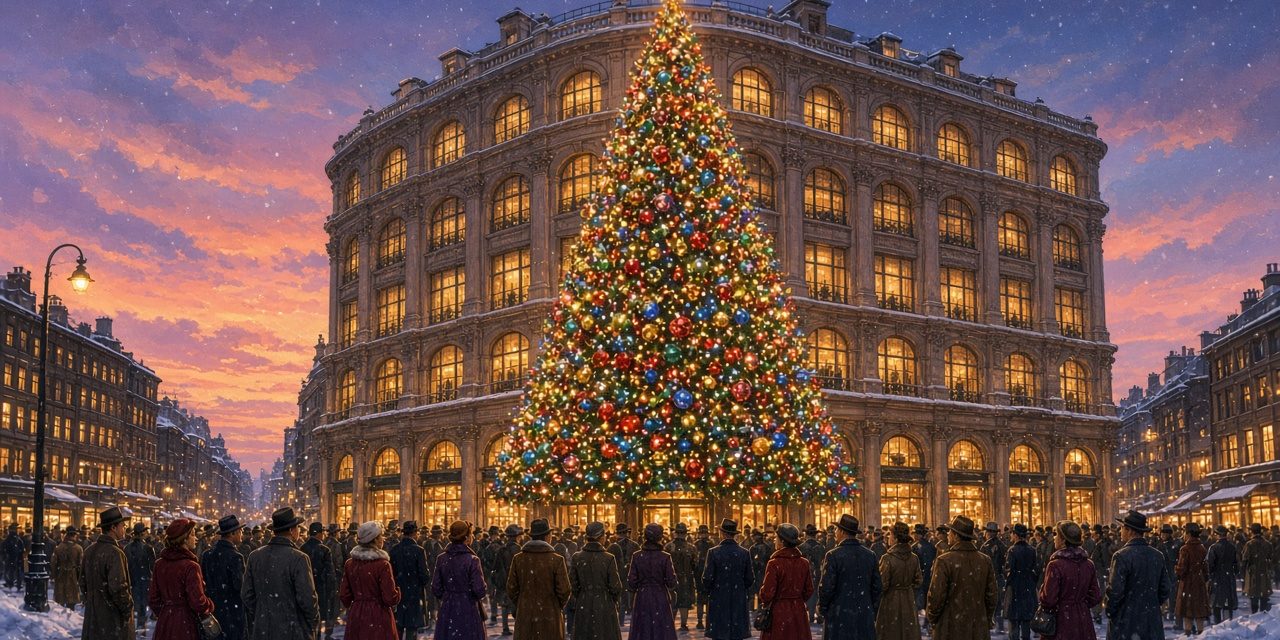
A little after 1 a.m. on May 3, 1897, flames from a burning grocery warehouse on Penn Avenue jumped the street and set fire to the contents of the show windows at the Joseph Horne Company, a department store that had been described as fireproof. The windows were rebuilt, and for the better part of a century they filled with Christmas scenes. Today the Horne’s Christmas tree is still lit every November on the same corner, more than 30 years after the last Horne’s closed. This is the story of how a store, its windows and its tree came to be tied to that corner, and how the tree ended up outliving the company that put it there.
A “fireproof” store that burned twice
Joseph Horne was 23 when he bought out his employer, F. H. Eaton, and renamed the business the Joseph Horne Company on February 22, 1849. He started in trimmings and fancy goods and, according to a Pittsburgh cemetery-history account of his life, began with a small Market Street shop and eleven employees. By the cemetery account’s telling, his big move came in 1886, when he added retail to what had been mainly a wholesale business. He died in 1892 while planning the store that would stand at Penn Avenue and Stanwix Street.
Sources disagree about when that building opened. A Pittsburgh Press story of August 1, 1893, “A Grand Opening,” cited by Wikipedia, supports an opening on July 31, 1893. The Observer-Reporter, Positively Pittsburgh and a Post-Gazette archive feature say 1879, and the carved frieze over the entrances reads “1849 – Joseph Horne Co. – 1879.” I could not find what 1879 commemorates, and I would go with 1893 for the building.
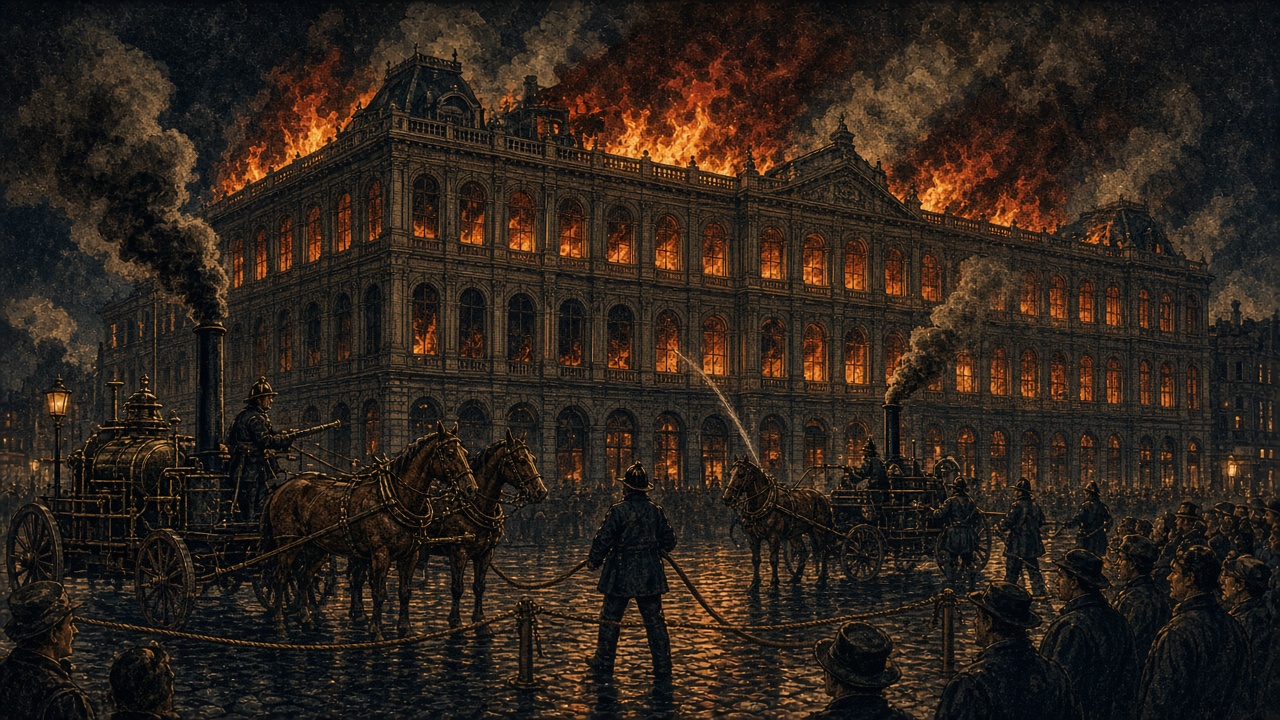
What is not in doubt is the fire. The night of Sunday, May 2, 1897, a watchman at T. C. Jenkins’s wholesale grocery on Penn Avenue found a fire in a barrel of rags and refuse at the bottom of an elevator shaft. According to a report in Engineering News that was reprinted in a 1898 British fire-prevention committee publication, the fire department arrived at 12:20 a.m., and a little after 1 a.m. the flames crossed the street and ignited “the inflammable contents of the dry goods store windows.” Within about two hours, the report says, the fire had destroyed the three larger buildings in the group, the Jenkins building, the Horne store and the Horne office building next to it, along with several smaller ones, and badly damaged others. The firemen from Pittsburgh and Allegheny fought it from rooftops across Fifth Street.
The Horne building was a six-story steel-frame structure protected by hard clay tile, which is why it had been called fireproof. A board of experts hired by the insurance companies concluded that the steel frame had survived better than the tile covering it. Test pieces cut from badly bent beams were not weakened. Their recommendations were aimed at other builders: put concrete around steel, not clay tile, which could not restrain the steel as it expanded, and fit “open front” stores like this one with metal shutters and metal elevator doors. The store was rebuilt, and Wikipedia, citing Engineering News from April 1900, says a second fire in 1900 damaged it again, though this time the walls and steel frame survived. By then Horne’s had a corner it would hold for nearly a century.
Windows before the tree
Long before there was a tree, Christmas on Penn Avenue meant windows. The Heinz History Center notes that elaborate animated Christmas windows grew out of electric lighting and plate glass in the late 1800s, and that by the 1920s they were an annual downtown ritual. In 1924, Horne’s published a request that parents bring preschool children in the mornings and early in the week, leaving later afternoons and Saturdays for school-age children, so that crowds would thin out.
In December 1950, Horne’s introduced a character named Christopher Candycane, an elf with radar antennae on his cap, in a window of twenty revolving scenes. A recording of a Candycane song, made with local producer George Heid Sr., is in the History Center’s archives. Over the next few years Candycane took a Carnegie Museum dinosaur sightseeing (1951), visited “Storybook Land” (1952) and hosted an animal costume ball (1953). The History Center’s account says his popularity in newspaper ads faded after 1963.
The department store’s display department also trained at least one person who became famous, Andy Warhol. The Andy Warhol Museum says Warhol took a summer job in Horne’s display department between his sophomore and junior years at Carnegie Tech. Wikipedia dates it to 1947, and a PaperCity writer who also worked at Horne’s says his job dressing windows and mannequins paid 50 cents an hour.
The Horne’s Christmas tree begins, 1953
The first Horne’s tree may not have been a tree at all. According to the Post-Gazette’s archive blog, it was a display of lights hung on the outside of the store in 1953 and dedicated to the young patients at Children’s Hospital of Pittsburgh. (Other accounts call it a tree.) Wikipedia, and a 2016 blog post based on Robert Keith Manherz’s Post-Gazette obituary, credit the design to Manherz, then the art director at Pittsburgh Outdoor Advertising Co. He died in 2016 at 99.
In the mid-1960s, on that telling, it grew into a tree with branches and ornaments. The Post-Gazette quotes a 1998 story by Bob Batz Jr. describing the job of putting it up: an artificial tree of more than 100 feet, branch sections so heavy they had to be bolted together and hoisted by crane, 87 ornaments “bigger than your head,” 2,500 lights and 30 plugs, all assembled on scaffolds on one of Downtown’s busiest corners. An electrician from Sargent Electric Co., John McDonough, oversaw the installation for more than 15 years.
The tree and the city’s other big holiday tradition grew up together. Pittsburgh’s first official Light Up Night was held Monday, November 21, 1960, according to a later City Council resolution. Downtown lights went on at 6 p.m., and the major department stores unveiled their Christmas windows. Before that, the downtown celebration had been called the “Preview of Christmas.”
The years the tree went dark
The tree has been turned off before. The Post-Gazette’s archive captions say half its lights were eliminated in 1973 to conserve energy, and that it was “mothballed” in 1978 because of a national energy crisis, then lit again on November 12, 1979. Light Up Night itself paused too. One history says it went dark for nine years from 1973 and returned in 1982 under Mayor Richard Caliguiri, and another account says the return was meant to lift morale as the steel industry collapsed. That suggests the tree was lit again before Light Up Night came back, but I could not find a source that spells out the sequence, so treat the exact years as approximate.
What happened to the store
Horne’s changed hands several times in its last decades. Associated Dry Goods bought it in 1966 and opened branches in malls around the region. When May Department Stores took over ADG in 1986, it sold Horne’s to a group that included Equitable Assurance, Mitsui USA and Massachusetts Mutual Life, according to Women’s Wear Daily. May already owned Kaufmann’s. A 1988 deal with Dillard’s and developer Edward DeBartolo collapsed and led to years of litigation, per Wikipedia.
By 1993 the numbers were bad. Women’s Wear Daily reported that Horne’s lost $8.5 million in the nine months ended October 31, 1993, on annual sales of about $215 million, and had been for sale since the start of 1994. In late April 1994, Federated Department Stores signed a letter of intent to buy the 10-store chain and fold it into its Lazarus division. The price was $123 million in cash and assumed mortgage debt. Horne’s had about 2,000 employees, including roughly 250 in its central office, and the stores were to be renamed Lazarus by fall. The Post-Gazette reported the Lazarus takeover on August 29, 1994, the date commonly given as the end of the Horne’s name.
The Penn Avenue flagship did not last long under the new name. Wikipedia, citing the Post-Gazette of December 31, 1995, says Lazarus stayed in the building about a year before moving to a new store on Fifth Avenue. Father Pitt says the Fifth Avenue Lazarus was closed later too, and a 2004 Pittsburgh Business Times story cited by Wikipedia is headlined “Federated to close Lazarus in Pittsburgh.” Old Navy took the first two floors of the old Horne’s from 1996 to 2003, and Highmark Blue Cross Blue Shield now owns the building and occupies the upper floors. The Pittsburgh History & Landmarks Foundation had designated the store a historic landmark in 1982.
Why the tree stayed
When the store was sold, nobody had to keep the tree. The Post-Gazette says Highmark continued it, and that a contest in the mid-1990s renamed it the “Unity Tree.” A columnist in the Observer-Reporter complained about the name in 2012, and the Post-Gazette’s archive blog added that “no one calls it that.” People still say Horne’s.
Part of the reason it never stopped is probably the building. Father Pitt points out that you can still see the brackets on the corner that hold the tree. Bronze plaques on the southwest corner still read “Joseph Horne Co Dry Goods Importers and Retailers,” and the Horne’s logo is inlaid in the sidewalk slabs by the entrances. The store sold goods for about 145 years. The tree has now been going for more than 70, and a 2024 events listing shows it lit again that holiday season on the old Horne’s corner.