
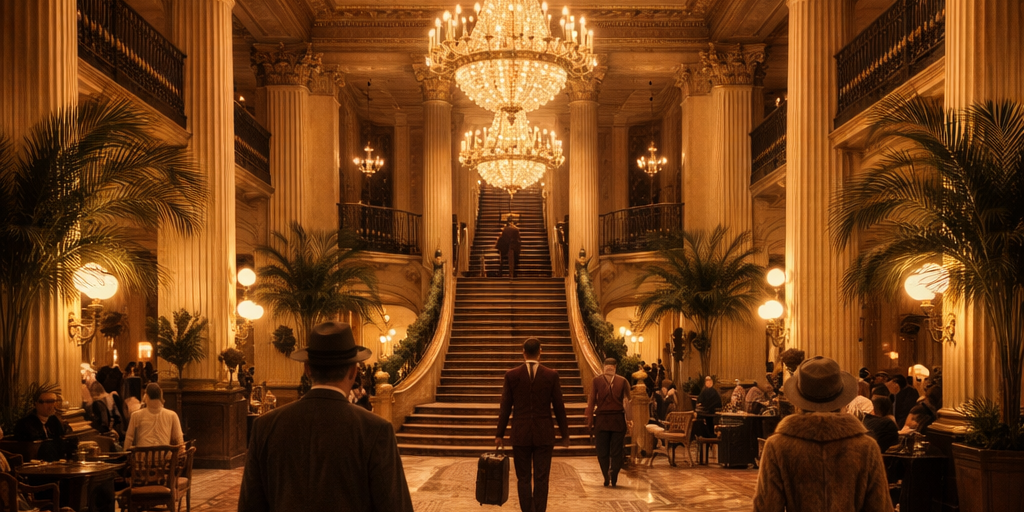
There is a moment, stepping through the front doors of the William Penn Hotel Pittsburgh and into the lobby, when the city outside seems to fall away. The ornate plasterwork overhead, the grand chandeliers throwing warm light across the polished floors, the sense of accumulated occasion that clings to a room where generations of deals have been struck and dignitaries have passed through: all of it arrives at once. It is a lobby that was built to impress, and after more than a century of doing exactly that, it still does. What most visitors do not fully consider, standing there in that gilded space, is how much of Pittsburgh’s history moved through this building, and how deliberately it was constructed to be the place where that history happened.
The William Penn Hotel opened its doors in March 1916 (the first guests arrived on March 9, according to the University of Pittsburgh Archives), on William Penn Place in the heart of downtown Pittsburgh. It was not built by accident or improvisation. It was built because Pittsburgh in the early twentieth century was one of the wealthiest and most consequential industrial cities in the world, and a city of that stature needed a hotel that could hold its own against anything in New York, Chicago, or Washington. For most of the century that followed, it did exactly that.
The City That Demanded Grandeur
To understand why Pittsburgh built the William Penn Hotel when it did, you have to understand what Pittsburgh was in 1916. Andrew Carnegie had sold Carnegie Steel to J.P. Morgan in 1901 for the staggering sum of nearly five hundred million dollars, a transaction that created United States Steel and made Carnegie the richest private individual in the world. The Mellon family, through banking and investments in aluminum, oil, and coal, had built a financial empire that reached into every corner of the American economy. Henry Clay Frick, whose complicated legacy remains one of the most debated in Pittsburgh history, had accumulated a fortune that placed him among the wealthiest Americans of his era. Westinghouse Electric was lighting the country. Heinz was feeding it. Pittsburgh-made steel was holding up its bridges and buildings.
The wealth concentrated in this river city was extraordinary by any measure, and it attracted a corresponding volume of business visitors: financiers, industrialists, politicians, lawyers, and deal-makers who needed somewhere to stay that reflected the seriousness of the business being conducted. The hotels that existed before the William Penn were not equal to that requirement. The city’s business class had been aware of the gap for years.
The project that eventually became the William Penn was conceived on a scale that matched Pittsburgh’s ambitions. The building that rose on William Penn Place was twenty-three stories tall, making it one of the larger hotel structures in the country at the time of its opening. The interior was designed with the opulence that the era considered appropriate for a first-class establishment: ornate public spaces, a ballroom capable of hosting the grandest events the city could produce, dining rooms and meeting spaces fitted out to the standard of the finest hotels anywhere in America.
The name was a statement as much as a designation. William Penn, the Quaker founder of Pennsylvania, had established the colony on principles of religious tolerance and fair dealing that remained points of civic pride for the commonwealth three centuries later. Naming Pittsburgh’s grandest hotel after him was a way of planting the establishment firmly in the civic tradition of the place, declaring it not merely a business venture but an institution.
The Lobby as Living Room
In the decades before television turned American living rooms into private entertainment spaces, the grand hotel lobby served a social function that is difficult to fully recover in imagination. It was where people went to see and be seen, to conduct the informal business that preceded formal meetings, to take tea, to read the afternoon papers, and to encounter the rotating cast of notable visitors that a city of Pittsburgh’s importance reliably attracted.
The William Penn’s lobby became, in this sense, a kind of permanent civic stage. The industrialists and bankers whose names appeared on Pittsburgh’s buildings would pass through it. The politicians who came to court their support would be received there. Visiting dignitaries, theatrical performers, athletes, and socialites all moved through the same ornate space, generating the kind of layered history that buildings accumulate over decades if they are lucky enough to stay standing and relevant.
The hotel’s Tea Room developed a particular reputation as a gathering place for Pittsburgh’s business and social elite. Afternoon tea at the William Penn was not simply refreshment. It was participation in the city’s ongoing conversation about itself, conducted in a room designed to make that conversation feel appropriately important.
Presidential Guests and National Moments
Over the course of its history, the William Penn Hotel has welcomed a remarkable number of American presidents. The list of heads of state and major political figures who have stayed in the building or attended events within it reads like a condensed history of twentieth-century American politics. Presidential visits to Pittsburgh were significant events for a city whose industrial output and labor politics made it a constant subject of national attention, and when a president came to Pittsburgh, the William Penn was typically where the visit was centered.
The pattern reflected both the hotel’s preeminence and Pittsburgh’s outsized importance in national affairs. The steel industry that powered the city was also the industry that powered American military production during two world wars and shaped the labor movement that transformed the relationship between workers and employers throughout the country. A politician who wanted to speak to those forces came to Pittsburgh, and coming to Pittsburgh meant coming to the William Penn.
During the Second World War, as Pittsburgh’s mills ran around the clock supplying steel for ships, tanks, and weapons, the hotel functioned as a hub for the wartime business and government activity that flowed through the city. The war years transformed Pittsburgh into what was sometimes called the Arsenal of Democracy, and the William Penn was at the center of the city’s civilian wartime life: a space where the pressure of the moment was briefly suspended in the dining rooms and ballrooms, and where the business of coordinating an industrial war effort was quietly advanced in the meeting rooms and suites above.
The Urban Room and Pittsburgh’s Social Calendar
The William Penn’s grand ballroom, known as the Urban Room, occupied a central place in Pittsburgh’s social calendar for decades. Charity galas, debutante balls, industry association dinners, political fundraisers, wedding receptions for the city’s prominent families: the Urban Room hosted the full range of occasions that a city’s formal social life produces, year after year, across multiple generations.
For a certain cohort of older Pittsburghers, the Urban Room carries the specific weight of personal memory. It is the room where grandparents danced, where parents attended their first formal event, where a generation of Pittsburghers experienced the city’s public life at its most elegant. That kind of accumulated personal history is not transferable to a newer building. It lives in the walls and the floors of the specific room where it happened, and the William Penn has had more than a century to accumulate it.
The ballroom has been restored and updated over the years, as any functioning venue must be, but its essential character has been preserved. Stepping into the Urban Room today is not a historical recreation. It is a continuation of something that has been going on in the same space since 1916.
The Lean Years and the Question of Survival
The mid-twentieth century was not uniformly kind to the great American grand hotels. The spread of automobile culture and the construction of the interstate highway system pulled travelers away from downtown hotels and toward the motels and chains that clustered around highway exits. The simultaneous decline of American downtowns, as retail and business followed the middle class to the suburbs, left many historic urban hotels in a difficult position: they were anchored to downtown neighborhoods that were losing the foot traffic and commercial activity that had once sustained them.
Pittsburgh was not immune to these forces. The steel industry’s contraction in the 1970s and 1980s hit the city hard, and downtown Pittsburgh experienced the same pressures that hollowed out urban cores across the Rust Belt. A hotel that had been built to serve a booming industrial city found itself navigating a city in economic transition, with the long-term outcome far from certain.
The William Penn survived, which is not something that can be said of all its contemporaries. The Schenley Hotel in Oakland, once a grand establishment serving the cultural and academic crowds around Carnegie Tech and the University of Pittsburgh, was converted into a university student union building. The Fort Pitt Hotel, a downtown rival that had hosted its own share of significant events including a famous chapter of NFL draft history, was eventually demolished. The William Penn endured, changing ownership and management multiple times but maintaining its essential identity as Pittsburgh’s preeminent downtown hotel.
Restoration and the Return to Prominence
The transformation that brought the William Penn back to something close to its original standard was not a single event but a sustained effort that unfolded over years of investment and restoration work. Subsequent ownership groups committed to preserving the historic character of the building while updating its infrastructure and amenities to meet contemporary expectations. The lobby’s ornate details were carefully maintained rather than stripped out in the name of modernization, a decision that has proven correct as the appetite for historically authentic hotel experiences has grown steadily in recent decades.
Today the building operates as the Omni William Penn Hotel, part of a chain that specializes in historic luxury properties and has generally taken preservation seriously as a value rather than an obstacle. The lobby that opened in 1916 is recognizable in the lobby that greets guests today. The chandeliers are still there. The plasterwork is still there. The sense of occasion that the original designers worked so hard to create is still, somehow, there.
What the Building Holds
A hotel that has been operating in the same downtown location for more than a century is not simply a building. It is an archive of the city it has served, a physical record of the events and people and conversations that passed through it over all those years. Most of that record is not written down anywhere. It exists in the form of institutional memory, in the details of the architecture, in the way the room proportions suggest the social rituals they were designed to accommodate.
Pittsburgh has lost more of its historic fabric than it should have. Buildings that deserved to stand were torn down during the urban renewal era, neighborhoods were demolished for highways and stadiums, and the physical record of certain chapters of the city’s history exists now only in photographs and documents. The William Penn Hotel is a counterexample: a building that was important enough, and beloved enough, and commercially viable enough, to survive everything the twentieth century threw at it.
Walking through that lobby now, knowing something of what has happened within those walls across more than a hundred years of Pittsburgh history, changes the experience. The chandeliers are not just chandeliers. The room is not just a room. It is the place where Pittsburgh’s industrial titans conducted their affairs, where presidents slept before addressing the city’s workers, where generations of Pittsburghers marked the most formal occasions of their lives. It is a building that remembers what it has seen, and if you know where to look, it will show you.