
Why did Pittsburgh’s steel industry collapse? The short answer: between 1980 and 1987 the Pittsburgh region’s steel workforce fell from about 84,500 to about 27,700, as imports, new technology and a deep recession exposed mills that had been built for a different century. The longer answer starts in 1875, when one rail mill on the Monongahela turned the city into the center of American steelmaking.
This guide gives the full arc in one place: a timeline, the companies that mattered, the labor fights, what went wrong in the 1980s, and what is still running today.
Pittsburgh Steel Industry Timeline: Key Dates
- 1853: The American Iron Works is founded on the South Side. It later became Jones & Laughlin, one of the city’s two great steel names.
- 1872–1875: Andrew Carnegie sees the Bessemer process in England in 1872. Construction of the Edgar Thomson Works in Braddock follows, and its first Bessemer heat is blown on August 22, 1875.
- 1886: Jones & Laughlin begins making steel.
- 1892: The Homestead lockout and battle between strikers and Pinkerton agents.
- 1901: Carnegie sells to J.P. Morgan’s syndicate for roughly $480 million, and U.S. Steel is formed.
- 1919: The Great Steel Strike, the first nationwide walkout in the industry, begins September 22 and collapses by January 1920.
- 1937: U.S. Steel recognizes the Steel Workers Organizing Committee and signs a contract on March 2.
- 1946: Pittsburgh’s smoke-control ordinance takes effect for commercial users on October 1.
- 1959: A 116-day national steel strike.
- 1980–1987: Regional steel employment falls from roughly 84,500 to 27,700.
- 1984 and 1986: U.S. Steel’s Duquesne Works and Homestead Works close.
- 2025: Nippon Steel completes its purchase of U.S. Steel on June 18. The Mon Valley Works, including Edgar Thomson and Clairton, is still operating.
Why Steel Took Root in Pittsburgh
Pittsburgh sits where the Allegheny and Monongahela rivers form the Ohio, which gave mills a cheap way to move ore, coal and finished metal. Coal and coke from the surrounding hills supplied the fuel. By one estimate in a Carnegie Mellon brownfields case study, the Pittsburgh district was producing about 40 percent of the nation’s iron and steel by 1900.
Iron came first. Small foundries and furnaces dotted the region long before steel; for that earlier chapter, see the rise and fall of Pittsburgh’s iron furnaces. Jones & Laughlin grew out of one such shop. It began in 1853 as the American Iron Works on the South Side, added Benjamin Jones and later James Laughlin, began making steel in 1886, and opened its Aliquippa Works in 1907.
The Rise of Carnegie’s Steel Empire

The Bessemer process blew air through molten iron to turn it into steel in minutes rather than days. Andrew Carnegie saw it during a trip to England in 1872, then built a rail mill at Braddock and named it for J. Edgar Thomson, president of the Pennsylvania Railroad, his biggest potential customer. The first heat of steel at the Edgar Thomson Works came on August 22, 1875, and the first rail was rolled on September 1. Carnegie’s full story covers how he turned that one mill into a company.
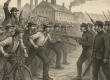
By some estimates, Carnegie Steel was producing more steel than all of Great Britain by 1900. The men inside the mills worked long shifts in extreme heat, and the tension broke open at Homestead in 1892, when Henry Clay Frick locked out the union and brought in armed Pinkerton agents by river barge. The commonly cited toll is ten dead (seven workers and three Pinkerton agents) in the fighting and its immediate aftermath, and the union was crushed at Homestead. Our full account of the Homestead Strike tells that story in detail. For Frick himself, see his biography.
In 1901 Carnegie sold his company to J.P. Morgan’s syndicate for roughly $480 million. Morgan folded it into the new United States Steel Corporation, capitalized at about $1.4 billion and the first billion-dollar corporation in the world. It was an enormous company, though estimates of its share of American steel production at formation vary with how output is measured.
Key Pittsburgh Steel Companies
- Carnegie Steel: Edgar Thomson (Braddock), Homestead Works and other mills, sold to Morgan in 1901.
- U.S. Steel: Created in 1901 from Carnegie Steel and other firms. Its Pittsburgh-area plants included Edgar Thomson, Homestead, Duquesne and Clairton.
- Jones & Laughlin (J&L): The South Side and Hazelwood mills plus the Aliquippa Works, taken over by LTV in 1974.
For the towns around these mills, read the Steel Valley story. For the machines inside them, see Steel Titans and Silent Stacks.
Unions, Strikes and the Mill Worker’s Life
Homestead set the pattern for decades. In September 1919 roughly 350,000 steelworkers nationwide walked out in the Great Steel Strike, and the walkout ended in defeat in January 1920. The breakthrough came in the New Deal era: the Steel Workers Organizing Committee was formed in June 1936, and on March 2, 1937 U.S. Steel signed a contract with it. The strike of 1959 shut down the industry for 116 days, and many analysts later argued that the long shutdown encouraged steel users to buy imports. For the other side of mill life, see the steelworker bars of Pittsburgh, and for an earlier labor explosion, the Great Railroad Strike of 1877.
The Peak: World War II and the Smoky City
During World War II the mills ran around the clock for war production; the Homestead Works alone employed roughly 15,000 to 20,000 people at its wartime peak. See Pittsburgh’s role in World War II for that chapter.
The price was the air. Pittsburgh passed a smoke-control ordinance in 1941, but the war delayed enforcement. Mayor David L. Lawrence, elected in 1945 on a clean-air platform, put it into effect for commercial users on October 1, 1946 and for households a year later. It was part of the postwar “Renaissance” driven by Lawrence and the Allegheny Conference on Community Development, created in 1943. Cleaner fuels, especially natural gas, did the rest.
Why Pittsburgh’s Steel Industry Collapsed
No single cause explains it. Historians and economists point to several overlapping ones:
- Imports. Steelmakers in Japan and Europe rebuilt after the war with newer mills, and foreign steel grew steadily in the American market.
- Old technology. American mills were slow to adopt cheaper methods such as the basic oxygen furnace and continuous casting, and the open-hearth furnaces that had made Pittsburgh rich became a cost problem.
- Recession. The twin recessions of the early 1980s hit an industry that was already weak. The Pittsburgh metro area’s unemployment rate peaked above 17 percent in January 1983, according to the Federal Reserve Bank of Cleveland; in Beaver County, home of J&L’s Aliquippa Works, it reached about 27 percent.
The numbers were stark. Pittsburgh-region steel employment dropped from roughly 84,500 in 1980 to 27,700 in 1987, and regional manufacturing employment fell from more than 287,000 in 1979 to 154,000 in 1987. The Duquesne Works closed in 1984. The Homestead Works, where about 15,000 to 20,000 people worked at the wartime peak, shut down in 1986. Its site reopened in 1999 as The Waterfront shopping center.
As the mills closed, young workers left and neighborhoods lost their anchor employers. In some places the vacuum was filled by other things; see organized crime in Pittsburgh and the towns described in Forgotten Steel Towns.
What Is Left: Steel in Pittsburgh Today
Pittsburgh still makes steel, but on a different scale. U.S. Steel’s Mon Valley Works runs along the Monongahela. It includes the Clairton coke plant, the Edgar Thomson Works in Braddock (the same site that began steelmaking in 1875), the Irvin Works and the Fairless Works. On June 18, 2025 Nippon Steel completed its purchase of U.S. Steel; the federal government holds a “golden share” with consent rights over certain decisions, including plant closures.
The city also kept its history. The Carrie Furnaces, across the river from Braddock in Rankin and Swissvale, were named a National Historic Landmark in 2006 and are part of the Rivers of Steel National Heritage Area, which offers tours of the Carrie Furnaces. To see how the city’s economy shifted afterward, read From Fort Duquesne to Tech Hub and how the skyline evolved. For employment numbers behind the 1980s collapse, see the Cleveland Fed’s “Rust and Renewal: A Pittsburgh Retrospective.”
A related earlier chapter of the same story is told in Steel City Saga.
Frequently Asked Questions
Why did Pittsburgh’s steel industry collapse? Foreign competition, slow adoption of cheaper technology, and the severe recessions of the early 1980s hit together. Regional steel employment fell from about 84,500 in 1980 to about 27,700 in 1987.
When did Pittsburgh’s steel mills close? Closures came in waves through the 1980s. U.S. Steel’s Duquesne Works closed in 1984 and its Homestead Works in 1986.
Does Pittsburgh still produce steel today? Yes. U.S. Steel’s Mon Valley Works, including the Edgar Thomson Works and the Clairton coke plant, is still operating, though with far fewer workers than in the mid-20th century.
Why is Pittsburgh called the Steel City? After Carnegie’s Edgar Thomson Works began making steel in 1875, the region became the center of American steel production, and by 1900 the Pittsburgh district produced roughly 40 percent of the nation’s iron and steel.
How did the steel industry affect Pittsburgh’s air? Smoke from mills and coal-burning homes darkened the city for decades. A 1941 smoke-control ordinance took effect in 1946 and, with the move to natural gas, cleared the air.
What happened to steelworkers after the collapse? Many left the region. Others retrained or found work in other fields, including health care, education and technology.