
In 1792, when Pittsburgh was barely a city and the surrounding region was still very much a frontier, a man named John Woods built a stone house overlooking the Monongahela River in what is now Hazelwood.
That house is still standing.
It has two-foot-thick rubble-stone walls, hand-hewn beams, wide-plank floors, and fireplaces at each end. It has survived fires, floods, the full arc of Pittsburgh’s industrial rise and collapse, and decades of sitting vacant with boarded windows and crumbling stonework while the neighborhood around it changed beyond recognition.
Today it’s a Scottish pub and restaurant called The Woods House, and it is considered the oldest house in Pittsburgh.
That combination — oldest house in the city, now a working bar — is either the most Pittsburgh thing imaginable or a perfect accident of history. Possibly both.
Who Built It and Why It Matters
John Woods wasn’t a random settler who happened to put up a durable house. He was a prominent attorney whose father, Colonel George Woods, was one of the men responsible for surveying and planning the city of Pittsburgh itself.
So the family that built this house helped build the city around it. That’s the kind of detail that makes a place feel less like a historical curiosity and more like an actual anchor point in the region’s story.
Woods constructed the house along what is now Monongahela Street, using the thick-walled, symmetrical Georgian vernacular style that was practical for the era — deep-set windows, gabled roof, chimneys at each end. It served as his residence and law office, and as Hazelwood grew around it, the house reportedly became a stopping point for travelers and stagecoach passengers heading east along the Greensburg Pike.
In 1868 the property passed to a local family and remained a private residence for over a century. Then it sat empty for a long time after that, slowly deteriorating while preservationists argued about what to do with it.
What Surviving Two Centuries Actually Looks Like
The Woods House was documented by the Historic American Buildings Survey in 1930, which at least meant someone official had acknowledged it mattered. It was designated a Pittsburgh historic structure in 1977.
But designation doesn’t equal preservation. For decades after that, the house sat vacant. Windows boarded. Stonework crumbling. One of only a handful of eighteenth-century structures remaining anywhere in Pittsburgh, slowly losing the fight against neglect.
Along the way it survived the kinds of disasters that erased most of what came before it. The Great Fire of 1845 wiped out a significant portion of Pittsburgh’s built environment in a single afternoon. The 1936 St. Patrick’s Day flood submerged whole neighborhoods. The Woods House, sitting on its Hazelwood hillside above the Monongahela, made it through both.
The fact that it’s still here at all is a minor miracle of structural engineering — those two-foot stone walls were built to last — and a major accomplishment of the people who eventually decided to do something about it.
The Building Itself
Walk into The Woods House today and you’re walking into a room that has been standing longer than the United States has been a country with a working government.
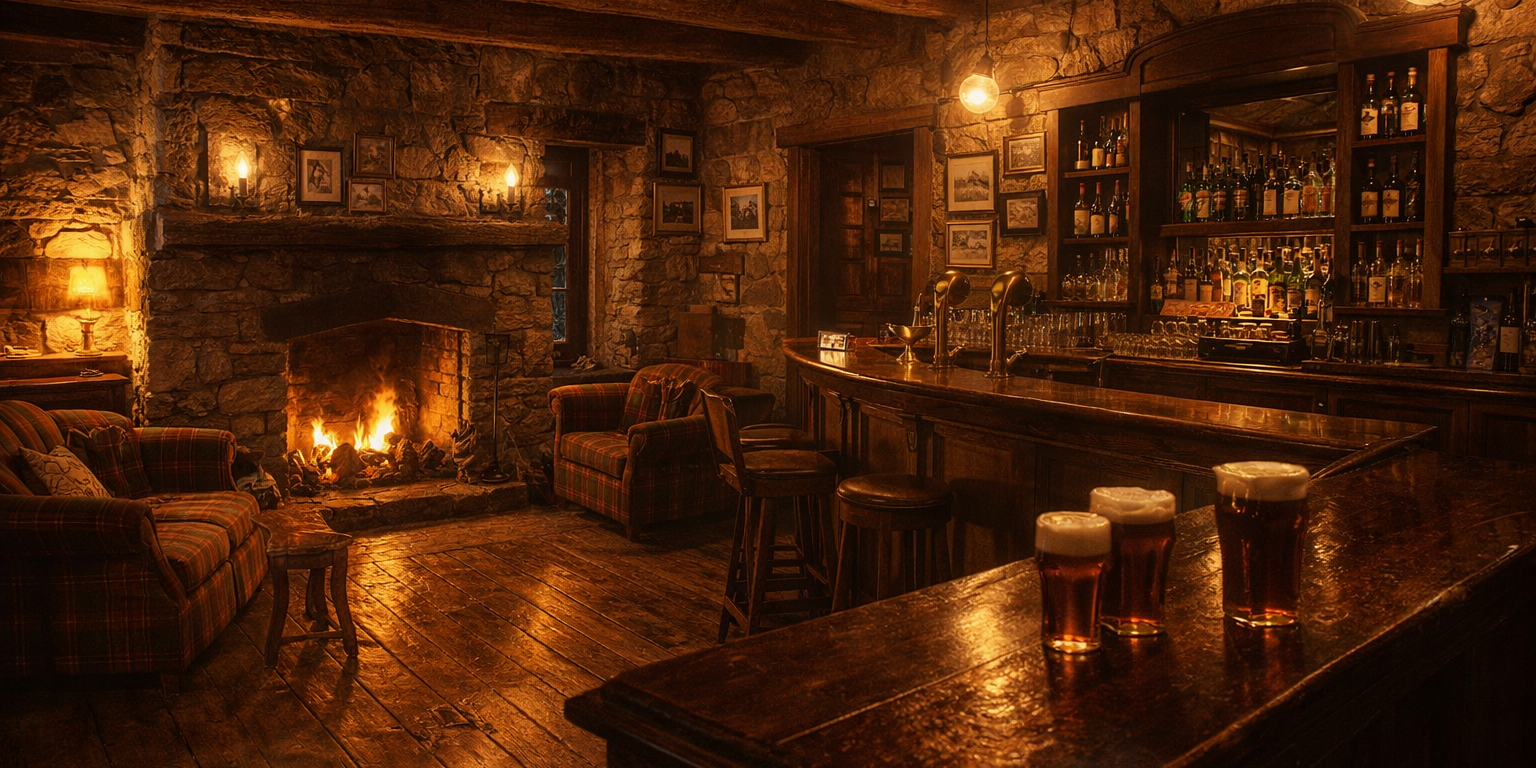
The original bones are intact. Hand-hewn beams overhead. Wide-plank floors underfoot. Fireplaces that were heating this space when Pittsburgh had a population in the hundreds. The restoration repaired the stonework, replaced the roof, and recreated period-appropriate woodwork without erasing what was already there.
The pub design layers Scottish elements over the eighteenth-century structure — tartan patterns, dark wood, antique photographs — which makes more sense than it might sound. Hazelwood had significant Scottish settler roots, and the aesthetic nods to that history while giving the space a coherent identity as a functioning bar and restaurant rather than a museum exhibit you happen to be able to drink in.
Why Scottish
The Scottish angle isn’t arbitrary.
Hazelwood’s early community included a substantial population of Scottish settlers, and the neighborhood’s character was shaped partly by that heritage. When the group of local entrepreneurs and preservationists who took over the building decided to reopen it as a pub, leaning into that history was a way of connecting the building’s present use to its actual past rather than imposing something unrelated onto a historic structure.
The menu reflects it — Scottish dishes, locally sourced meats, craft beverages — and the programming continues with live music and community events that keep the place integrated into neighborhood life rather than cordoned off as a relic.
If you want to see how The Woods House fits into Pittsburgh’s broader landscape of historic drinking establishments, Pittsburgh’s oldest bars and the history behind them puts it in good company.
The Reopening
The Woods House reopened in 2020 as a pub and restaurant, which given the timing was either very brave or very unfortunate depending on how you look at it.
The fact that it’s operating today, hosting events and serving food and keeping the building maintained, is the continuation of a preservation story that could have ended badly multiple times across the past two centuries.
Proceeds from the business support the ongoing maintenance of the building. That’s the model: make the place economically viable as a neighborhood establishment, and the history takes care of itself.
What a Visit Actually Is
Going to The Woods House is a layered experience in a way that most bar visits aren’t.
You’re sitting in a room built in 1792. The walls around you are older than almost any other structure in the city. The Monongahela River is visible from the property. The neighborhood outside has been through versions of itself that would be unrecognizable to anyone who only knows the current one.
And you can get a beer and a meal there on a Wednesday evening.
The Lewis and Clark Trail Heritage Foundation describes the John Woods House as “considered the oldest house in Pittsburgh.” That’s the official framing. The practical version is simpler: it’s a genuinely historic place that is also a genuinely good reason to spend an evening in Hazelwood.
Both things are true at once, which is rarer than it should be.
Visitor Information
Address: 4604 Monongahela Street, Pittsburgh, PA 15207
Hours: Wednesday–Sunday 4–10pm (hours may vary seasonally — check their website before visiting)
Website: woodshousepgh.com
Reservations and events: Check the website for current availability
The Woods House was built in 1792 by John Woods and is considered the oldest house in Pittsburgh. It was designated a Pittsburgh historic structure in 1977 and reopened as a pub and restaurant in 2020.