
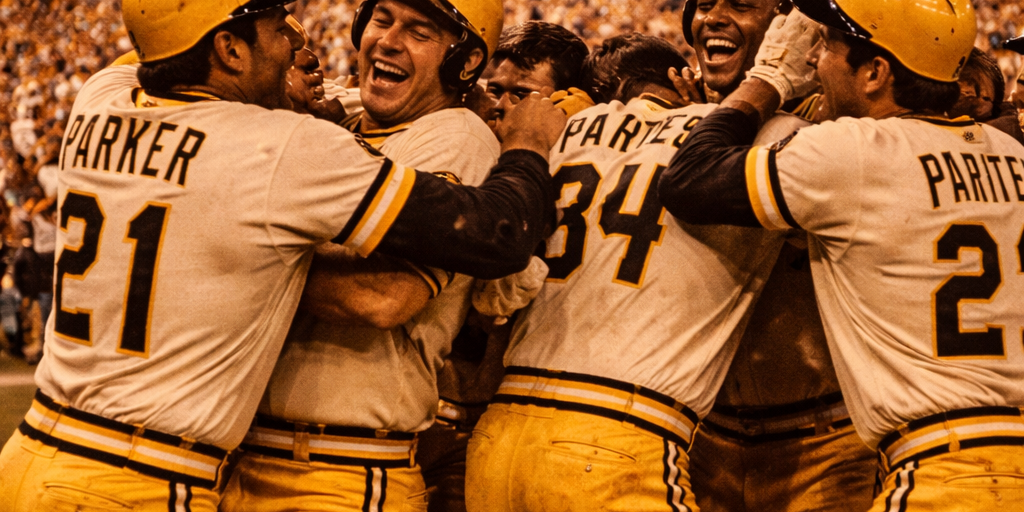
The 1979 Pittsburgh Pirates arrived at the World Series trailing in a way that should have ended their season. Down three games to one against the Baltimore Orioles, facing elimination on the road, managed by a man whose mother had died that very morning, the Pirates did something that only a handful of teams in baseball history had managed: they won three consecutive games to claim the championship. They did it with a thirty-eight-year-old designated elder statesman at the center of everything, a song blasting from every clubhouse speaker they entered, and a spirit of collective joy that made them one of the most genuinely beloved championship teams the city of Pittsburgh has ever produced. The 1979 Pittsburgh Pirates were not just a great baseball team. They were a family. They said so themselves, and for once that kind of statement was actually true.
Pittsburgh in 1979
To understand what the 1979 Pirates meant to Pittsburgh, you need to understand what Pittsburgh was living through in 1979. The steel industry that had defined the city for a century was entering its most severe period of contraction, mills idling, workers being laid off in numbers that would only accelerate in the years immediately ahead. The economic identity of the region was fracturing in real time. Neighborhoods built around specific mills were beginning to feel the specific anxiety of watching the thing that organized their daily life start to disappear.
Into this context arrived a baseball team playing joyful, aggressive, come-from-behind baseball to a disco song, led by a man everyone called Pops who handed out gold stars like a kindergarten teacher rewarding good work. The contrast between the heaviness of what was happening in the mills and the lightness of what was happening at Three Rivers Stadium was not lost on anyone. The Pirates gave Pittsburgh something to celebrate at precisely the moment the city needed something to celebrate.
The Family and Its Father
Willie Stargell had been a Pittsburgh Pirate since 1962. By 1979 he was thirty-eight years old, a left fielder turned first baseman whose body had accumulated the specific damage that seventeen professional seasons inflict, and whose presence in the clubhouse had become as important as anything he did on the field. The younger players called him Pops. The nickname was not ironic. Stargell genuinely functioned as a paternal figure, a stabilizing warmth at the center of a roster full of outsized personalities that in other circumstances might have pulled in different directions.
His method of building team chemistry was memorable and specific. When a teammate made a play that deserved recognition, Stargell gave them a small gold star to stick on their helmet. The Stargell Stars, as they came to be called, became one of the defining images of that season. Grown professional baseball players wore gold stars on their helmets like children who had gotten their spelling words right, and they were visibly proud of them. The gesture worked because Stargell meant it. The stars were not a gimmick. They were an expression of genuine appreciation from a man the entire team respected, and receiving one actually meant something.
The music that tied the whole season together arrived by accident more than design. Sister Sledge released “We Are Family” in 1979, and somewhere along the way it found its way into the Pirates’ clubhouse and stayed there. The players responded to it because it described something that was actually true about their team rather than something they were being asked to perform. By the time the postseason arrived, “We Are Family” had become the soundtrack of the season, played before and after games, sung in the dugout, blasted at volumes that suggested the entire franchise had made peace with the fact that they would be associated with a disco song for the rest of their lives.
The Roster That Backed Him Up
Stargell was the soul of the team but he was not carrying it alone. Dave Parker, the reigning National League MVP and one of the most physically imposing right fielders in the sport’s history, provided the kind of intimidating presence in the lineup that made opposing pitchers think carefully. Parker’s throwing arm from right field was the most feared in the league, capable of cutting down runners at any base with the kind of accuracy and velocity that made highlight reels on a regular basis.
Phil Garner played second base with a scrappy intensity that would prove prophetic come October. Omar Moreno provided speed at the top of the order from center field. Bill Madlock, one of the better contact hitters of his era, played third. Tim Foli handled shortstop. The lineup was deep, balanced, and built to wear pitchers down across a full game rather than relying on a single offensive weapon.
The pitching staff was less celebrated than the lineup but no less important. John Candelaria provided an ace presence when healthy. Bert Blyleven, acquired midseason, gave the rotation a second legitimate starter. Jim Bibby contributed throughout the year. And Kent Tekulve, the submarine-delivery relief pitcher who appeared to be throwing the ball from somewhere around his ankles, emerged as one of the most effective closers in baseball. Tekulve’s delivery was so unorthodox that right-handed hitters genuinely struggled to pick up the ball until it was too late, and in the postseason that quality would prove decisive.
Manager Chuck Tanner, a New Castle, Pennsylvania native who had managed in Oakland and Chicago before coming home to manage the Pirates, ran the clubhouse with a relentless positivity that matched the team’s personality. Tanner believed in his players with a completeness that his players returned in kind. He was one of them in a way that not every manager achieves, and in 1979 the relationship between the manager and the roster was as functional as any in baseball.
The Immaculate Inning and the NLCS
The Pirates reached the World Series by defeating the Cincinnati Reds in the National League Championship Series, a three-game sweep that announced Pittsburgh’s intentions clearly. The offense performed. The pitching held. The family dynamic that had been the team’s defining quality all season showed no signs of fraying under postseason pressure.
What waited in the World Series was a Baltimore Orioles team that had won 102 games in the regular season and featured one of the strongest rotations in baseball, anchored by Mike Flanagan, the Cy Young Award winner that year. The Orioles were favored. The series began in Baltimore, and the early results suggested the oddsmakers had been right.
Three Games Down
Baltimore won the first game. Baltimore won the second game. Pittsburgh won the third game back at Three Rivers, a moment of relief that briefly suggested the series might be competitive. Then Baltimore won the fourth game, and Pittsburgh was staring at elimination. Three games to one, needing three consecutive victories against a team that had spent the entire season demonstrating it did not lose three consecutive games to anyone.
The morning of Game Five, Chuck Tanner received word that his mother had died. He managed the game anyway. Pittsburgh won.
That fact is not decoration. It captures something real about who that team was and what they were capable of. Their manager was operating on grief, in an elimination game on the road, and the team responded by playing the best baseball of the series.
The Comeback
Game Six returned to Baltimore with Pittsburgh needing a win to force a seventh game. The Pirates won. For the second time in the series the teams would play a decisive seventh game, and for the second time it would be played in Baltimore rather than at the more comfortable Three Rivers Stadium.
Willie Stargell settled the matter in the sixth inning with a two-run home run that gave Pittsburgh a lead they would not relinquish. Kent Tekulve came out of the bullpen and closed the game with the submarine precision that had defined his postseason. Final score: Pittsburgh 4, Baltimore 1.
Phil Garner, who had spent the entire series doing everything asked of him and more, finished with twelve hits in twenty-four at-bats. A .500 batting average in a World Series is the kind of performance that exists almost entirely outside the range of normal human achievement in October baseball. Garner was named to the discussion of great World Series performances and then, with the casual cruelty that sports history sometimes applies to players who are not the primary narrative, largely forgotten in favor of the man whose home run won Game Seven.
Willie Stargell was named the World Series Most Valuable Player. He had also been named the National League Championship Series Most Valuable Player. He shared the National League regular season MVP award that year with Keith Hernandez of the Cardinals. No player in baseball history has ever won all three awards in the same postseason. The clean sweep of every meaningful award in a single October remains, to this day, unique to Willie Stargell in 1979.
The Clemente Shadow and the Legacy of Right
The 1979 Pirates carried with them the specific weight of what had happened eight years earlier. The 1971 World Series championship, won with Roberto Clemente delivering perhaps the greatest individual World Series performance in the game’s history, had ended with Clemente’s death in a plane crash on New Year’s Eve 1972. The Pirates of 1979 wore number 21 patches on their uniforms in his honor, a permanent acknowledgment that the franchise understood its own history and refused to let it go quietly.
Dave Parker, playing the same right field position that Clemente had made legendary, carried some of the weight of that inheritance. Whether deliberately or organically, the 1979 Pirates had a sense of connection to the 1971 team that made the championship feel like a continuation of something rather than an isolated event. Pittsburgh baseball had a lineage, and the 1979 team was its next chapter.
The Year Pittsburgh Won Everything
Months after the Pirates celebrated in Baltimore, the Pittsburgh Steelers defeated the Los Angeles Rams in Super Bowl XIV to win their fourth championship in six years. Pittsburgh had, in the span of a single calendar year, won both the World Series and the Super Bowl. It is a coincidence of timing that has happened to very few cities in American sports history, and it happened to Pittsburgh in 1979, the same year the steel mills were beginning their most serious decline.
The championship double did not fix the economic problems that were coming. The mills closed anyway. The population declined anyway. Pittsburgh went through the difficult years of the early 1980s with the same grinding difficulty that Rust Belt cities across the country experienced. But the memory of 1979 was real and it was permanent, and the city carried it as evidence of what it was capable of when everything came together.
Where They Went
Willie Stargell played three more seasons after 1979 and retired in 1982, having spent his entire twenty-one-year career in Pittsburgh. He was inducted into the Baseball Hall of Fame in 1988 in his first year of eligibility. He died on April 9, 2001, the day PNC Park opened. Pittsburgh’s new baseball stadium opened its doors on the same morning that Pops left. The symmetry was painful and perfect and entirely in keeping with how Pittsburgh and Willie Stargell had always related to each other.
A statue of Stargell stands outside PNC Park today, right arm raised mid-swing, the most natural pose in the world for a man who spent two decades swinging a bat for this city. On any given game day, people walk past it without fully registering what they are looking at. On the days when someone stops, they are stopping in front of thirty-eight years old and down three games to one and winning anyway. They are stopping in front of a gold star on a grown man’s helmet and a song playing in a clubhouse and a team that actually meant it when they said they were a family.