
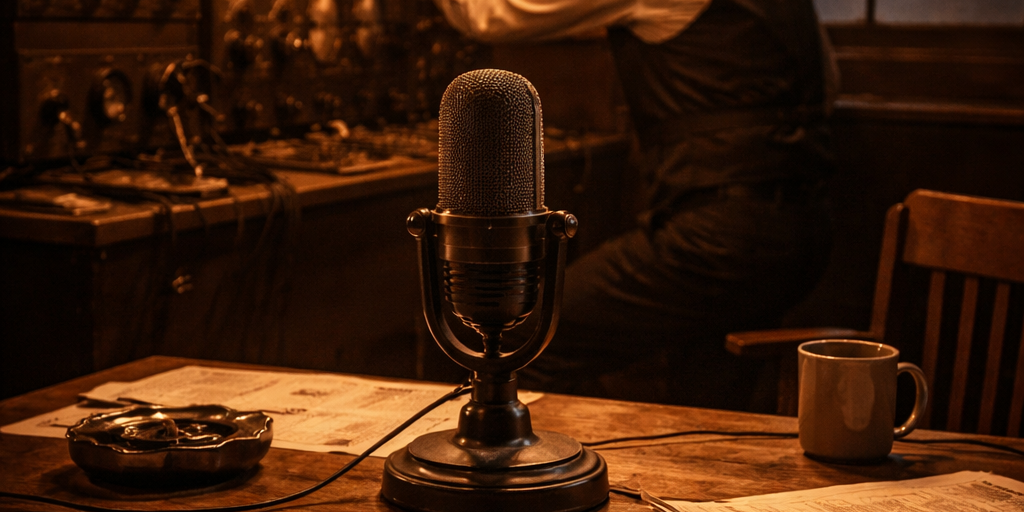
The night of November 2, 1920, was cold and clear in Pittsburgh, and somewhere on the roof of a Westinghouse factory in East Pittsburgh, a small group of men huddled around a transmitter inside a makeshift wooden shack and did something that had never been done before. They broadcast a radio program to the general public, live, on a scheduled frequency, with the expectation that strangers sitting at home with receivers might actually be listening. KDKA radio history begins on that rooftop, with those men, reading election returns over the air into the darkness, not entirely sure anyone was out there to hear them. As it turned out, the whole country eventually would be.
What happened that night was the beginning of commercial broadcasting as we know it. Not experimental radio, not military communications, not the hobbyist transmissions that had been flickering across the airwaves for years. This was something new: a station, a schedule, a program, and an audience. Pittsburgh did not merely witness the birth of commercial radio. Pittsburgh caused it.
The Engineer in the Garage
To understand how KDKA came to exist, you have to start with a Westinghouse engineer named Frank Conrad, and with the amateur radio hobby that consumed his evenings and weekends.
Conrad worked at the Westinghouse Electric and Manufacturing Company, and like many engineers of his era, he was a dedicated amateur radio operator. He had built a transmitter in the garage of his home in Wilkinsburg, just east of Pittsburgh, and beginning in 1919 he began broadcasting from that garage under the call sign 8XK. His programming was informal by any standard: he would play phonograph records on the air, read sports scores, chat about whatever was on his mind, and sign off when he felt like it. There was no schedule, no commercial intention, and no particular ambition beyond the pleasure of tinkering with the technology.
But people were listening. Crystal radio receivers were not uncommon among technically inclined hobbyists, and Conrad had built up a small but genuine audience in the neighborhoods around Pittsburgh. Listeners would send him requests. He played them. It was, in embryonic form, radio as we now understand it.
The moment that changed everything did not happen on the air. It happened in a newspaper. A Pittsburgh department store called Horne’s ran an advertisement promoting radio receiver sets for sale, with the explicit pitch that buyers could use them to pick up Frank Conrad’s broadcasts. It was a retail advertisement that casually described a new entertainment medium as if it were already an established feature of modern life.
Harry P. Davis, a vice president at Westinghouse, saw that advertisement, and he understood immediately what it meant.
Harry Davis Sees the Future
Davis recognized something that seems obvious in retrospect but was genuinely visionary in 1920. If a department store was advertising radio receivers specifically so that customers could listen to one man broadcasting from his garage, then there was a market. Not just a market for the receivers, but a market for the concept itself. Regular broadcasts, reliably scheduled, over a dedicated commercial frequency, would drive demand for radio equipment. And Westinghouse, which had spent the First World War manufacturing radio equipment for the military and was now looking for peacetime markets, was very well positioned to sell that equipment.
The idea Davis proposed was straightforward and transformative: Westinghouse would build a proper broadcasting station, obtain a federal license, establish a regular programming schedule, and create the audience that would in turn create demand for the receivers that Westinghouse manufactured. The broadcast station would be both a product and an advertisement for a product. It was one of the cleaner commercial insights in American industrial history.
George Westinghouse himself had died in 1914, six years before any of this unfolded. But the company he built was still operating on the same foundational principle that had guided him throughout his career: find a technology that works, find a way to scale it, and find a way to deliver it to the public before anyone else does. Davis was working entirely within that tradition.
Westinghouse applied to the Department of Commerce for a commercial broadcasting license. On October 27, 1920, the license was granted. The call letters assigned were KDKA. The station had six days to prepare for its first broadcast.
Election Night, 1920
The decision to launch on election night was deliberate and smart. The presidential race between Republican Warren G. Harding and Democrat James M. Cox was exactly the kind of event that would give people a reason to sit by their receivers and listen. Election returns were dramatic, they arrived in real time, and they were genuinely newsworthy in a way that phonograph records were not. If KDKA was going to make an impression on its first night, election returns were the right content.
The setup was improvised but functional. Westinghouse arranged with the Pittsburgh Post newspaper to receive returns by telephone as they came in. Those results would be read over the air from the rooftop studio at the Westinghouse plant in East Pittsburgh. A man named Leo Rosenberg handled much of the announcing. The transmitter put out roughly 100 watts of power.
The broadcast began at eight o’clock in the evening on November 2, 1920, and ran until midnight. Harding won the election in one of the largest landslide victories in American presidential history to that point, which made for uncomplicated broadcasting. The returns came in, Rosenberg and his colleagues read them over the air, and somewhere out in the Pittsburgh night, a few hundred listeners with crystal sets and headphones heard the news as it happened.
The audience was small. But the concept had been proven. A commercial radio station had broadcast a scheduled program over a licensed frequency to a general public audience, and it had worked.
The Explosion That Followed
What KDKA set in motion was immediate and enormous. Within two years of that first broadcast, hundreds of radio stations had been licensed across the United States. The model that Davis had conceived at Westinghouse, the idea that broadcasting could be a commercial enterprise rather than a technical hobby, spread so quickly that federal regulators struggled to keep up. The airwaves filled with stations, programming, advertising, and audiences in a compressed burst of adoption that has few parallels in the history of communications technology.
Westinghouse itself moved quickly, establishing additional stations in cities including Newark, Chicago, and Boston. The company understood that it had not just launched a radio station; it had launched an industry. The legacy of Westinghouse as a driver of technological transformation was already well established in Pittsburgh, but KDKA added something new to that legacy. Previous Westinghouse innovations had rewired the physical infrastructure of the country. KDKA rewired how Americans received information and entertainment.
The 1920s became the decade of radio in the same way the 1990s became the decade of the internet. Families gathered around receivers in their living rooms. Advertisers discovered a new medium. Politicians began to understand that the voice could reach people in ways that the printed word never had. Sports broadcasts brought live play by play into homes for the first time. News arrived in real time. The relationship between Americans and the flow of information changed fundamentally and permanently, and it changed because of what happened on a rooftop in East Pittsburgh on a November night in 1920.
KDKA Through the Decades
The station did not rest on its founding history. Through the 1920s and 1930s, KDKA built a reputation for serious broadcasting, covering news, sports, and cultural programming with a consistency that established it as a Pittsburgh institution. The Pittsburgh Pirates and Steelers became part of the station’s identity. Local news coverage made KDKA a fixture in the daily lives of western Pennsylvania residents.
The transition from radio’s golden age through the rise of television and beyond tested every radio station in America. KDKA adapted, adjusting its programming format across the decades as the medium changed around it. Talk radio, news radio, sports coverage, the formats evolved. The signal and the call letters remained.
Today KDKA broadcasts on 1020 AM, the same frequency it has occupied for more than a century. It is one of the oldest continuously operating radio stations in the world. The content has changed countless times. The essential fact of its existence, a licensed commercial radio station in Pittsburgh broadcasting to a public audience, is exactly what it has been since the night Leo Rosenberg read Harding’s election returns over a 100-watt transmitter on a factory rooftop.
The Dispute Worth Acknowledging
KDKA’s claim as the world’s first commercial radio station is well established and widely recognized, but it is not entirely without challenge, and the full picture is worth understanding.
Station 8MK in Detroit, which later became WWJ, began broadcasting in August 1920, three months before KDKA’s inaugural broadcast. Proponents of WWJ’s claim point to its earlier start date as evidence of priority. The counter-argument, and the reason KDKA’s claim generally prevails, rests on the distinction between a licensed commercial broadcast station and an experimental or irregular transmission. KDKA received the first federal license specifically for commercial broadcasting and operated on a regular public schedule from its opening night. The licensing and the commercial framework are what distinguish it from the various experimental broadcasts that preceded it.
The honest answer is that radio, like most transformative technologies, did not spring into existence from a single moment. Frank Conrad’s garage broadcasts, 8MK’s Detroit transmissions, and the various other experimental stations of the era were all part of the same building process. KDKA was the moment when that process crystallized into a commercial model that could be replicated and scaled. Whether you call it the first or the most consequential, the outcome is the same: Pittsburgh is where commercial broadcasting started.
Why It Still Matters
It is easy to look back at 1920 and see KDKA as a quaint artifact of early technology, a story about crystal sets and wooden shacks and a novelty that has long since been superseded. That reading misses the point.
The specific innovation that KDKA introduced, the idea that a broadcaster could reach a mass audience directly in their homes through a scheduled, regular, licensed transmission, is the template on which every form of mass media that followed has been built. Television inherited the model directly. Podcasting is essentially radio unbundled from the broadcast frequency. Streaming services are the same concept delivered over different infrastructure. The content changes. The fundamental architecture, a producer, a signal, an audience at home, is KDKA’s architecture.
Pittsburgh contributed enormously to the industrial foundations of modern America. The steel, the coal, the aluminum, the glass, the railroads: this city’s material output shaped the physical world in ways that are still visible in every American city. But KDKA’s contribution was different in kind. It shaped not the physical world but the information environment that every American inhabits, the expectation that news, entertainment, and ideas will arrive at home in real time, on a schedule, from a broadcaster operating somewhere out of sight.
That expectation, which feels as natural as electricity or running water, was invented on a factory rooftop in East Pittsburgh in 1920. It is probably the most consequential thing Pittsburgh ever made, and it does not get nearly enough credit for it.